Additional Intergovernmental Negotiations End Without Agreement After Ten Days
Oil-Producing Countries Stand Firm Against "Production Regulations"
United States Delivers Decisive Blow With Reversal of Position
Over 180 countries participated in discussions to establish a legally binding agreement to end plastic pollution, but they failed to reach a consensus.
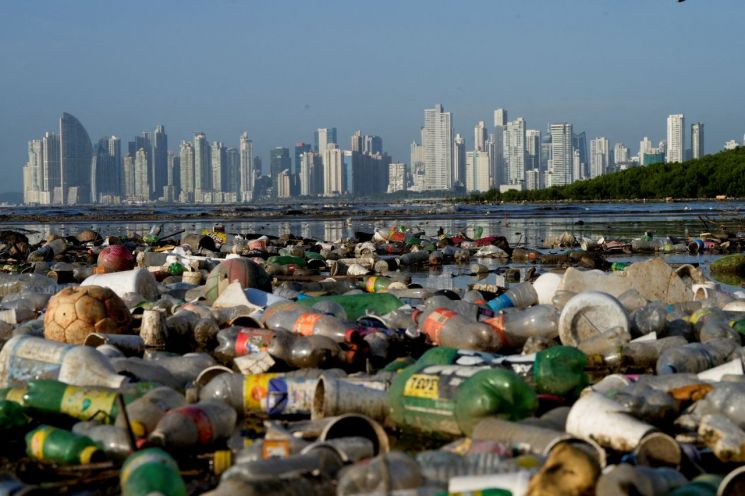 Plastic waste abandoned on the beach in Panama City, Panama, on December 8 last year. Photo by Yonhap News
According to the South Korean government and foreign news sources on August 15, the additional session of the fifth Intergovernmental Negotiating Committee (INC-5.2) for drafting an international treaty to end plastic pollution, held in Geneva, Switzerland for ten days starting August 5, concluded at 9 a.m. on this day without reaching an agreement. Delegates from more than 180 countries continued negotiations even past the scheduled end date, but ultimately failed to come to an agreement.
Previously, in March 2022, United Nations member states agreed at the United Nations Environment Assembly (UNEA) to establish a legally binding agreement by 2024 to end plastic pollution through full life-cycle management, from production to disposal. Although five rounds of negotiations were held for this purpose, the treaty was not finalized as planned.
According to climate and environmental organizations, at one point during this session, the "brackets" indicating unresolved sections in the "Chair's Proposal," which served as the basis for discussions, numbered around 1,500. This was about five times more than during the fifth round of negotiations. Article 6, which was the most contentious, was entirely bracketed. Article 6 pertains to provisions on plastic production.
The main issues that led to the breakdown of negotiations were whether to regulate "plastic production" and "chemicals of concern used in plastic production." How to secure funding for implementing the agreement was also a major point of contention. More than 100 countries supported regulating plastic production, including "primary plastic polymers" derived from fossil fuels, but oil-producing countries such as Saudi Arabia, Kuwait, Russia, Iran, and Malaysia drew a "red line" and resisted these measures.
A change in the United States' position also played a decisive role in the failure to reach an agreement. With a new administration, the United States shifted to strongly opposing regulations on plastic production. Major foreign media outlets previously reported that the United States had sent memos to dozens of countries urging them not to agree to restrictions on plastic production, supply, or additives. The United States is the world’s largest importer of plastic and the second-largest producer after China.
South Korea, which is recognized as a major producer and consumer of plastics due to its heavy chemical industry, has also been criticized for not playing an appropriate role in these negotiations. According to environmental groups such as Green Korea United and the Korean Federation for Environmental Movements, as of August 12, South Korea’s proposal stipulated that each country should take appropriate measures against hazardous plastic products according to their circumstances and capabilities, which was regarded as a step back compared to proposals from other countries. Environmental organizations pointed out, "The South Korean government was not visible at the meeting," and criticized the government for "maintaining a passive stance on reducing plastic production."
The government stated, "As a previous host of the negotiation committee, our delegation continued to play a constructive role by actively proposing compromise opinions to narrow the differences among parties and facilitate the conclusion of the agreement."
The participating countries only agreed to continue negotiations by holding an additional session at a later date.
Globally, 435 million tons of plastic were produced annually as of 2020. The Organisation for Economic Co-operation and Development (OECD) projects that if plastic production is not regulated, annual production will reach 736 million tons by 2040, an increase of 70% from current levels. While 15% of plastic waste is collected for recycling, only 9% is actually recycled. Nearly half, or 46%, is sent to landfills, 17% is incinerated, and the remaining 22% remains as unmanaged waste.
© The Asia Business Daily(www.asiae.co.kr). All rights reserved.











