Ishiba: "We Must Engrave the Reflection and Lessons of War Once Again"
Prime Minister Shigeru Ishiba of Japan mentioned "reflection" in his memorial address for the war dead on the anniversary of Japan's defeat, marking the first time in 13 years that the term has been used in such a speech.
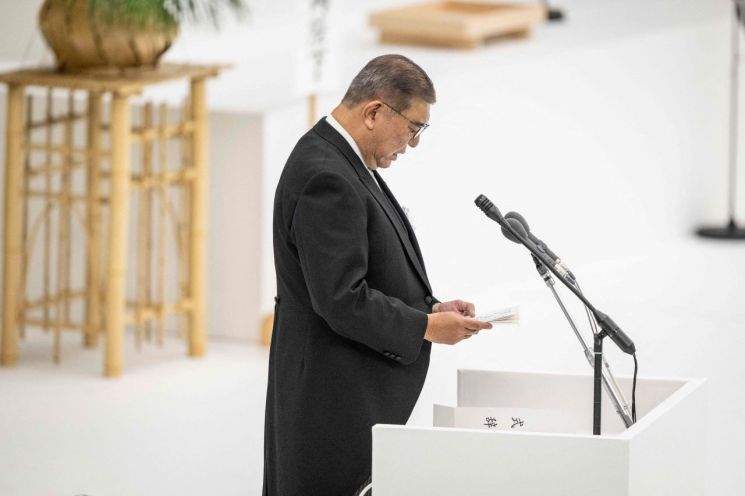
On August 15, at the Nippon Budokan in Tokyo, Prime Minister Ishiba attended the "National Memorial Service for the War Dead" commemorating the 80th anniversary of Japan's defeat. He stated, "We must never repeat the devastation of war," and emphasized, "We must once again deeply engrave in our hearts the reflection and lessons from that war." He also stressed, "For the past 80 years, Japan has consistently walked the path of a peace-loving nation and has worked for world peace and prosperity."
This is the first time in 13 years that a Japanese prime minister has used the word "reflection" in a memorial address for the war dead on the anniversary of Japan's defeat. However, he did not specifically mention neighboring countries that suffered colonial rule as a result of Japan's wars of aggression as subjects of this reflection.
In the past, Japanese prime ministers expressed remorse and mentioned the suffering of neighboring countries on the anniversary of Japan's defeat, but this practice ended after Shinzo Abe returned to office in December 2012. Former Prime Minister Morihiro Hosokawa was the first to mention the harm caused by Japan's wars of aggression to other countries in his 1993 address on the anniversary of Japan's defeat. At that time, Hosokawa stated at the memorial service, "I offer my sincere condolences, transcending national borders, to all victims of war and their bereaved families around the world, including many neighboring Asian countries."
However, after Shinzo Abe returned to power, on August 15, 2013-the first anniversary of Japan's defeat during his second term-he did not acknowledge the harm Japan caused to other countries or express remorse. Since then, references to aggression and reflection have disappeared from these addresses, a practice that was effectively continued by former Prime Ministers Yoshihide Suga and Fumio Kishida.
On this day, Prime Minister Ishiba did not issue a formal prime ministerial statement following a Cabinet meeting. Originally, he considered issuing such a statement to mark the 80th anniversary of Japan's defeat, but postponed it in consideration of opposition from conservative factions within the ruling Liberal Democratic Party, including former Abe faction members. It is reported that he is considering releasing a separate personal message in the future, but this too remains uncertain due to resistance from party conservatives.
Since 1995, marking the 50th anniversary of the end of World War II, Japanese prime ministers have issued statements around the anniversary every ten years following Cabinet meetings. Former Prime Minister Tomiichi Murayama issued a statement on the 50th anniversary, and former Prime Minister Junichiro Koizumi did so on the 60th anniversary, both expressing apologies and reflections regarding colonial rule.
© The Asia Business Daily(www.asiae.co.kr). All rights reserved.












