President Lee Attends 80th Liberation Day Ceremony
"Respect for North Korean Regime... Restoration of September 19 Military Agreement"
Hopes for North's Positive Response
"Respect for Existing Inter-Korean Agreements... Will Broaden International Support through Inter-Korean and U.S.-North Korea Dialogue"
"Denial of Independence Struggle History Must No Longer Be Tolerated"... Need to Change Divisive Political Culture
"Seeking Future-Oriented Cooperation in Korea-Japan Relations through Pragmatic, National Interest-Centered Diplomacy"
On the 15th, President Lee Jaemyung stated that South Korea respects the current North Korean regime and has no intention of pursuing any form of unification by absorption. He added that, in order to build trust with North Korea, the government would restore the September 19 Military Agreement and seek a peaceful resolution to denuclearization on the Korean Peninsula through inter-Korean and U.S.-North Korea dialogues as well as international cooperation. Regarding Japan, he said that, based on the principle of pragmatic diplomacy centered on national interests, he would pursue frequent meetings and honest dialogue through shuttle diplomacy, while seeking a path toward future-oriented, mutually beneficial cooperation.
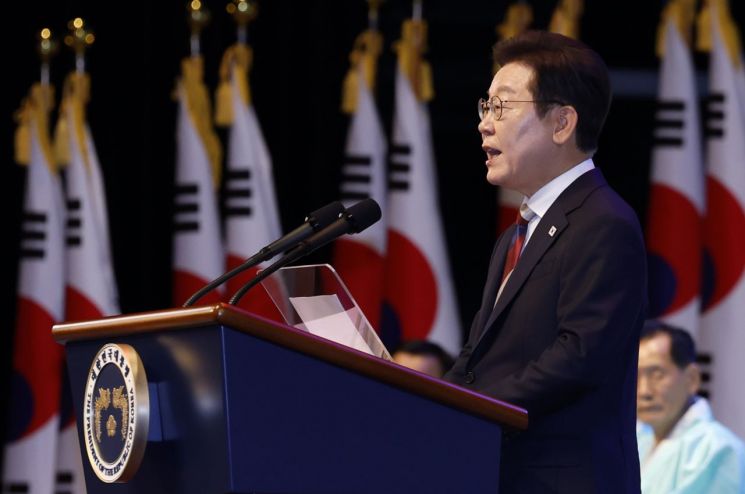
President Lee also emphasized that acts denying the history of the independence movement and insulting independence activists should no longer be tolerated. He pledged to provide special treatment for surviving patriots and to further expand compensation for the families of independence merit awardees.
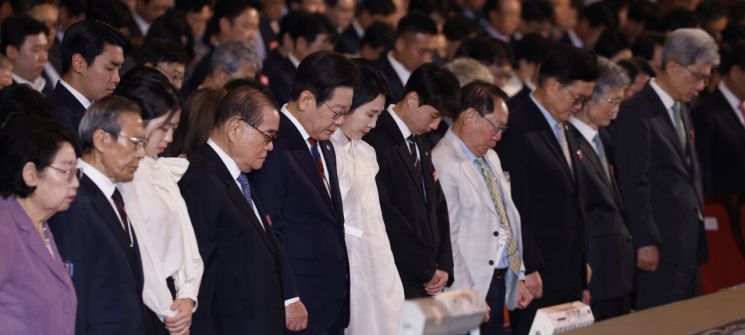
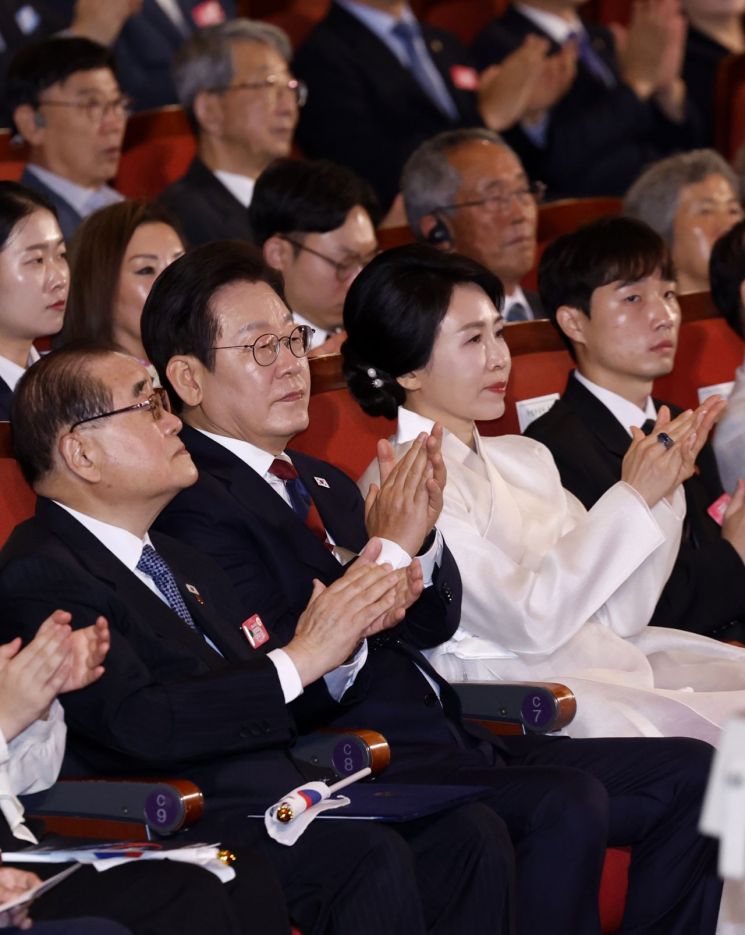
President Lee made these remarks during his congratulatory address at the 80th Liberation Day ceremony held at the Sejong Center for the Performing Arts in Gwanghwamun, Seoul. He stated, "Honoring the proud history of the anti-Japanese struggle and safeguarding the dignity of independence merit awardees is the way to protect our community's past, present, and future," and added, "We will do our utmost to honor surviving patriots and expand the scope of compensation for the families of independence merit awardees."
He continued, "We will actively pursue the repatriation of the remains of overseas independence merit awardees and identify those who have not yet been officially recognized, ensuring that everyone receives the honor they deserve." He stressed, "Let us all work together to ensure that the light regained through liberation is never lost again, and that the light preserved from dictatorship and civil strife never goes out."
In particular, he stated that the forces seeking private interests, who have used division as a pretext to split the public and create discord, must be overcome through the energy of inclusion and unity. President Lee said, "Not only did these groups oppress democracy and restrict popular sovereignty, but they also shamelessly attempted to drive the people into the horrors of war." He added, "When we transform the dark energy of division and exclusion into the bright energy of inclusion, unity, and solidarity, our society can make a greater leap toward a better future."
President Lee also pointed out the need to change the political culture. He said, "Our politics are not meeting the expectations and standards of our people," and added, "When politics restores its function of serving the public interest rather than private interests, and when the abnormal situation in which the people worry about politics comes to an end, the barriers of conflict and hatred within us will also disappear."
He continued, "I once again propose and urge that we move away from divisive politics based on outdated ideologies and camps, and instead build a politics of solidarity and mutual prosperity based on dialogue and compromise together."
"The most important thing is to create a state where there is no need to fight, to build peace"... Restoring Dialogue with North Korea, a 'Special Relationship'
President Lee announced his commitment to restoring inter-Korean dialogue, which had been suspended throughout the previous administration. He noted that, immediately after taking office, he implemented measures such as halting leaflet launches and loudspeaker broadcasts toward North Korea, and said, "It is time to move beyond outdated Cold War thinking and confrontation to usher in a new era of peace on the Korean Peninsula."
President Lee continued, "The South and the North are in a 'special relationship' in which both sides respect and recognize each other's systems while pursuing peaceful unification." He declared, "We respect the current regime in the North, will not pursue any form of unification by absorption, and have no intention of engaging in any hostile acts." He also stated that, to prevent accidental clashes and build military trust between the two Koreas, the government would proactively and gradually restore the September 19 Military Agreement.
He further pledged to continue efforts toward denuclearization of the Korean Peninsula through inter-Korean and U.S.-North Korea dialogues and international cooperation. President Lee said, "Denuclearization is a complex and difficult task that cannot be resolved in the short term, but we will seek a peaceful solution through inter-Korean and U.S.-North Korea dialogues and international cooperation." He added, "We will broaden international support and consensus for peace on the Korean Peninsula and the development of inter-Korean relations."
He also said, "This year, the 80th anniversary of liberation, is the right time to end the era of confrontation and hostility and open a new era of peaceful coexistence and joint growth on the Korean Peninsula together." He added, "We patiently hope that the North will respond to our efforts to restore trust and resume suspended dialogue."
"Japan is our neighbor with whom we share a yard"... Seeking a Path toward Future-Oriented, Mutually Beneficial Cooperation through 'Pragmatic Diplomacy Centered on National Interests'
Regarding South Korea-Japan relations, President Lee stated that, based on the principle of pragmatic diplomacy centered on national interests, he would pursue frequent meetings and honest dialogue through shuttle diplomacy, while seeking a path toward future-oriented, mutually beneficial cooperation.
President Lee said, "Japan is our neighbor with whom we share a yard and an indispensable partner in economic development." He added, "Just as Korea and Japan have grown together throughout the process of industrial development, if our two countries cooperate for the future based on trust, we will be able to overcome the challenges of the super-gap artificial intelligence era." He also expressed hope that the Japanese government would face up to the painful history of the past and work to ensure that mutual trust between the two countries is not undermined.
He also urged the nation to wisely navigate the complex crises brought on by the reorganization of global supply chains, rapid changes in trade order, industrial transformation due to advanced technology competition, and the energy transition prompted by the climate crisis. President Lee said, "The Korea-U.S. tariff negotiations are just one wave. Many other waves will continue to come our way." He emphasized, "We must not repeat the mistakes of 120 years ago, in the year of Eulsa, when we failed to keep pace with the changing international situation, were caught between the great powers, and ultimately lost our national sovereignty."
President Lee continued, "If we fall one step behind, we will be weary pursuers, but if we stay half a step ahead, we can enjoy infinite opportunities as pioneers." He added, "By fostering advanced science and technology such as semiconductors and artificial intelligence, we must actively respond to change and accelerate the pace of energy transition, including building an energy superhighway, to lead the future." He also said, "We must further refine our culture and lead the world with soft power. Only then can we achieve a new leap forward for the next 100 years."
© The Asia Business Daily(www.asiae.co.kr). All rights reserved.














