Lower Tax Burden for Additional Home Purchases in Population-Declining Areas
Pre-Feasibility Study Threshold Raised to 100 Billion Won... Faster SOC Projects
The regions and scope eligible for tax benefits for existing homeowners purchasing homes in areas with declining populations will be expanded. In addition, to accelerate local social overhead capital (SOC) projects, the government will raise the threshold that requires preliminary feasibility studies (pre-feasibility studies) and revise evaluation criteria to encourage regional investment. These measures are intended to stimulate demand and remove obstacles that have hindered investment, with the goal of revitalizing the local construction industry.
On August 14, the government held an economic ministers’ meeting and announced the “Measures to Strengthen Construction Investment Centered on Local Regions.” The decision comes amid a prolonged slump in regional construction markets, which has hurt local businesses and employment, weakened small business owners and vulnerable groups, and placed a burden on the national economy by lowering gross domestic product (GDP) and potential growth rates. The government plans to provide tax incentives to boost housing demand, while also removing factors that have hindered local SOC projects. In addition, measures to reduce construction costs for companies facing management difficulties will be pursued.
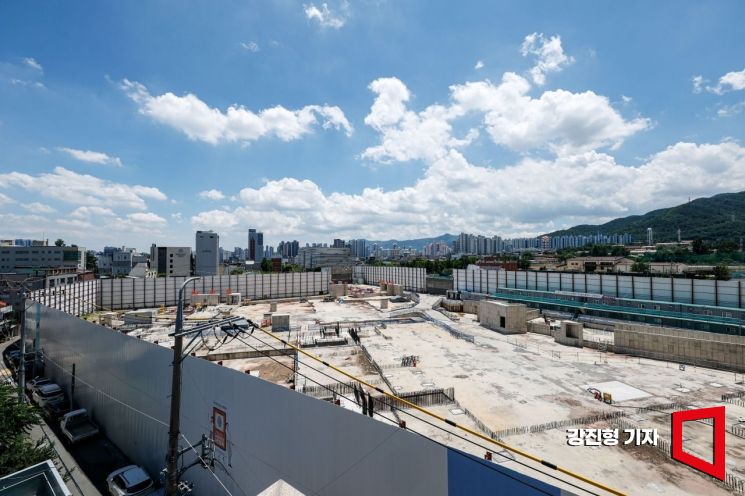 Construction has been halted at an apartment construction site in Daemyeong-dong, Nam-gu, Daegu. Photo by Kang Jin-hyung
Lower Tax Burden for Additional Home Purchases in Depopulating Areas
The regions eligible for “second home” tax support will be expanded. The “second home” policy allows existing single-homeowners to purchase an additional home while maintaining the single-home tax benefits for their original property. Currently, this applies only to areas with declining populations, but will now be extended to non-metropolitan areas of demographic concern. Newly included areas are Gangneung, Donghae, Sokcho, and Inje in Gangwon Province; Iksan in North Jeolla Province; Gyeongju and Gimcheon in North Gyeongsang Province; and Sacheon and Tongyeong in South Gyeongsang Province. In these non-metropolitan depopulating areas, the upper limit for homes eligible for capital gains and property tax benefits will be raised from 400 million won to 900 million won in publicly assessed value. The acquisition tax benefit threshold will also be increased from 300 million won to 1.2 billion won.
A government official explained, “A publicly assessed value of 900 million won is equivalent to a market price of about 1.2 billion won. By raising this threshold, we expect to stimulate demand for high-end villas and similar properties in the regions, thereby boosting local construction. Since the policy was introduced last year, the reduction in acquisition tax has amounted to several tens of billions of won, demonstrating its effectiveness.”
In depopulating areas, the government will temporarily restore the 10-year private rental apartment purchase program for one year. It also plans to exclude these rental properties from heavy capital gains taxation. This system, previously abolished due to concerns about market instability, will be reinstated for one year to evaluate its effectiveness. In addition, various tax benefits for unsold homes purchased after completion in regional areas will be extended for one more year, until next year. The government also newly included a provision to exclude additional capital gains tax when purchasing unsold apartments through corporate restructuring real estate investment trusts (CR-REITs).
Korea Land and Housing Corporation (LH) will increase its purchases of unsold completed homes in regional areas to 5,000 units next year, up from this year. The maximum purchase price will be raised from 83% to 90% of the appraised value. The previous lower cap had been criticized for reducing the effectiveness of the system. The government will also establish a system within the year to utilize national funds when converting regional residential or commercial buildings into integrated government offices or official residences.
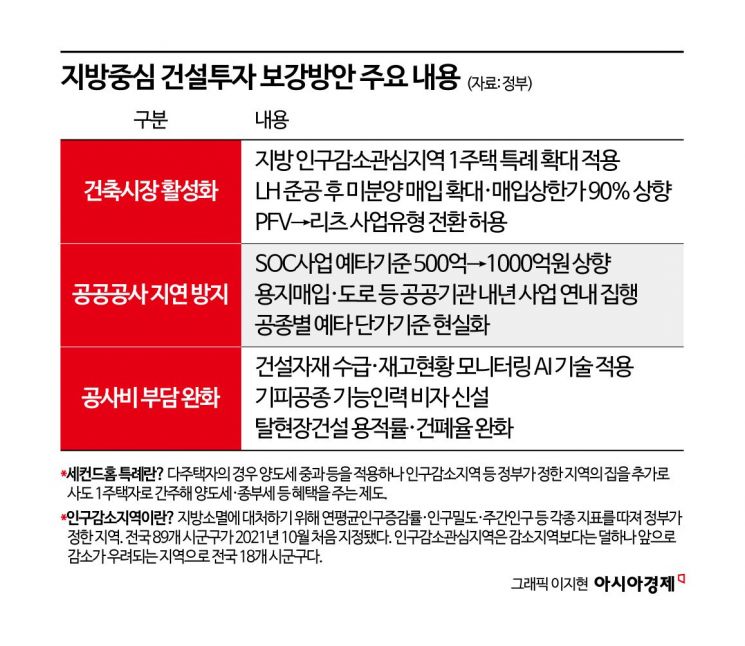
Pre-Feasibility Study Threshold Raised to 100 Billion Won... Faster SOC Projects
To accelerate regional SOC projects, the government will raise the threshold for projects requiring pre-feasibility studies from 50 billion won to 100 billion won. This threshold has remained unchanged since the system was introduced in 1999, 26 years ago. Evaluation criteria for pre-feasibility studies will also be revised to promote regional growth. However, as this requires legislative changes, the details and timing of implementation will be discussed with the National Assembly and other stakeholders. A government official stated, “Although there are concerns that projects with low economic feasibility could proceed, we believe it is necessary to review the system to incorporate the value of regional growth.”
Additionally, to better reflect actual costs at each stage of construction, the government will revise short-term standards for different types of work and update the criteria for reflecting price changes from the project planning stage to the start of investigations. Currently, the construction investment GDP deflator is applied, but if there is a difference of more than 4% compared to the construction cost index, the average value will be used. The government will also expand the scope of major managed construction types for which market prices are surveyed annually, so that price increases at the ordering and bidding stages can be reflected more quickly.
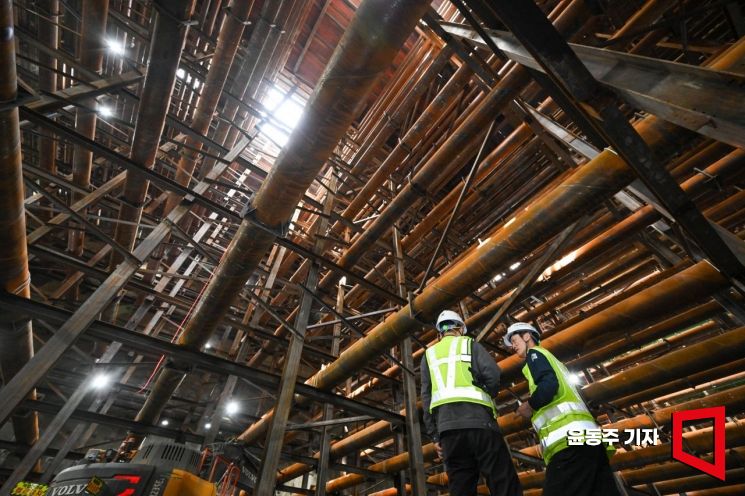 Seoul Gangnam-gu Yeongdong-daero Underground Space Complex Development Construction Site. 2025.04.23 Photo by Dongju Yoon
Some public agencies will also move up the execution of SOC projects initially planned for next year to the current year. This will focus on projects that can be implemented immediately, such as land acquisition and road improvement works. The government expects this could result in up to an additional 400 billion won in spending. For 15 ongoing advanced national industrial complexes, administrative procedures will be streamlined to allow for earlier groundbreaking, and in four regions including Gwangju, pre-feasibility studies are expected to be completed within the year. The period for corporate tax reductions for companies relocating their headquarters or factories from the metropolitan area to regional areas will be extended from 8 to 15 years, and the sunset date for these benefits will be pushed back to 2028.
The measures also include establishing a monitoring system using artificial intelligence (AI) technology to ease construction cost burdens in the industry. Currently, materials such as ready-mixed concrete and rebar are monitored manually, but the government expects that real-time monitoring of regional conditions and inventory will improve supply and demand. Additional measures include simplifying the permit process for marine aggregates and forest soil and rock extraction, introducing new visas for skilled workers, and revitalizing the skilled worker grading system to encourage more young people to enter the field. When off-site construction (OSC) methods are used, regulations such as floor area ratio, building coverage ratio, and height limits will be relaxed.
© The Asia Business Daily(www.asiae.co.kr). All rights reserved.














