"Very Vulnerable National Finances," Says President Lee
Leads Fiscal Savings Roundtable with Civilian Experts
"If Seeds to Sow Are Lacking, Borrow If Necessary"
Efficiency to Be Pursued in Parallel Through Expenditure Restructuring
Reviewing Citizen Participation System to Strengthen Budget Transparency
"With 100 Million Eyes, Waste Is Easier to Spot"
Policy Finance for SMEs: Reducing Zombie Companies and Scaling Up
Unrecovered Assets of Pro-Japanese Collaborators... President Lee: "Look Into It Separately"
President Lee Jaemyung made it clear that while the nation's finances are "very vulnerable" due to a shortfall in tax revenue, an active expansionary fiscal policy is necessary to overcome the slowdown in economic growth. He emphasized that while fiscal efficiency should be improved through expenditure restructuring, any fiscal shortfall should be financed-even through borrowing-so that the government's five-year agenda can be carried out. The Presidential National Policy Planning Committee, which announced the new administration's five-year plan, also stated that a fiscal investment of 210 trillion won will be needed from 2026 to 2030 to implement key national policy tasks, increasing the likelihood of government bond issuance.
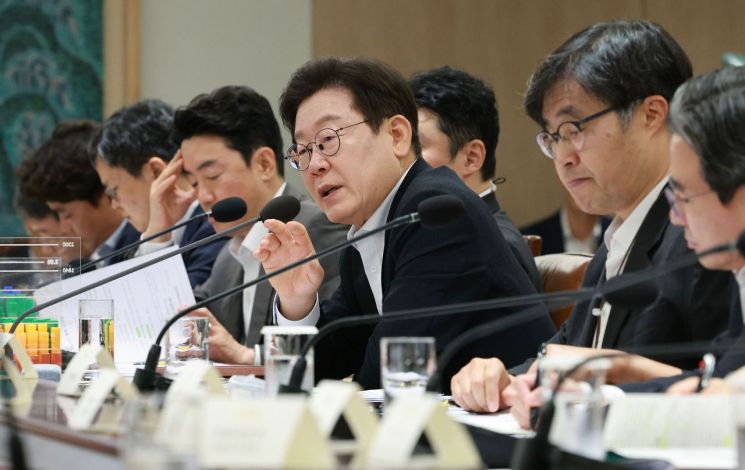
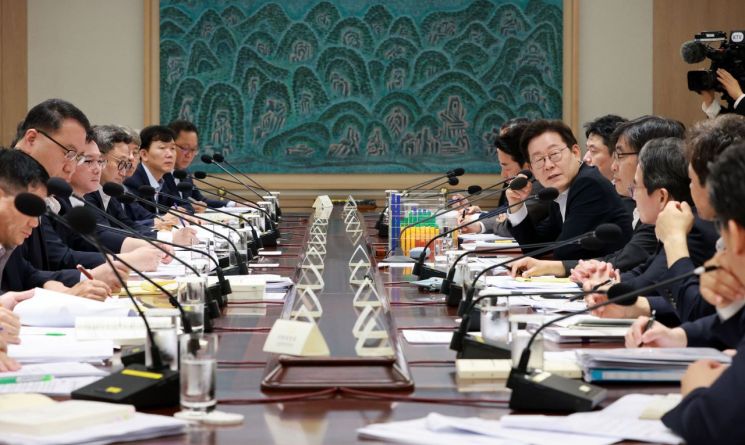
On the previous day (the 12th), at the Yongsan presidential office, President Lee held a "National Fiscal Savings Roundtable" that lasted nearly two hours. He remarked, "Right now, we lack the 'seeds to sow,'" and added, "If we can borrow a bushel to sow and reap a full sack in the fall, we should 'borrow if necessary.'" This effectively signaled the concurrent use of temporary borrowing, including government bond issuance, alongside expenditure restructuring. The roundtable included officials from the Ministry of Economy and Finance, other relevant ministries, as well as academic and civil society experts, who engaged in focused discussions on solutions for shifting the entire budget-from welfare and policy finance to social overhead capital (SOC), energy, and local finances-from low efficiency to high efficiency.
First, President Lee defined the role of public finance as "priming the pump for growth." While he acknowledged the need for balanced budgets, he believes that during periods of economic slowdown and declining tax revenue, fiscal spending should be boldly allocated to investments with clear objectives, and that restoring fiscal soundness should be pursued during periods of recovery. He stressed, "If you 'divide up' the budget, it becomes weak, but if you 'pool it,' it becomes powerful," highlighting a "pooled spending" strategy that concentrates resources secured through restructuring on growth and livelihood sectors.
In response, the Ministry of Economy and Finance plans to implement expenditure restructuring amounting to 27 trillion won starting with next year's budget. Yoo Byungseo, Director General of Budget at the Ministry, reported at the roundtable with the President, "We have prepared expenditure restructuring totaling 27 trillion won, including 25 trillion won in discretionary spending and 2 trillion won in mandatory spending, and have reduced or reorganized about 4,400 out of 17,000 projects." This is the largest scale ever. The Ministry especially highlighted that it addressed both reductions in current expenses such as events, publicity, and travel, as well as institutional improvements including education grants and job-seeker benefits. When Jung Changsoo, Director of the National Fiscal Research Institute, pointed out the need to disclose the full list of expenditure restructuring, President Lee instructed the Ministry, "Now, disclose all 'finalized adjustment details,'" and emphasized, "The national budget must be transparent before the National Assembly and the people."
'Strengthening Transparency'-A Citizen Participation Monitoring System: "With 100 million eyes, waste is easier to spot"
President Lee also stated that it is necessary to institutionalize ways to expand public participation in the budget review stage to listen to feedback and build consensus. Shin Seungkeun, Director of the Center for Tax and Fiscal Reform at People's Solidarity for Participatory Democracy, said, "Simply arguing a lack of fiscal resources is not persuasive," and proposed a "citizen participation budget review" linked to public debates and broadcasts. The President responded, "With 100 million eyes, waste is easier to spot." Chief of Staff Kang Hoonshik said, "We need a system that encourages the first round of voluntary restructuring within ministries and cross-checking at the central level." Policy Chief Kim Yongbeom said he would hold meetings not only internally but also with ministries.
President Lee also instructed a review of changing the structure in which various welfare benefits are provided only when recipients apply. He called for moving away from administrative convenience and making payments automatic. He stated, "'Application-based' systems, where benefits are only given if you apply, are 'cruel systems,'" and set the direction by saying, "If someone is eligible, benefits should be paid 'automatically' in principle." In response, Policy Chief Kim said, "The government should basically take responsibility for finding eligible recipients and making payments, and only with special reasons for refusal should payments not be made. This would actually be a major paradigm shift," adding, "It's a fundamentally different philosophy, but we will review it with the ministries."
Regarding welfare benefits, Woo Sukjin, a professor at Myongji University, pointed out the fragmentation of cash benefits for infants and children and proposed, "Let's consolidate them under a provisional 'Child Basic Income' and supplement vulnerable groups with additional payments." He also suggested for the Earned Income Tax Credit (EITC), "We should expand and strengthen the 'increasing segment' that strongly incentivizes labor supply."
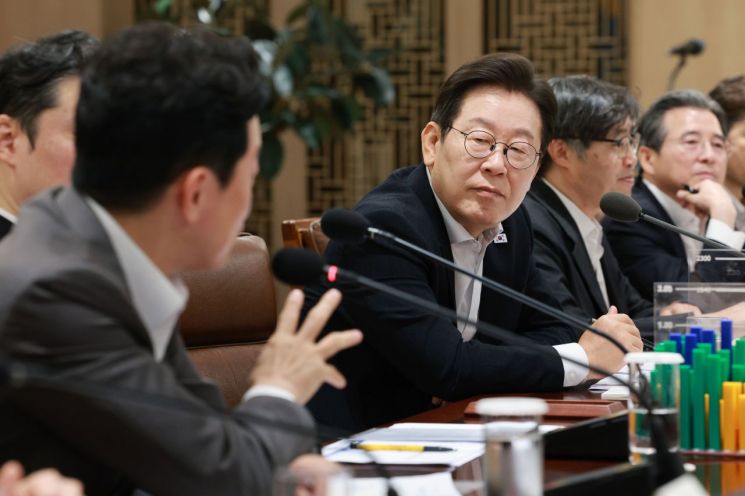
'Expenditure Restructuring'-Policy Finance for SMEs: Reducing Zombie Companies and Scaling Up
Regarding policy finance for small and medium-sized enterprises (SMEs), Jang Woohyun, Senior Research Fellow at the Korea Institute of Public Finance, argued, "Support is 'misdirected,'" and "Large-scale support for loss-making companies in the lower tier and those with more than 15 years in business needs to be scaled back." He proposed, "Classify companies by profitability, business age, and sales in multiple dimensions, match finance, R&D, export, and workforce support packages to those with growth potential, and prioritize restructuring and consulting for long-term underperformers." Kim Jeongae, Director of the Industry, SME, and Venture Budget Division at the Ministry of Economy and Finance, stated, "We have set criteria for 'zombie companies,' such as those over 15 years old and unable to cover interest payments, and have reduced policy loans by 0.7 trillion won, while expanding specialized tracks for AI, deep tech, and scaling up."
During discussions on budget-saving projects and private sector proposals, Director Jung suggested, "We need to drastically cut or reorganize overestimated or delayed projects in areas with low execution rates, such as roads and railways." The Ministry of Land, Infrastructure and Transport acknowledged delays due to unpredictable variables such as contractor bankruptcies and environmental procedure delays, but explained that a 'recovery and reallocation' system is in operation for delayed execution. Kim Jiyeon, Director of Land Policy at the Ministry, said, "We will strengthen criteria for sales rates, workforce, energy, and living conditions to curb the excessive development of industrial complexes, and focus on upgrading aging complexes." President Lee urged, "Do not be swayed by political demands; instead, endure with 'selection and concentration.'"
Unrecovered Assets of Pro-Japanese Collaborators... President Lee: "Look into it separately"
President Lee also ordered a separate review after hearing claims that 150 billion won in assets from pro-Japanese collaborators have not been recovered. Director Jung told the President, "With Liberation Day coming up the day after tomorrow, there are still 150 billion won in pro-Japanese assets that have not been recovered," and added, "We assess that the previous administration made only minimal efforts."
Director Jung emphasized, "We need to recover these assets to help those who made sacrifices." The argument is that recovered pro-Japanese assets could be used for veterans' budgets. President Lee responded, "Since there are discussions about recovering pro-Japanese assets, look into it separately," and instructed, "Once you have checked, report back to me."
There was also criticism regarding government ministries owning golf courses. Director Jung said, "I believe the Ministry of Patriots and Veterans Affairs has not sold the 88 Golf Course for 10 years," and added, "It would be much more efficient to sell it quickly and use the proceeds for the veterans' fund." When Policy Chief Kim reported that other ministries also own several golf courses, President Lee remarked, "It is questionable for the government to own such assets with public funds." President Lee also commented on public institutions, "We probably need to merge or abolish some; there are so many that I can't even count them," and instructed Policy Chief Kim, "Take bold action."
© The Asia Business Daily(www.asiae.co.kr). All rights reserved.














