Signs of a Surge Detected Through Sewage and Respiratory Surveillance
75% of Cases Among Those Aged 50 and Above
"Adherence to Preventive Measures Urged"
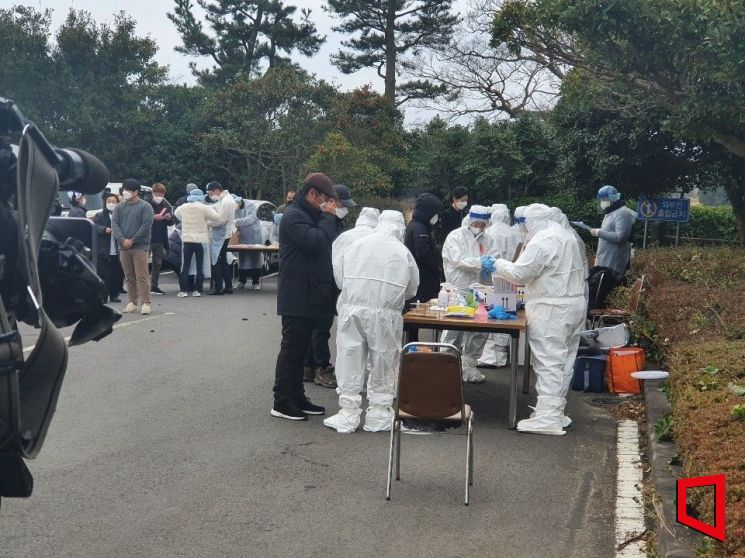 Testing to identify confirmed cases in suspected areas during the COVID-19 pandemic. Photo by Park Changwon
The Jeju Special Self-Governing Province Institute of Health and Environment announced on August 12 that, according to the results of the National Respiratory Infection Surveillance System (K-RISS), the COVID-19 detection rate for the 32nd week (August 3-9) reached 50%. Notably, individuals aged 50 and older accounted for more than 75% of all cases.
The COVID-19 detection rate has shown a continuous upward trend over the past five weeks. Four weeks ago, the rate jumped sharply from 8% to 25%. Two weeks ago, it rose to 40%, and last week, it surged to 50%. This figure is twice the national average.
By age group, the detection rate was significantly higher among middle-aged and older adults. In the 32nd week, the rates were 8.3% for ages 13-18, 16.7% for ages 19-49, 50.0% for ages 50-64, and 25.0% for those aged 65 and above. Individuals aged 50 and older accounted for 75% of all cases.
Signs of a resurgence were also observed in the analysis of influent water at local sewage treatment plants. Starting from the 26th week, the concentration of the virus began to gradually increase, and from the 30th week, this led to an actual rise in patient numbers.
The new variant NB.1.8.1 has become the dominant strain in Jeju. Analysis of 25 COVID-19 positive samples collected in 2025 showed that the variant, first identified in Jeju in April, continued to be the dominant strain in both May and June.
The NB.1.8.1 variant was first reported in the United Kingdom in January this year, and the World Health Organization (WHO) has designated it as a "variant under monitoring." It is spreading globally due to a slight increase in immune escape capability compared to previous variants.
Nationally, the detection rate rose steadily from 9.9% in April to 31.4% in May and 71.8% in June (according to the Korea Disease Control and Prevention Agency). In Jeju, the rates were 100% in April, 75% in May, and 100% in June, indicating a high prevalence.
Kim Eonju, Director of the Institute of Health and Environment, stated, "The proportion of cases among middle-aged and older adults aged 50 and above is increasing." She identified insufficient ventilation due to indoor air conditioner use and increased contact during the summer vacation period as independent factors contributing to the resurgence. She also urged, "Please adhere to basic preventive measures such as indoor ventilation and mask-wearing, and seek prompt medical attention if symptoms develop."
© The Asia Business Daily(www.asiae.co.kr). All rights reserved.












