Law Allows Only a 100,000 Won Fine... Local Governments Cite Staff Shortages
Unauthorized Damage Can Lead to Up to 3 Years in Prison or a 7 Million Won Fine
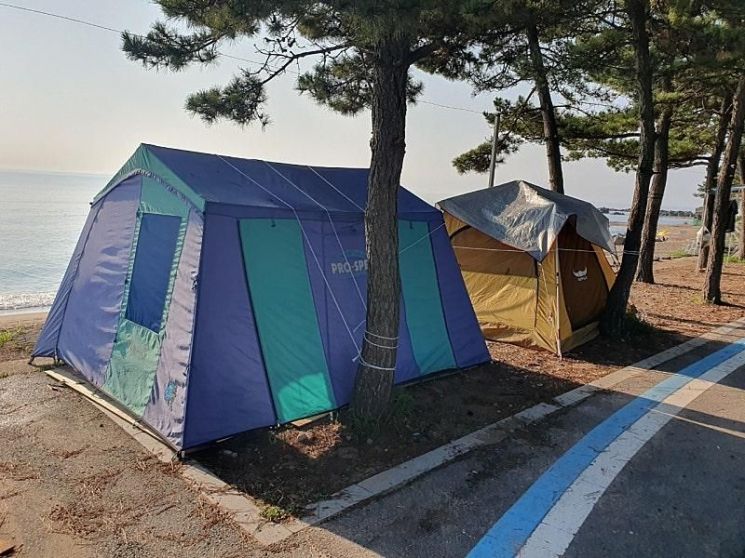
As the summer vacation season arrives, the so-called "tent staking" phenomenon?where people set up tents for extended periods along beaches?is drawing criticism from online users. Despite being a recurring issue every holiday season, some claim that the relevant authorities have not significantly strengthened enforcement efforts.
On August 11, a post and accompanying photo were uploaded to an online community, showing what was described as "a scene of long-term tent staking in front of a certain beach." The photo depicts a tent set up next to a road adjacent to the beach.
The poster commented, "The tent in the photo appears to be used almost like a private pension, with ropes tied to trees and sandbags installed for long-term occupation," and added, "This area seems to be state-owned land, making this a clear case of privatizing public resources. The local government should not just remove the tents, but should also impose excessive usage fees for illegal occupation to eradicate such behavior."
The poster continued, "These actions are no different from the issue of 'electricity theft,' where people in camping cars secretly use electricity from public restrooms," expressing anger by saying, "It is infuriating to see people who lack even the most basic manners in public spaces. There are simply too many people behaving unreasonably."
There Are Laws, but They're Virtually Ineffective... Local Governments Cite 'Staff Shortages'
The practice of staking out prime spots at beaches is clearly illegal, and there are relevant laws in place. The "Act on the Use and Management of Beaches" prohibits installing structures without the approval of the managing authority or camping in undesignated areas. Violators can be fined up to 100,000 won, and the managing authority also has the power to forcibly remove illegal structures.
However, local governments argue that they lack sufficient personnel to monitor the vast stretches of beach. Even when officials are present on-site, it is difficult to impose fines if the tent owner is absent, and forced removal requires a complicated administrative process, such as posting a removal notice, making immediate action challenging.
As a result, some citizens have resorted to damaging the tents, but this can result in fines that are much higher than the 100,000 won penalty for tent staking. Damaging someone else's property constitutes the crime of property damage under Article 366 of the Criminal Act, which is punishable by up to three years in prison or a fine of up to 7 million won. This is a much harsher punishment than the fine for staking, and there may also be additional civil liability for damages.
© The Asia Business Daily(www.asiae.co.kr). All rights reserved.











