Strengthened Measures Against Damage to Corporate Value of In-Kind Payment Securities
KAMCO to Actively Exercise Shareholder Rights
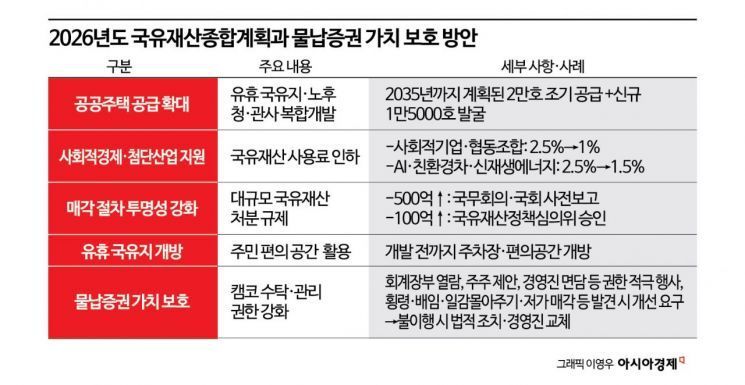
The government will supply approximately 35,000 units of public housing for young people and low-income households by redeveloping large-scale idle state-owned land and outdated government and official residences into mixed-use complexes. In addition, to counter intentional corporate value damage related to securities in kind acquired in lieu of taxes, the authority and responsibility of trustee institutions will be strengthened.
On August 12, Deputy Prime Minister and Minister of Economy and Finance Koo Yooncheol presided over the 27th State Property Policy Deliberation Committee meeting at the Government Complex Seoul, where the 2026 Comprehensive State Property Plan and measures to protect the value of securities in kind were reviewed and approved. Deputy Prime Minister Koo stated, "A shift in state property policy is necessary to enter a super-innovative economy," adding, "State assets must also play a proactive role."
Early Supply of Planned Volume by 2035... Additional Discovery of 15,000 New Units
The government will accelerate the supply of about 20,000 public housing units, including youth rental housing, originally planned by 2035. It will also identify additional underutilized urban public office sites and land near transit stations to supply at least 15,000 new public housing units. Representative projects include the Seoul Daebang Military Residence Complex Development (180 units for newlyweds, completion in 2027), Jongno Mixed-use Government Office (50 units for youth, completion in 2027), Yongsan Water Retention Site (300 units for newlyweds, completion in 2031), and Youth Mixed-use Government Office (50 units, completion in 2030). To ensure smooth project execution, not only Korea Asset Management Corporation (KAMCO) and Korea Land & Housing Corporation (LH) but also local public corporations will be included as entrusted development agencies, alongside institutional improvements for preliminary economic feasibility analysis.
Startup spaces, previously centered on physical infrastructure, will be enhanced by linking with various government youth startup policies (such as incubation, commercialization, and investment). In startup-activated areas like Yeoksam and Mapo in Seoul, the government will promote the development of residential-combined youth startup hubs, which combine office facilities with youth rental housing under a "startup + residential" model.
Special Provisions for Supporting Social Economy and Advanced AI Industries Using State Assets
The government will also support advanced industries such as artificial intelligence (AI) by utilizing state-owned assets. It is promoting amendments to special laws to reduce the usage fee for state assets from 2.5% to 1.5% for advanced and eco-friendly industries, including AI, eco-friendly vehicles, and renewable energy. For social economy organizations such as social enterprises and cooperatives, the usage fee will be lowered from the current 2.5% to 1% to support stable operations. To ensure that those eligible for reduced state asset usage fees receive necessary support, the current highest-bid competitive auction system will be changed to a lottery system.
Additionally, an AI-based state asset analysis system will be introduced. When new state assets are generated, the system will analyze specific uses such as development, preservation, or sale, and utilize this information for decision-making. The government plans to minimize idle land by closely monitoring development demand for state assets using AI. Idle state-owned land will be opened for community use, such as parking lots, until development begins. Furthermore, to support development of areas returned after the relocation of US military bases, the government will amend the State Property Special Cases Restriction Act to allow long-term leases.
To ensure future generations can fully utilize state assets, the disposal process for state-owned assets exceeding 10 billion KRW will also be reformed. For state-owned assets exceeding 50 billion KRW, review by the Cabinet and prior reporting to the National Assembly will be required. For assets exceeding 10 billion KRW, the State Property Policy Deliberation Committee process will be applied, thereby increasing transparency in the disposal process. In addition, administrative property surveys, previously conducted every five years, will now be conducted annually. When idle or underutilized assets are discovered, recommendations or administrative action for discontinuation of use will be implemented promptly to strengthen management.
Strengthened Response to Intentional Damage to the Value of Securities in Kind
The government will strengthen its response system to prevent losses to the national treasury caused by some companies intentionally lowering their corporate value during the "in-kind payment" process, where inheritance and gift taxes are paid with unlisted shares. Currently, KAMCO (Korea Asset Management Corporation) is responsible for the custody and management of in-kind shares. The government will revise KAMCO's internal regulations to expand the scope of its responsible activities. Securities in kind refer to shares in listed companies received in lieu of taxes, and there have been concerns that the rights and interests of the state as a shareholder have not been adequately reflected due to control by major shareholders and related parties.
Going forward, KAMCO as the trustee will actively exercise shareholder rights under the Commercial Act, including inspecting accounting books, making shareholder proposals, and holding meetings with management. An official from the Ministry of Economy and Finance stated, "There have been cases where some companies maliciously damaged the value of securities received in kind by taking advantage of information asymmetry," adding, "To address this, the government will actively utilize rights under the Commercial Act and the right to inspect accounting books to counter any actions that harm shareholder value."
If signs of corporate value damage, such as misappropriation of company funds, unfair business opportunities for related parties, asset sales below market value, or significant operating losses, are detected, the government will require management to implement improvement measures. If management fails to make substantial improvements, the government will pursue claims for damages or initiate lawsuits. In addition, it will respond in stages, including legal action and replacement of management (appointment of directors or auditors).
© The Asia Business Daily(www.asiae.co.kr). All rights reserved.












