Council Holds Forum at National Assembly
Attended by Kim Moonsoo, Lim Taehee, and Others
The National Council of Superintendents of Education (Chairperson Eunhee Kang, Daegu Superintendent of Education) held a forum on August 11 at the National Assembly Members’ Office Building in Seoul under the theme “The Present and Future of Local Education Finance.”
This forum was co-hosted by Democratic Party lawmaker Kim Moonsoo (representing Suncheon, Gwangyang, Gokseong, and Gurye in South Jeolla Province), the Council, and the Special Committee on Local Education Finance of Superintendents (Chairperson Lim Taehee, Gyeonggi Superintendent of Education). More than 50 participants attended, including Kangwon Superintendent Shin Kyungho, Chungbuk Superintendent Yoon Kunyoung, Jeju Superintendent Kim Kwangsoo, officials from the Ministry of Education, education finance experts, and representatives from city and provincial education offices.
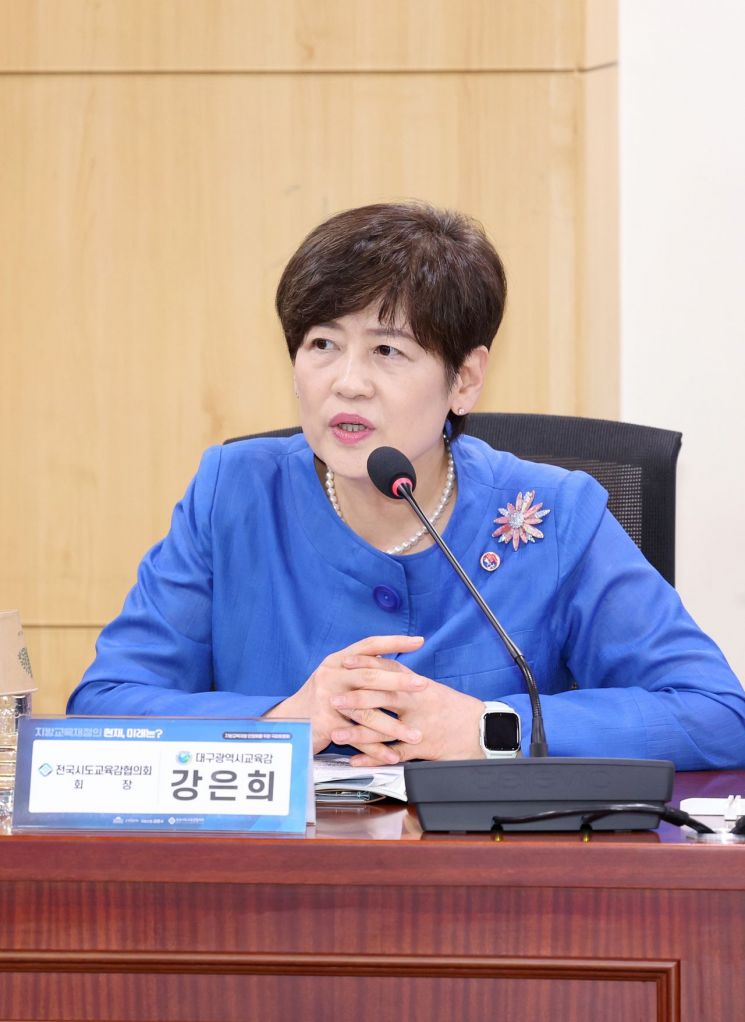 Eunhee Kang, Chairperson of the National Association of Provincial and Metropolitan Education Superintendents (Daegu Education Superintendent)
Kim Youngho, Chairperson of the National Assembly Education Committee (Democratic Party, Seoul Seodaemun-eul), delivered a written congratulatory message emphasizing the need to strengthen the state’s responsibility for education, such as extending the national burden for free high school education, and expressed his commitment to creating a stable and equitable educational environment.
Lawmaker Kim Moonsoo, Special Committee Chairperson Lim Taehee, and Council Chairperson Eunhee Kang, who attended the forum, stressed in their opening remarks the need for cooperation to ensure stable local education finance and to strengthen educational autonomy. These concerns are closely linked to the actual financial conditions faced by city and provincial education offices.
Over the past three years, the 17 city and provincial education offices have supplemented shortfalls in tax revenue with funds such as the Education Finance Stabilization Fund, but they continue to face financial instability. Structural limitations of rigid fixed expenditures, such as personnel costs, also persist. In this context, the Council welcomed the government’s 2025 tax reform plan?which includes extending the validity period of the Special Account for Early Childhood Education Support, extending state support for free high school education expenses for three more years, and raising the education tax rate for financial and insurance companies with annual revenue exceeding 1 trillion won?as a positive signal for stabilizing local education finance.
However, the Council noted that these measures alone are not sufficient to fundamentally resolve the structural financial issues at the educational field level. Through this forum, the Council aimed to share the realities on the ground in detail and to strengthen cooperation among the National Assembly, the government, and city and provincial education offices to seek joint solutions for the stabilization of local education finance.
Lee Sunho, Director at the Korean Educational Development Institute, delivered the keynote presentation on “Directions for Operating the Local Education Finance System to Support Successful School Education.” He proposed establishing appropriate education expenditure standards that reflect demand based on school and class size as well as student characteristics, in order to substantively support qualitative growth in education.
During the ensuing discussion, the urgent voices of those facing financial cutbacks in the field of education were vividly conveyed. Song Kichang, President of Seongsan Hyo Graduate School and moderator of the session, emphasized that “the issue of local education finance is not just a problem for city and provincial education offices, but a national issue. Now is the time to listen to voices from the field and to develop practical solutions.”
Budget officers from each region also expressed concern that the financial capacity of education offices has reached its limit, with fund depletion and financial constraints threatening students’ right to education and learning environments. They agreed on the urgent need for fundamental countermeasures.
Eunhee Kang, Chairperson of the National Council of Superintendents of Education and Daegu Superintendent of Education, stated, “Local education finance is not merely a budget item, but a national responsibility to safeguard children’s learning and growth, and it is a core issue directly tied to the sustainability of educational autonomy. The simplistic logic that education finance should be reduced just because the school-age population is declining is extremely dangerous.”
Chairperson Kang added, “I hope that the voices from the field have been clearly conveyed to the National Assembly and the government through this forum. Going forward, the Council will continue to work closely with city and provincial education offices, the National Assembly, and the central government to ensure stable education finance and to safeguard the essence of public education.”
Meanwhile, the forum was broadcast live via the Council’s YouTube channel (National Council of Superintendents of Education).
© The Asia Business Daily(www.asiae.co.kr). All rights reserved.












