People in Their 20s and 30s Spend the Most Consumer Coupons on Dining Out
Those in Their 40s to 60s Use Coupons Evenly for Dining Out and Daily Necessities
A recent survey found that people in their 40s to 60s used the Livelihood Recovery Consumer Coupons fairly evenly for dining out and daily necessities, while those in their 20s and 30s spent the highest proportion on dining out.
On August 8, data consulting firm PMI announced that it had recently conducted a "public perception survey on the Livelihood Recovery Consumer Coupon policy" among 1,000 men and women aged 20 to 69 nationwide.
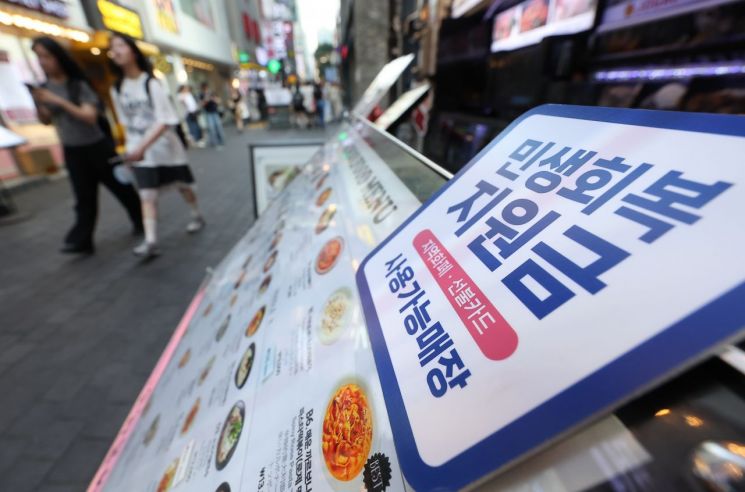 On the 24th of last month, a notice about the Livelihood Recovery Support Fund was posted on the menu board of a restaurant in downtown Seoul. Photo by Yonhap News
According to the survey, 96.4% of respondents applied for the consumer coupons, and among them, 81.1% actually used them. The most commonly used payment method was credit or debit card linkage (80.0%), followed by mobile and paper-type local gift certificates (10.5%), prepaid cards (8.4%), and other or unsure (1.1%).
When asked about the main places where they used the consumer coupons (multiple responses allowed), 66.7% said dining establishments such as restaurants and cafes, making it the most common. This was followed by the purchase of daily necessities at supermarkets or traditional markets (61.9%). Other uses included beauty and medical services (32.3%), culture and leisure (7.8%), and education expenses (7.6%). By age group, those in their 20s and 30s had a higher proportion of spending related to dining out, while those in their 40s to 60s showed a more balanced spending pattern between dining out and daily necessities.
The person for whom respondents most frequently used the consumer coupons was "myself" (51.3%). This was followed by "family or children" (39.4%), "parents or relatives" (5.4%), "acquaintances or others" (1.7%), "for donation or sponsorship purposes" (0.3%), and "other" (1.9%). By age group, the response "used for myself" was especially high among those in their 20s and 30s, while those in their 40s to 60s had a relatively higher proportion of spending for family or children.
When asked about changes in their living environment after the policy was implemented (multiple responses allowed), many respondents said, "Traditional markets or supermarkets seem to have become more lively" (37.8%) and "There are more people in restaurants or cafes" (37.4%). Some also answered that "leisure spaces such as movie theaters and performance venues have become more crowded" (13.9%), while 27.6% said, "There was no noticeable change."
Regarding whether the policy should continue in the future, 53.9% said "It should continue," 25% said "Not sure," and 21.1% said "No." More than 60% of respondents in their 40s and 50s agreed on the need for the policy to continue.
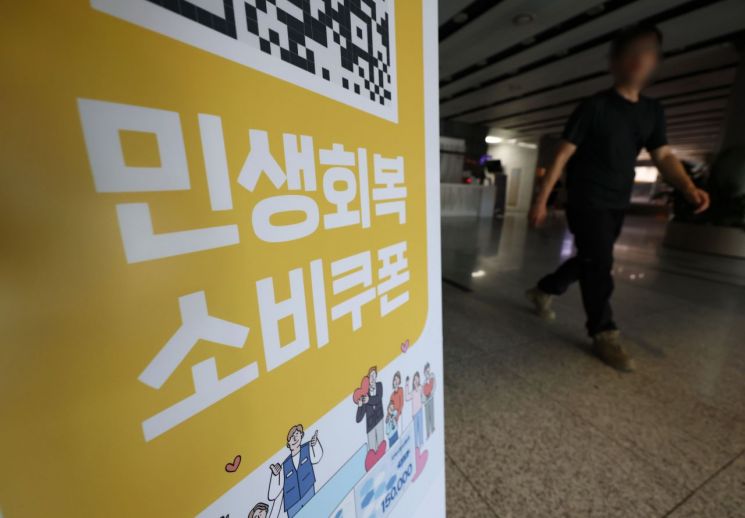 On the 26th of last month, a consumer coupon application notice was placed on the first floor of Gwanak District Office in Seoul. Photo by Yonhap News
Alongside the positive effects of the consumer coupon policy, there were also calls for improvement. When asked about shortcomings during the policy implementation (multiple responses allowed), the most common response was "The range of places where the coupons could be used was limited" (48.4%). In addition, 39.3% answered "There were no shortcomings," indicating that a significant number of participants evaluated the policy positively. Other responses included "Lack of promotion" (8.1%) and "The application process was inconvenient" (6.8%).
As for the areas most in need of improvement in future consumer coupon policies (multiple responses allowed), "Diversification of places where the coupons can be used" (52.4%), "Improvement of fairness in payment criteria" (36.2%), and "Adjustment of support amount" (33.6%) were cited. There were also responses for "Simplification of the application process" (18.5%), "Adjustment of payment timing" (9.1%), and "Strengthening policy promotion" (7.7%).
When asked about the most effective method for future livelihood support, the most common answer was "distribution of local currency or consumer coupons" (39.5%), followed by "cash payment" (29.8%), "tax reduction" (19.2%), "direct support for public utility fees or education expenses" (8%), and other (3.5%). By age group, people in their 20s preferred "cash payment," while those in their 30s and older tended to prefer policies using "consumer coupons or local currency."
© The Asia Business Daily(www.asiae.co.kr). All rights reserved.













