Trump Announces 100% Tariff on Semiconductors
Hints at Exemptions for Companies Producing in the U.S.
Continuing Jobless Claims Hit Highest Level in 3 Years and 8 Months
The three major U.S. stock indexes showed mixed performance in early trading on the New York Stock Exchange on the 7th (local time). As President Donald Trump announced a 100% tariff on imported semiconductors but hinted at exemptions for companies producing within the United States, semiconductor stocks rose, supporting the S&P 500 and Nasdaq indexes.
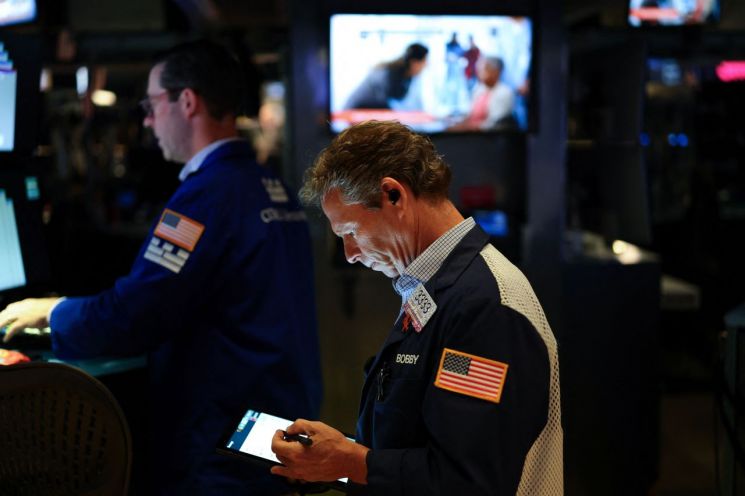
As of 11:19 a.m. on the same day in the New York stock market, the blue-chip Dow Jones Industrial Average (Dow) was down 251.27 points (0.57%) from the previous trading day, standing at 43,941.85. The large-cap S&P 500 index was up 1.06 points (0.02%) at 6,346.12, while the tech-heavy Nasdaq index was trading at 21,285.34, up 115.91 points (0.55%).
By sector, semiconductor stocks were strong. AMD surged by 7.34%. Nvidia rose by 1.56%. In contrast, Intel was down 3.26% after President Trump called for the resignation of CEO Lipbu Tan, who is of Chinese descent, amid allegations that he posed a threat to U.S. national security due to ties with China. Apple jumped 3.03% after announcing an additional $100 billion investment plan in the U.S. the previous day.
President Trump stated the previous day that he would impose a 100% tariff on semiconductors entering the United States, but also made broad exceptions by saying that companies that have established a production base in the U.S. or have made a firm commitment to produce in the U.S. would not be subject to the tariff. As a result, semiconductor-related stocks rose, supporting investor sentiment.
The United States implemented reciprocal tariffs by country starting today, but the market has not reacted significantly so far. President Trump strongly defended his tariff policy through his social network service, Truth Social, stating, "Tariffs are pouring into the United States at an unimaginable rate!"
Investors are also closely monitoring labor market conditions. According to the U.S. Department of Labor, the number of continuing jobless claims?those claiming unemployment benefits for more than two weeks?stood at 1,974,000 for the week of July 20-26, an increase of 38,000 from the previous week (1,936,000). This not only far exceeded the market expectation of 1,950,000 but was also the highest level since November 2021. Initial jobless claims also increased, reaching 226,000 for the week of July 27 to August 2, surpassing both the previous week's figure (219,000) and the market forecast (221,000). This coincides with the weak July nonfarm payroll data released on August 1, which showed an increase of only 73,000 jobs, well below the forecast of 106,000.
There is analysis that aggressive tariff policies and the resulting economic uncertainty are causing companies to hesitate in new hiring, leading to an overall slowdown in the labor market.
Anthony Saglimbene, chief market strategist at Ameriprise, said, "There is a lot to digest right now regarding tariffs and trade, and various complex situations are unfolding around the macroeconomic environment. The market tends to set aside issues unless they have an immediate negative impact on the economy or corporate earnings, and that is exactly the situation now." He added, "The market remains focused on the solid economic backdrop and strong earnings, and will maintain this stance until more evidence of tariff impacts emerges. The effects of President Trump's tariffs are expected to start appearing in economic indicators around the fall."
U.S. Treasury yields are moving sideways. The 10-year U.S. Treasury yield, the global benchmark for bond yields, was at 4.23%, unchanged from the previous session, while the 2-year U.S. Treasury yield, which is sensitive to monetary policy, was at 3.72%, up 2 basis points (1bp=0.01 percentage point) from the previous day.
© The Asia Business Daily(www.asiae.co.kr). All rights reserved.











