Policy Discussion on Tariff Negotiations Held on August 6
"Comparative Advantage in Auto Tariffs Disappears"
"Revisions Needed for the Yellow Envelope Act and Commercial Act Amendment"
On August 6, the People Power Party criticized the tariff negotiations with the United States, arguing that the competitive advantage enjoyed by the automobile sector under the Korea-US Free Trade Agreement (FTA) has now disappeared. The party emphasized the management burdens faced by companies and urged revisions to the Yellow Envelope Act and the Commercial Act amendment currently being promoted by the Democratic Party of Korea.
Song Eonseok, Emergency Response Committee Chairman and Floor Leader of the People Power Party, stated at the policy committee’s meeting titled “Evaluation and Tasks of the Automobile Tariff Negotiations,” “The government and the ruling party are praising themselves for negotiating the tariff rate down from 25% to 15%, but this is nothing more than a complacent commentary from those who are unaffected.”
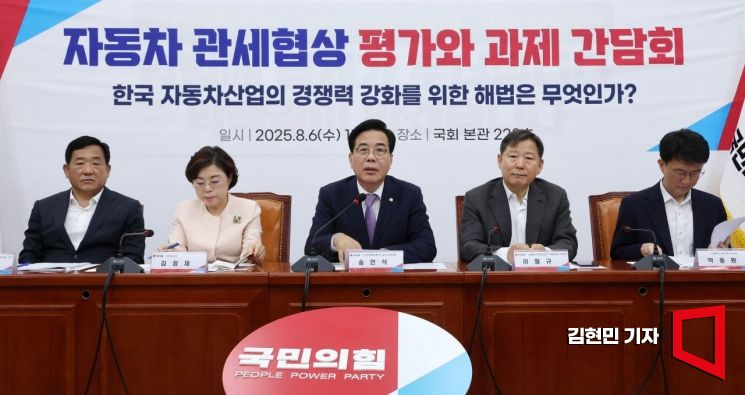 Song Eonseok, Emergency Response Committee Chairman and Floor Leader of the People Power Party, is speaking at the meeting evaluating and discussing tasks of the automobile tariff negotiations held at the National Assembly on August 6, 2025. Photo by Kim Hyunmin
Chairman Song pointed out, “Through the FTA, our automobile exports to the US had a 0% tariff, while Japan and the EU were subject to a 2.5% tariff. Now, with the same 15% rate applied to all, this is not a success but rather a 2.5 percentage point loss for us,” adding, “It is difficult to agree that the negotiations were successfully concluded.”
He continued, “The government and the ruling party must proactively reconsider the stronger Commercial Act amendment and the Yellow Envelope Act, and swiftly prepare revisions to prevent the complete undermining of corporate management mindsets.”
Kim Jungjae, Policy Committee Chair of the People Power Party, said, “What is even more concerning is that the direct blow from the tariff increase will be concentrated not only on large corporations like Hyundai Motor but also on small and medium-sized partner companies. If even one finished car manufacturer is shaken, countless partner companies in parts, logistics, and equipment will be hit in a chain reaction.”
Lee Cheolgyu, a People Power Party lawmaker who chairs the National Assembly’s Trade, Industry, Energy, SMEs and Startups Committee, asserted, “Everyone agrees that the comparative competitive advantage the automobile industry enjoyed under the Korea-US FTA has been offset and neutralized by this tariff negotiation.” He continued, “It will not be easy to readjust this in the remaining negotiation process,” diagnosing the issue as “a problem caused by a lack of negotiation power.”
Chairman Lee emphasized, “If the Yellow Envelope Act, which encourages illegal strikes and is being pushed by the ruling party, is unilaterally passed, it is obvious that the automobile industry will face a crisis due to the loss of competitiveness from tariffs and the deterioration of the domestic production environment.” He then called on the government, saying, “If the comparative advantage from tariffs is gone, it is the government’s obvious duty to create an environment where our companies can still compete. If it is difficult to directly adjust tariff rates in the remaining negotiations, please ensure that our companies do not face difficulties even in the smallest details regarding non-tariff barriers.”
© The Asia Business Daily(www.asiae.co.kr). All rights reserved.












