The Former “Emperor Stock” Once Worth Over 1.1 Billion KRW per Share
Investor Sentiment Worsens After CEO Buffett Announces Retirement Plans
Underperforms Compared to S&P 500
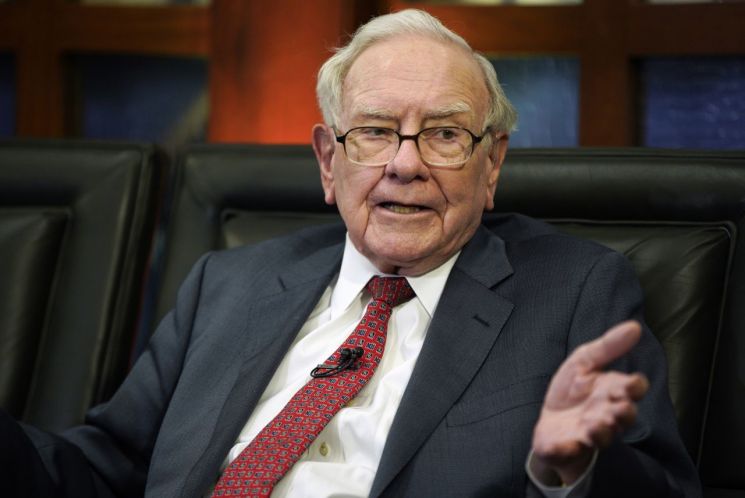 Warren Buffett, Chairman and CEO of Berkshire Hathaway, is conducting an interview in Omaha in 2018. CEO Buffett announced his retirement last May and stated that he will hand over the CEO position to Vice Chairman Greg Abel. Photo by AP Yonhap News
Three months after Chairman and CEO Warren Buffett announced his retirement plans last May, Berkshire Hathaway's stock price has fallen by 14%, according to reports on August 5 (local time).
According to the UK’s Financial Times (FT), Berkshire Hathaway’s Class A shares declined by 14% over the roughly three-month period starting from May 2. May 2 was the last trading day before former CEO Buffett announced that he would hand over management control to Vice Chairman Greg Abel. As of the closing price on August 5, the stock was trading at $694,750 (966 million KRW).
This decline in Berkshire Hathaway’s stock is among the largest three-month drops since 1990. Apart from the period at the onset of the COVID-19 pandemic, when insurance and financial stocks plummeted and overall returns worsened, such a steep drop is considered unusual.
The underperformance stands out even more when compared to the broader market. During this period, the total return of the US S&P 500 Index, including dividends, reached 11%. This year, the New York stock market has been buoyed by semiconductor stocks with an artificial intelligence (AI) theme, led by Nvidia, which holds the top spot in market capitalization.
In fact, concerns that Berkshire Hathaway was being left out of this year’s tech rally were cited as one factor dampening investor sentiment. This is because CEO Buffett has primarily focused on undervalued value stocks. Another cited reason was that CEO Buffett stopped repurchasing the company’s own shares in May 2024, citing overvaluation of its stock.
FT added that the specific entities driving the recent stock price decline have not yet been identified. It is expected that the details of who holds, and how much of, Berkshire Hathaway’s Class A shares?which were considered “emperor stocks” trading at around $810,000 (about 1.126 billion KRW) per share in early May?will become clear when hedge fund and other institutional holdings for the second quarter are disclosed at the end of this month.
Nevertheless, Berkshire Hathaway is reported to have posted strong results in the second quarter. Most of the company’s business segments in which it has invested?including railroads, utilities, manufacturing, services, and distribution?achieved solid performances. Excluding currency fluctuations, operating profit increased by 8% compared to the previous year.
Meanwhile, CEO Buffett appears to be maintaining a cash accumulation strategy. He has continued a net selling trend for 11 consecutive quarters, including selling part of the company’s stake in Apple, a stock he is known to favor. As of the end of June, cash holdings had grown to 30% of total assets. However, this is slightly lower than the record high reached in the first quarter. CEO Buffett doubled Berkshire Hathaway’s cash reserves over the course of 2024.
© The Asia Business Daily(www.asiae.co.kr). All rights reserved.












