NYT: "Tariff Policy Transformed into a Tool for Investment Pressure"
South Korea, Japan, and EU Pledge Hundreds of Billions of Dollars in Investment
Questions Raised Over the Effectiveness of Investment Pledges
The New York Times (NYT) reported that U.S. President Donald Trump, leveraging America's economic power, has secured large-scale investment pledges from other countries, effectively turning tariff policy into a means of raising funds.
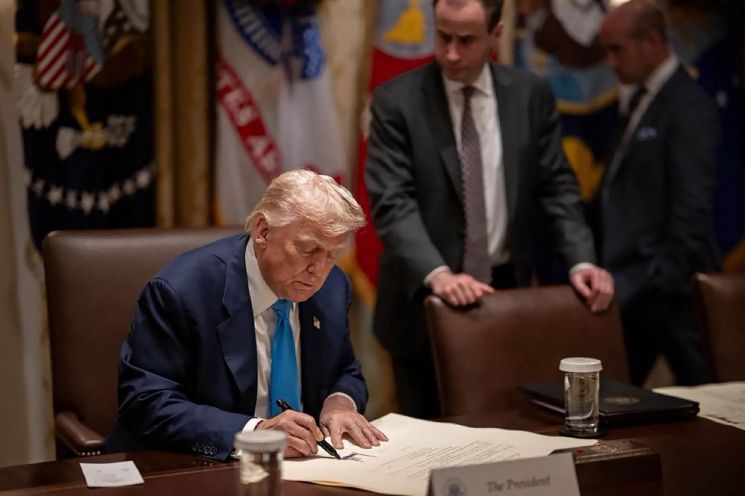 A photo of U.S. President Donald Trump signing, posted along with the news of the conclusion of the Korea-U.S. tariff negotiations. White House website
On August 4 (local time), the NYT stated that President Trump is employing a strategy of extracting hundreds of billions of dollars in investment from foreign companies and countries under the pretext of trade negotiations.
The NYT wrote, "President Trump's second-term trade policy directly reflects the approach shown in his signature book, 'The Art of the Deal.' In effect, he is demanding that trade partners pay up in the form of investment pledges, and if they do not comply, he threatens to impose astronomical tariffs."
The article continued, "These financial commitments serve as an opportunity for President Trump to showcase his negotiation skills in a way that is easy for the public to understand, and to boast about the large sums he claims to be drawing into the U.S. The Trump administration, as it struggles to finalize trade agreements with dozens of countries before (trade deal) deadlines, has adopted a strategy that goes beyond simple market opening or reducing trade deficits."
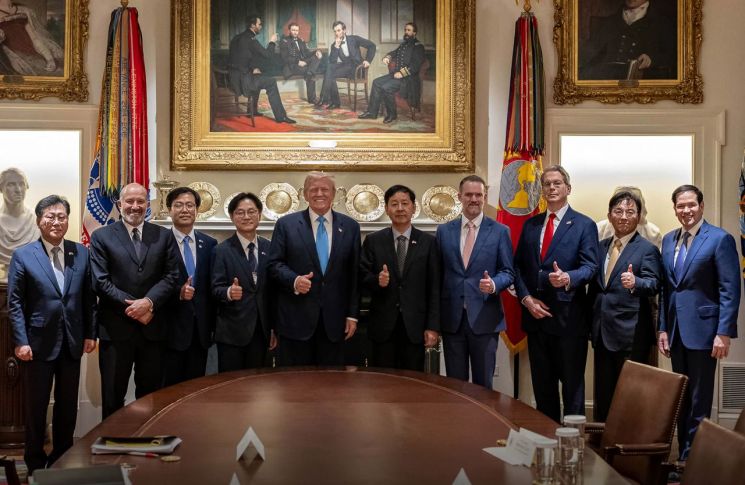 US President Donald Trump is taking a commemorative photo with representatives from both countries after reaching a trade agreement with the South Korean government negotiation team at the White House in Washington DC on the 30th (local time). Photo by White House X account
The NYT specifically pointed out that President Trump's tactics were revealed without filter during negotiations with South Korea. On July 30, just before the mutual tariff suspension deadline (August 1) set by the U.S. administration, President Trump announced a meeting with the South Korean negotiating team on his social media, stating, "South Korea currently faces a 25% tariff, but they have proposed to pay to lower the tariff. I am interested in hearing what that proposal is."
After the meeting, President Trump decided to adjust the mutual tariff with South Korea to 15%. In return, South Korea agreed to invest $350 billion in the U.S. and purchase $100 billion worth of energy, including liquefied natural gas (LNG). Previously, Japan also lowered the mutual tariff rate to 15% but pledged to establish a $550 billion investment fund for the U.S., while the European Union (EU) announced that European companies were prepared to invest at least $600 billion.
According to the NYT, trade experts questioned whether President Trump was negotiating with trade partners or with trade hostages. Scott Lincicome, vice president of the right-leaning Cato Institute, said, "This is, without a doubt, a kind of global shakedown," adding, "The U.S. is using its tariff policy to force these terms."
Concerns have also been raised about the unofficial and vague nature of the investment pledges and the feasibility of their implementation. The article noted, "The EU does not have the authority to determine the types of investments promised, and a significant portion of Japan's pledge is in the form of loans. Most of South Korea's $350 billion investment is also expected to consist of loans and guarantees." It also reported that "South Korean government officials have stated that the U.S. explanation that 90% of investment returns will go to American citizens is unclear."
Michael Froman, who served as U.S. Trade Representative during the Barack Obama administration, pointed out, "Even the governments themselves do not know exactly what these pledges mean or whether there are concrete conditions for their implementation."
© The Asia Business Daily(www.asiae.co.kr). All rights reserved.













