Transition from Emergency Economic Monitoring TF to Growth Strategy TF
Discussions on Easing Corporate Burdens and Improving Regulations
Selection of Key Items for AI-Driven Transformation and Ultra-Innovative Economy
New Government's Economic Growth Strategy and Budget Plan to Be Announced This Month
The government has decided to conduct a comprehensive review of regulations on mid-sized and large companies to align them with global standards in order to enhance corporate growth. Support systems for small and mid-sized enterprises will be restructured to focus on promoting growth. In addition, economic-related criminal penalties will be rationalized by either easing criminal provisions or introducing exemption clauses in cases where violations are not serious or are not committed intentionally or through gross negligence.
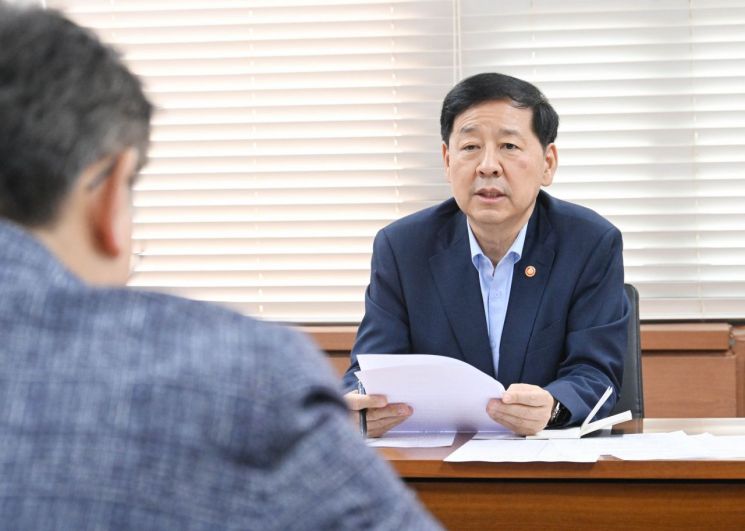 Koo Yoonchul, Deputy Prime Minister for Economy and Minister of Economy and Finance. Photo by Yonhap News
Growth Strategy Task Force Discussions to Be Included in New Government's Economic Growth Strategy and Budget Plan
On the afternoon of August 5, the government held the first meeting of the "Growth Strategy Task Force (TF)" at the Korea Chamber of Commerce and Industry in Jung-gu, Seoul, presided over by Deputy Prime Minister and Minister of Economy and Finance Koo Yooncheol. The meeting was attended by ministers and vice ministers from relevant ministries, including the Ministry of SMEs and Startups, the Ministry of Justice, and the Ministry of Trade, Industry and Energy. Leaders from six major economic organizations, including the Korea Chamber of Commerce and Industry and the Korea International Trade Association, were also present.
The government has converted the Emergency Economic Monitoring Task Force, which was previously chaired by President Lee Jaemyung, into the Growth Strategy Task Force. The Growth Strategy TF has set the enhancement of corporate vitality for "genuine growth" as its top priority, and will operate as a platform to listen to and publicize on-site opinions and proposals for easing corporate burdens and improving regulations. Various economic organizations and experts will participate to discuss ways to boost corporate vitality and foster new industry packages.
Going forward, the government plans to hold a series of on-site relay meetings by industry and region, as well as the "Economic Criminal Penalty Rationalization TF," to collect opinions from relevant ministries and the field, and to identify tasks for institutional improvement to promote corporate growth. In addition, key items for the AI-driven transformation and ultra-innovative economic transition will be selected and included in the "New Government Economic Growth Strategy" and the budget plan, which will be announced within August.
Swift Implementation of Corporate Regulatory Reform and Rationalization of Economic Criminal Penalties
At this meeting, the government decided to swiftly implement improvements to corporate regulations. In this process, regulations on mid-sized and large companies will be improved in line with global standards, and all regulations by company size will be comprehensively reviewed. In cases where other laws reference company size criteria (such as business groups subject to disclosure), the regulatory standards will be changed to reflect the legislative intent and necessity of the regulation.
The current support system for small and mid-sized enterprises will shift its focus from small-scale support to growth-oriented policies. Investment, research and development (R&D), adoption of artificial intelligence (AI), and development of export markets?business activities closely linked to growth?will receive concentrated support. In addition, to prevent a sharp decline in government support benefits as companies grow, the support system will be designed to gradually decrease benefits, and both the criteria and methods of support will be diversified.
The government will also move quickly to rationalize economic criminal penalties. The focus will be on areas where the public can feel the impact, such as reducing the criminal liability risks for CEOs, including breach of trust, and alleviating management burdens for small business owners and SMEs. Instead of relying primarily on criminal penalties, the government will ease economic criminal provisions and strengthen administrative fines, surcharges, and civil monetary liability, thereby shifting sanctions from criminal to monetary penalties.
The Ministry of Economy and Finance stated, "If violations of obligations are not serious or are not committed intentionally or through gross negligence, we will uniformly ease criminal provisions or introduce exemption clauses. We will rationalize criminal regulations by converting or increasing surcharges, applying administrative sanctions before criminal penalties, and strengthening compensation liability to victims."
© The Asia Business Daily(www.asiae.co.kr). All rights reserved.












