Selected for MOTIE Project... 10.19 Billion KRW to Be Invested by 2027
Building an AI-Based Driver Assistance System for GGM Casper
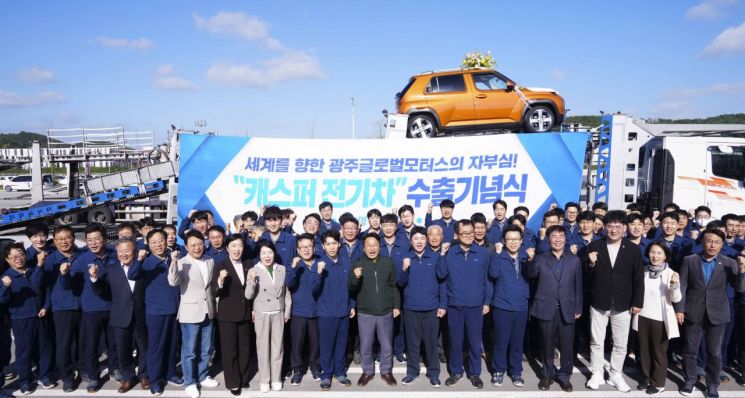 Gwangju Mayor Kang Kijeong is attending the "Casper Electric Vehicle (EV) Export Ceremony" held at Gwangju Global Motors in Gwangsan-gu on October 23 last year, posing for a commemorative photo with guests. Provided by Gwangju City
Gwangju City is launching a full-scale innovative automotive technology development project aimed at strengthening the mobility rights of transportation-vulnerable individuals.
According to the city on August 4, it has been finally selected for the Ministry of Trade, Industry and Energy's "2025 Automotive Industry Technology Development Project" and will receive a total of 7 billion KRW in national funding. This project will be based on Gwangju Global Motors (GGM)'s electric vehicle, the "Casper Electric."
The main goal of the project is to develop AI-based customized technologies that dramatically improve driving safety for elderly drivers and transportation-vulnerable individuals. Specifically, the project will focus on the development of a perception sensor module, the establishment of a customized AI driver assistance system, and the acquisition of system verification technologies.
The project period will span three years, from the second half of this year until 2027, with a total investment of 10.19 billion KRW (7 billion KRW in national funding and 3.19 billion KRW in private investment). The city expects that this project will enhance the competitiveness of the local automotive industry and lay the foundation for Gwangju to become a leading city in future mobility.
Choi Taejo, Director of the Artificial Intelligence Industry Bureau, stated, "Developing driver assistance systems, which are future-oriented transportation technologies for the transportation-vulnerable, is an essential project for Gwangju City's transition to future mobility. We will actively pursue the attraction of national projects to lead various pioneering initiatives for companies transitioning to future mobility."
Meanwhile, the city was already designated as a "Future Mobility Materials and Parts Specialized Complex" in July last year and plans to invest 65.7 billion KRW by 2028. In February this year, the Future Mobility National Industrial Complex was confirmed as a national strategic project, accelerating the establishment of the national industrial complex.
© The Asia Business Daily(www.asiae.co.kr). All rights reserved.











