Ministry of Trade, Industry and Energy Announces July Trade Trends
July Exports Reach $60.8 Billion, Setting a New Record for the Month
Exports to the U.S. Rise 1.4% to $10.3 Billion
...Ranking Third After China and ASEAN
Despite uncertainties caused by the U.S. government's announcement of reciprocal tariffs, Korea's main export items?semiconductors and automobiles?performed strongly, leading to record-high exports in July and continuing the growth trend. Exports to the United States also increased by 1.4% year-on-year, driven by rising shipments of IT products such as semiconductors, making the U.S. the third-largest export destination after China and ASEAN. However, steel exports to the U.S., which are subject to a 50% tariff, have been declining for three consecutive months.
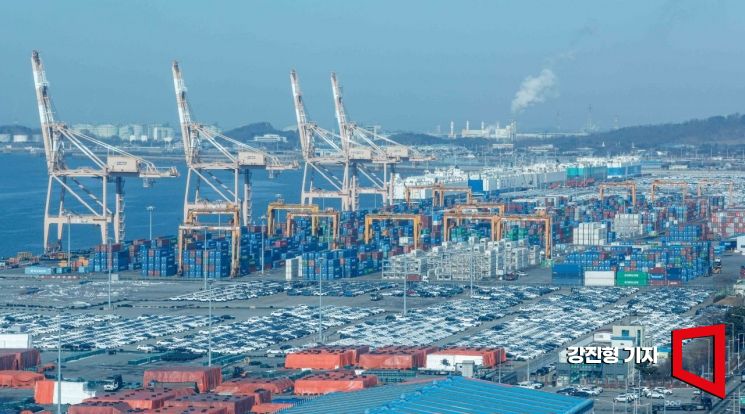
According to the Ministry of Trade, Industry and Energy on August 1, exports in July reached $60.82 billion, up 5.9% from the same month last year. This marks the highest July export figure ever and represents two consecutive months of export growth, following June.
Strong exports of semiconductors and automobiles drove the overall increase in exports. Semiconductor exports, led by memory semiconductors ($9.47 billion, 39.3%), benefited from rising fixed prices and sustained robust demand for high-value-added products such as high-bandwidth memory (HBM) and double data rate (DDR) 5, resulting in a record-high July performance of $14.71 billion (31.6%).
Automobile exports also showed strong results in major markets outside the U.S., such as the European Union (EU), Commonwealth of Independent States (CIS), and Central and South America. Increased shipments of hybrid and internal combustion engine vehicles led to an overall 8.8% increase, reaching $5.83 billion and marking two consecutive months of growth.
Ship exports rose by 107.6% to $2.24 billion, marking five consecutive months of growth, as shipments of high-value-added vessels such as tankers and liquefied natural gas (LNG) carriers expanded. However, exports of petroleum products ($4.21 billion, -6.3%) and petrochemicals ($3.75 billion, -10.1%) continued to decline due to ongoing low oil prices and falling product prices caused by global oversupply.
Steel product exports have been declining for three consecutive months since May this year (-12.4%) due to the impact of U.S. tariffs. In July, exports fell by 2.9% year-on-year. The U.S. began imposing a 25% tariff on steel and aluminum on March 12 this year and raised it to 50% on June 4.
Last month, exports increased to six out of nine major regions, including the U.S., ASEAN, and the EU. Exports to China, Korea's largest export market, fell by 3.0% to $11.05 billion due to a slowdown in key export items such as petrochemicals and wireless communication devices. Exports to ASEAN rose by 10.1% to $10.91 billion, driven by a 1.5-fold increase in semiconductor exports, the region's top export item.
Exports to the U.S. increased by 1.4% to $10.33 billion, making it the third-largest export destination after China and ASEAN. This growth was achieved despite declines in steel and auto parts, thanks to strong performance in IT items such as semiconductors and wireless communication devices, as well as non-IT items like cosmetics and electrical equipment.
Exports to the EU increased by 8.7% to $6.03 billion, marking five consecutive months of growth, as major items such as automobiles, ships, and petroleum products all saw increases. Exports to the CIS ($1.22 billion, 21.5%) rose for five months in a row, while exports to Central and South America ($2.68 billion, 4.4%) and India ($1.79 billion, 10.7%) increased for two consecutive months.
Imports in July increased by 0.7% to $54.21 billion. Energy imports ($9.67 billion) fell by 11.3%, but non-energy imports ($44.55 billion) rose by 3.7%.
The trade balance in July recorded a surplus of $6.61 billion, up $2.99 billion from the same month last year, as exports grew much faster than imports. This is the largest July surplus since 2018 ($6.89 billion). As a result, the cumulative trade surplus from January to July reached $34.39 billion.
Minister of Trade, Industry and Energy Kim Jung-kwan said, "As a result of negotiations with the U.S., tariffs were settled at levels equal to or lower than those of competing countries, eliminating uncertainty in the export environment and enabling our exporters to compete on equal or superior terms in the U.S. market." He added, "The government will actively support our exporters so they can secure and enhance export competitiveness and diversify both products and markets, even in this new environment."
© The Asia Business Daily(www.asiae.co.kr). All rights reserved.












