The KOSPI, currently absorbing the impact of the Korea-US tariff negotiations, plunged more than 3% in early trading on August 1, falling below the 3,200 mark. While the market is closely monitoring the government's tax reform plan, the KOSDAQ also reacted sensitively to changes in the major shareholder capital gains tax criteria, dropping more than 3%.
As of 10:00 a.m. on this day, the KOSPI was trading at 3,145.35, down 100.09 points (3.08%) from the previous day. The index had opened at 3,210.32, down 35.12 points (1.08%), but the decline deepened as foreign investors and institutions net sold approximately 660 billion KRW. Although individual investors alone bought 654 billion KRW, it was not enough to offset the selling pressure. At the same time, the KOSDAQ was trading at 776.41, down 28.83 points (3.58%).
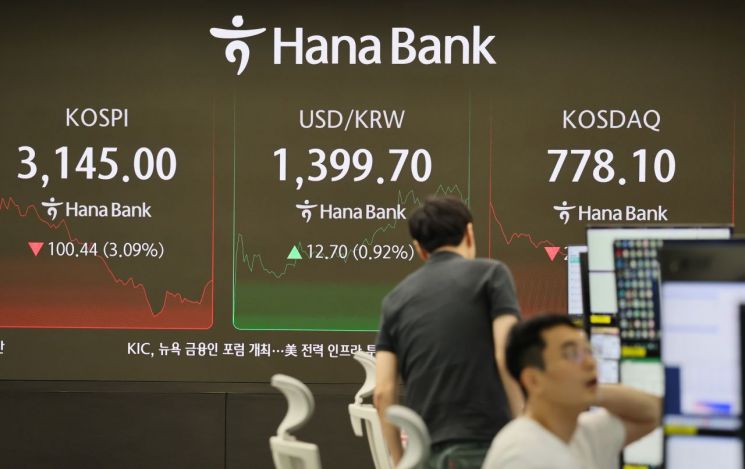 After news of the conclusion of the Korea-US mutual tariff negotiations was reported, the domestic stock market on the 1st started lower and widened its losses, with the KOSPI index falling more than 100 points at one point in the morning, and the won-dollar exchange rate approaching the 1400 won level. Stock prices and exchange rates are displayed in the dealing room at the Seoul Hana Bank headquarters. Photo by Yoon Dongjoo
Among large-cap stocks, Hanwha Aerospace plunged more than 7%, relinquishing its 'emperor stock' title in just one day. Doosan Enerbility, HD Hyundai Heavy Industries, and SK Hynix also fell more than 5%. Major financial stocks such as KB Financial Group (-4.06%) and Shinhan Financial Group (-2.94%) were also declining. By sector, most industries were falling except for healthcare technology.
The domestic stock market on this day is seeing a wave of disappointment-driven selling as investors focus on the economic impact of the Korea-US tariff agreement reached the previous day and the government's tax reform plan. The government had previously announced a tax reform plan that lowers the threshold for 'major shareholders' subject to capital gains tax from 5 billion KRW to 1 billion KRW, and introduces a maximum 35% separate taxation on dividend income.
Han Jiyeong, a researcher at Kiwoom Securities, commented, "Large-cap KOSPI stocks with heavy individual investor inflows, as well as KOSDAQ stocks with a high proportion of individual investors, are showing weak performance," adding, "In the short term, exposure to volatility may be inevitable, but if this situation persists, it could critically impact the credibility of policies aimed at revitalizing the stock market and resolving the Korea Discount."
Overnight weakness in US tech stocks and a sharp rise in the KRW-USD exchange rate were also cited as factors dampening investor sentiment. The New York Stock Exchange closed lower across the board as caution grew over inflation and employment indicators that exceeded expectations, despite strong second-quarter results from Microsoft (MS) and Meta Platforms. The Philadelphia Semiconductor Index fell 3.1% due to sharp declines in major semiconductor design companies such as ARM Holdings (-13%). In addition, renewed trade uncertainty, including the US imposing 35% tariffs on Canada and 20% on Taiwan, is also weighing on the stock market.
Lee Sunghoon, a researcher at Kiwoom Securities, explained, "Even if the influence of tariff-related news on the stock market becomes somewhat limited after peaking this week, the market's sensitivity to economic and inflation data, which can confirm the general and reciprocal tariff impacts, will increase," adding, "With the Commercial Act revision and tax reform plan having been finalized at the first stage, it is also worth paying attention to the industrial policies to be announced in this month's economic policy direction."
Meanwhile, the plenary session for the second revision of the Commercial Act is scheduled for August 4. On August 8, the results of the Morgan Stanley Capital International (MSCI) August regular review will be released.
© The Asia Business Daily(www.asiae.co.kr). All rights reserved.












