Small Complex Security Guard: "I Feel Watched Every Day"
Large Complex Security Guard: "Endless Recycling and Complaints"
At 1:00 p.m. on July 31, in an apartment complex with about 100 households in Seongdong-gu, Seoul, Mr. Lee (75), who has been working as a security guard here for nearly four years, kept glancing over his shoulder as he sorted trash in the recycling area with his gloves on. He was anxious that residents might be watching him. Lee said, "There are many times when residents passing by watch me as I work in the complex," and added, "It's not that I'm neglecting my job, but the moment they see me, they might misunderstand, thinking I'm taking a break or not working properly, so I have to be careful."
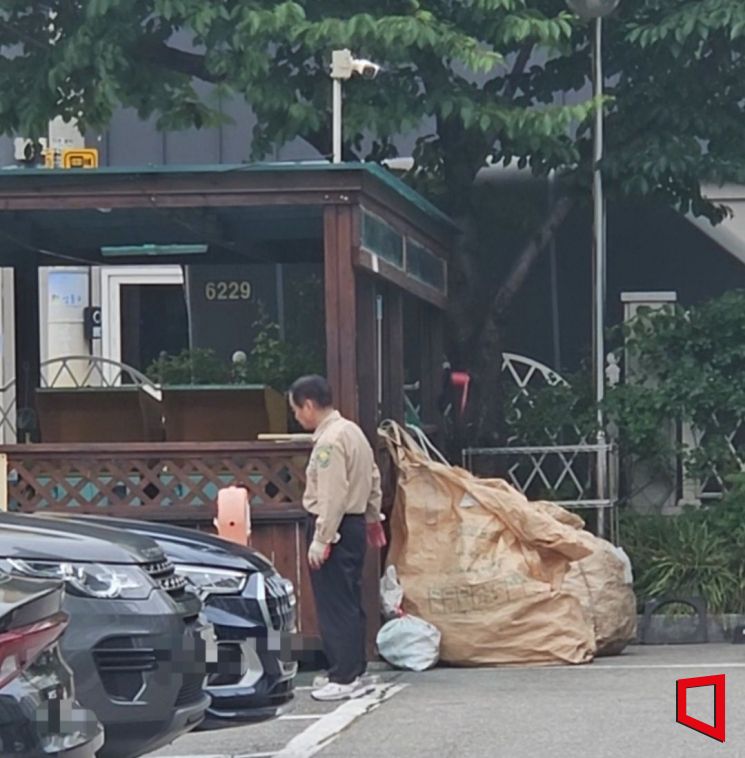 A security guard at an apartment complex of about 100 households in Seongdong-gu, Seoul is sorting recyclables. Photo by Seungwook Park
In contrast, Mr. Park (77), who has been working for five years at an apartment complex with over 1,300 households, has no time to look around as he separates boxes, glass, and PET bottles. Because the complex is so large, trash keeps piling up every moment, turning recycling into a constant battle. Even after finishing the recycling, he often gets up from the security office to check the recycling area again, just in case. If the recycling is not done properly, the garbage collection truck, which comes twice a week, will not take the trash away.
Same Work, Different Hardships
Both security guards work the same hours and receive the same level of monthly salary. Both Park and Lee work every other day, from 6 a.m. to 6 a.m. the next day. Their monthly salary is about 2.4 million won. Their basic duties include patrolling, cleaning, recycling and other complex management tasks, and handling residents' complaints.
That day, even after finishing the recycling, Lee continued to be conscious of his surroundings. When the reporter spoke to him, he would only answer from a spot behind the security office where no one could see. Lee said, "Because the complex is small, there is only one security office and one main gate, so the security guard is easily visible to residents," and added, "Not only passing residents, but also people looking down from above sometimes complain." He continued, "Basic duties are important, but in the end, it's all about reading the room from start to finish," and added, "I have to make sure nothing negative is mentioned at the residents' representative meeting held once a month."
Taking a vacation is out of the question. In this complex, only two security guards including Lee work in shifts, so there is no one to cover in their absence. Lee confessed, "Since there are no vacations at all, it's hard to even see my family during holidays," and added, "Because it's a small apartment, if I take time off, there's no one to replace me."
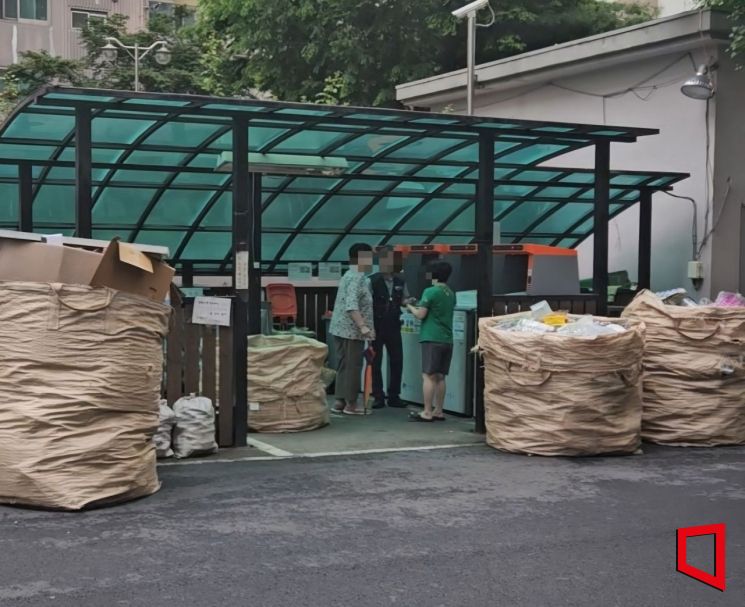 A security guard at a complex of about 1,300 households in Seongdong-gu, Seoul, is explaining the recycling separation method to residents. Photo by Park Seungwook
Park's hardships are no less than Lee's. Because the complex is large, five security guards work the same shift and can take five days off per year, but complaints from residents pour in constantly. While Lee handles complaints from about 100 households alone, Park has to deal with complaints from more than twice as many, about 260 households. Every issue in the complex, from elevator breakdowns to requests to fix sinks, is reported to Park. When the phone rang in the security office, Park hurriedly ran to answer it.
Late at night, he has to deal with intoxicated residents. When a resident causes a disturbance in the complex after drinking in the early morning, he wakes up to calm the person down. He said, "When a drunk resident comes, it's not just about shouting; sometimes they don't go home and fall asleep on the street," and added, "When I try to help them get home, they often curse at me, but I've gotten used to it now." He continued, "Because so many people live here, there are many complaints about noise between floors, suspicious people, and intoxicated residents, so I can hardly sleep at night, always on alert."
Although security guards work 24 hours, they practically have no break time. Because Lee works alone, he doesn't have any designated break time. His only real rest is eating a simple meal with side dishes brought from home, but even then, he has to watch the vehicle barrier at the entrance to make sure incoming cars can enter immediately. If he raises the barrier late, some residents make negative remarks.
Park has designated break times, but they are rarely observed. His official break times are from 9:00 to 9:30 a.m., noon to 2:00 p.m., and 5:00 to 6:00 p.m., but complaint calls come in at all hours, leaving him no time to rest. As a result, he runs to answer the phone the moment he hears it ring.
Despite all this, they have no choice but to keep smiling. If word spreads among residents that they are 'unfriendly,' it could lead to dismissal. Lee has seen three people quit at his current apartment, while Park has seen ten people leave.
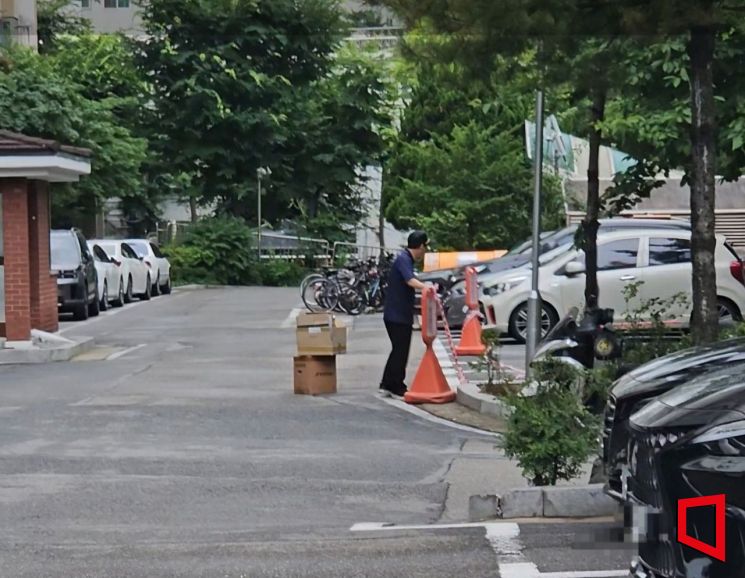 A security guard is organizing a no-parking sign at an apartment complex with about 1,300 households in Seongdong-gu, Seoul. Photo by Park Seungwook
"Residents' Personal Awareness Needs to Improve"
The number of elderly security guards is steadily increasing. According to the National Police Agency, the number of security guards aged 60 or older rose from 88,995 in 2020 to 121,962 last year. Their average monthly salary is 2.45 million won, which is more than 600,000 won higher than the average monthly income of seniors, including the national pension, which was 1.8 million won as of 2023.
Because of this, more and more elderly people are seeking jobs as security guards. Most register with security staffing agencies, and when a position opens up at an apartment complex, they apply and are hired through interviews. An employee at a security staffing agency in Jung-gu, Seoul, said, "More and more elderly people are applying, so some are rejected several times during interviews," and added, "Even after registering with the agency, some people wait more than three months before they can become a security guard."
Lee Byoung-Hoon, emeritus professor of sociology at Chung-Ang University, said, "Security guards still suffer from various forms of abuse, and the serious concerns about the quality of their work reflect the backward labor reality of our society," and added, "The main perpetrators of abuse are known to be residents' representatives, and it is necessary for them to reduce unnecessary complaints to security guards."
© The Asia Business Daily(www.asiae.co.kr). All rights reserved.














