Trump Announces 15% Tariff on South Korea
South Korea Promises 630 Trillion Won in Investments and Energy Purchases
On July 30 (local time), South Korea finalized a trade agreement with the United States under which South Korea promised $450 billion (approximately 630 trillion won) in investments and energy purchases. In return, the United States agreed to lower its reciprocal tariffs and automobile tariffs on South Korean goods from the existing 25% to 15%. This agreement was reached just two days before the expiration of the tariff suspension measures on August 1. President Lee Jaemyung is scheduled to visit the White House in two weeks to hold a summit with U.S. President Donald Trump and announce the large-scale investment plan.
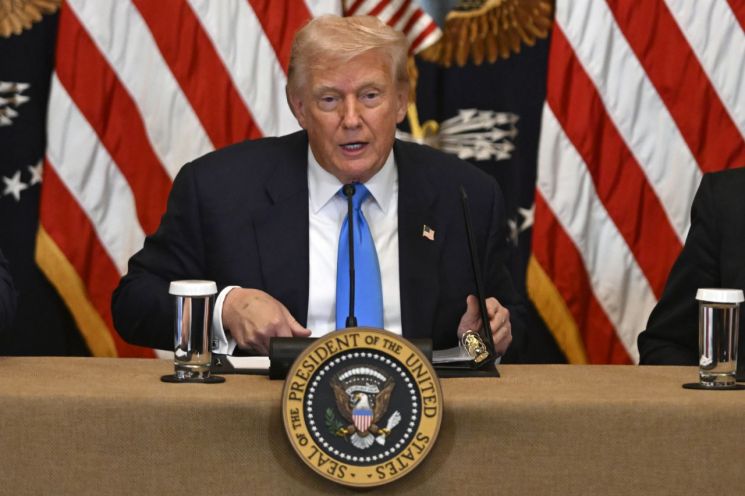
After meeting with the South Korean trade negotiation delegation on this day, President Trump announced via his social networking service (SNS), Truth Social, which he founded, "I am pleased that the United States has reached a complete and comprehensive trade agreement with South Korea."
President Trump stated, "We have agreed to impose a 15% tariff on South Korea," and added, "No tariffs will be imposed on the United States." He continued, "South Korea has agreed to fully open its market to trade with the United States and to accept American products such as automobiles, trucks, and agricultural goods." However, under the existing Korea-U.S. Free Trade Agreement (FTA), South Korea already applies a 0% tariff on most U.S. imports.
The 15% tariff agreed upon is significantly lower than the 25% initially notified by President Trump in his letter. This is the same condition as the agreements reached between the United States and Japan and the European Union (EU). South Korea had set '15% or lower' as its bottom line in the negotiations. President Trump also effectively set 15% as the minimum tariff threshold, so this is considered the lowest realistically achievable rate.
In return, South Korea pledged a total of $450 billion in investments and energy purchases in the United States.
President Trump stated, "Under this agreement, South Korea will provide $350 billion to investment destinations owned and controlled by the United States and directly designated by me as President." He also explained, "South Korea will purchase $100 billion worth of liquefied natural gas (LNG) and other energy products and has also agreed to make additional large-scale investments for its own investment purposes."
This agreement structure is similar to those with Japan and the EU, where they lowered tariffs to 15% (previously Japan 25%, EU 30%) and promised large-scale investments and market opening to the United States. Previously, Japan promised $550 billion and the EU $600 billion in investments in the United States. Notably, the EU also agreed to purchase $750 billion worth of U.S. energy products, bringing the total 'gift package' to $1.35 trillion.
President Trump also mentioned that President Lee Jaemyung will visit the White House in two weeks for a bilateral summit.
He emphasized, "This (large-scale) investment will be announced at the bilateral summit to be held during President Lee Jaemyung's visit to the White House within the next two weeks," and added, "I congratulate the new president on his election victory and look forward to future cooperation."
Lastly, President Trump expressed his gratitude to the (South Korean) trade delegation in attendance, stating, "It was an honor to meet with them and discuss South Korea's remarkable achievements."
With this agreement, South Korea has avoided the 'worst-case scenario' in which its companies would have faced disadvantages in the U.S. market compared to Japan and the EU. The United States also lowered its automobile tariffs on South Korea from 25% to 15%. Although the detailed terms have not yet been disclosed, if the automobile tariff is not reduced to 12.5%, South Korea is expected to have difficulty maintaining a competitive edge over Japan. Before the United States imposed a blanket 25% high tariff on all imported automobiles in May, South Korea had enjoyed a 0% tariff under the Korea-U.S. FTA, while Japan had been subject to a 2.5% tariff. If both South Korea and Japan are subject to the same 15% automobile tariff, South Korea will lose its previous price competitiveness advantage.
Meanwhile, this trade agreement was reached just two days before the expiration of the tariff suspension measures on the first of next month. Compared to Japan and the EU, the South Korean government was relatively slower in negotiations, but it mobilized the highest-level negotiation channels in the fields of economy, industry, and trade to conduct intensive talks with the United States until the last minute. The negotiations faced difficulties, particularly due to differences over the scale of investment in the United States. The South Korean government proposed an investment plan of $100 billion plus alpha, but the United States insisted on its original demand of around $400 billion, and the gap could not be bridged. Ultimately, South Korea significantly increased its investment pledge as a condition for reaching the trade agreement with the United States.
© The Asia Business Daily(www.asiae.co.kr). All rights reserved.











