Establishing Discharge Strategies Through Virtual Simulation
24/7 Integrated Situation Room for Dams and Weirs Nationwide
Only 2 Out of 20 Multipurpose Dams Opened Floodgates
Securing Flood Season Water Storage Over Three Times the Standard Capacity
Korea Water Resources Corporation (K-water) is being recognized for minimizing damage during the record-breaking torrential rains that swept across the nation in mid-July, thanks to the stable operation of its multipurpose dams. In particular, proactive measures to secure water storage capacity and the use of core water management technologies based on digital twin systems played a significant role in preparing for irregular and unpredictable rainfall caused by climate change.
According to K-water, despite the prolonged heavy rain that began on the 16th, only two out of the 20 multipurpose dams nationwide?Namgang Dam and Boryeong Dam?actually opened their floodgates. The remaining 18 dams retained all incoming water without releasing it, focusing on preventing downstream flooding. Especially in the Chungcheong and southern regions, where rainfall was heaviest, dams such as Yongdam, Daecheong, Juam, Hapcheon, and Miryang successfully maintained stable water levels, ensuring the safety of downstream residents despite the torrential rain.
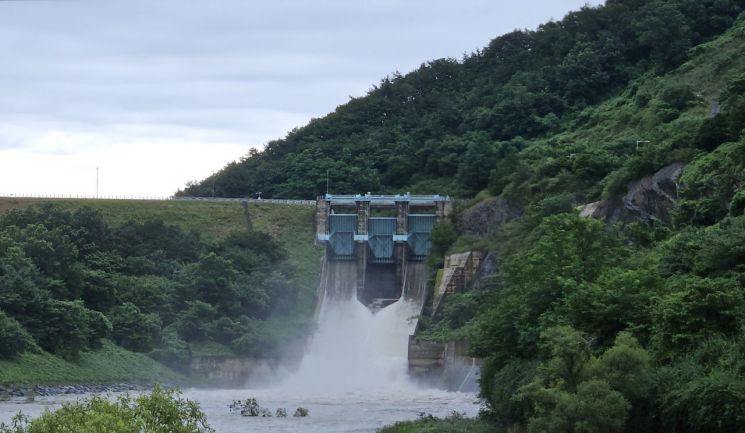 Around 7 p.m. on the 17th, about 200 tons per second of water discharge was being conducted at Boryeong Dam located in Jusanmyeon and Misanmyeon, Boryeong City, Chungnam. (Photo by Korea Water Resources Corporation)
Namgang Dam: Minimal Gate Opening Despite Inflows 1.6 Times the Design Limit
Namgang Dam serves as a representative case in this flood response. Located in Jinju, Gyeongnam, the dam received a staggering 529mm of rainfall over four days from July 16 to 20. On July 19, intense rainfall of 25mm per hour continued for more than six hours. Around 3 p.m. on the same day, the dam recorded an inflow of 16,951 cubic meters per second, far exceeding its design standard of 10,400 cubic meters per second and setting a new record. This surpassed the previous record of 14,818 cubic meters per second set during Typhoon Rusa in 2002.
The dam’s water level surged by 7.5 meters in just six hours, leaving only 27 centimeters below the planned flood level of 46 meters above sea level, creating a crisis situation. K-water responded by utilizing pre-secured flood control capacity, limiting the outflow to 3,750 cubic meters per second?just 22% of the design standard?to manage the water level.
The core technology behind K-water’s response is the digital twin-based water management platform ‘Digital GARAM+.’ ‘Garam’ is a pure Korean word meaning ‘river.’ This innovative solution integrates digital technology to enable smart and efficient water management. The platform establishes a digital virtual world identical to the real water management environment, allowing for advance simulations of possible scenarios and supporting on-site decision-making with the results.
Specifically, the system visualizes flood-prone areas in real-time 3D spatial data, analyzes potential inundation zones for each release scenario in advance, and establishes optimal release strategies. It integrates a wide range of data necessary for water management, including water levels, rainfall, facility specifications, and flood risk maps. The platform also overlays flood simulation results on high-resolution topographical data, enabling precise identification of flood risk areas. Additionally, it visualizes flood prediction analyses in digital space based on real-time meteorological and radar images and hydrological data from the Korea Meteorological Administration, allowing for scenario-based release decisions.
In practice, during the recent torrential rains, the operating teams of major dams, including Namgang Dam, used Digital GARAM+ to identify downstream village flood risks in advance when considering gate openings. They then adjusted their water level management strategies accordingly, achieving ‘proactive flood response.’ A K-water official emphasized, “This platform enables precise decisions that reflect even a 1cm change in water level. As a result, Namgang Dam was able to overcome an unprecedented torrential rain event without downstream flood damage.”
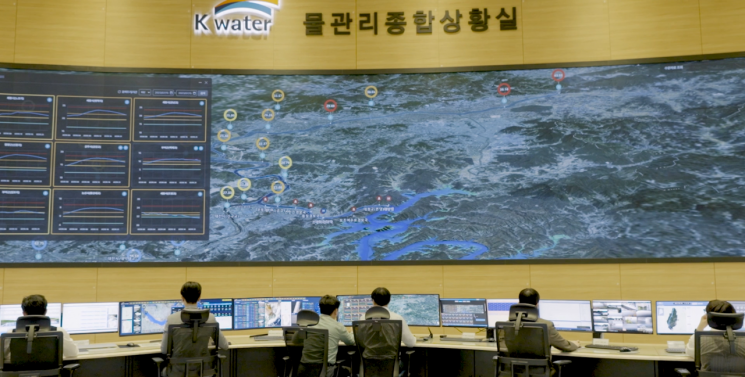 Employees are managing water through the digital twin big board at the Water Management Comprehensive Situation Room in the Daejeon headquarters of Korea Water Resources Corporation. (Photo by Korea Water Resources Corporation)
Integrated Water Situation Room Operates 24/7 as Disaster Response Command Center
Digital GARAM+ is enabled by the 24/7, year-round operation of K-water’s Integrated Water Situation Room, the company’s central control center. The Situation Room provides comprehensive disaster response?covering floods, droughts, algal blooms, and more?by real-time monitoring of the operation status of 67 dams and weirs nationwide, as well as the floodgates of major connected rivers.
Here, staff can simultaneously monitor floodgate information (inflow, outflow, dam water levels), weather data (satellite and radar images, rainfall), water quality data (cyanobacteria, chlorophyll-a concentration, water temperature), and hydropower generation status. This enables immediate response measures in crisis situations. In the face of rapidly changing climate conditions, where even dam water levels and outflow rates must be managed precisely to the second, the Situation Room serves as a vital control tower.
For this year’s flood season (June 21 to September 20), K-water anticipated heavier rainfall than usual and proactively secured additional water storage capacity. While the standard flood control capacity of multipurpose dams is 2.18 billion cubic meters, K-water prepared by emptying 6.84 billion cubic meters?more than three times the standard. This measure reflects the recent trend of frequent torrential rains exceeding dam design standards over the past several decades.
A K-water official stated, “This year, a level of complex disasters incomparable to previous years was expected, so we focused on proactive measures such as securing ample storage space before the flood season. By precisely determining the timing and volume of floodgate releases based on advanced technologies like digital twin systems, we were able to protect public safety.”
© The Asia Business Daily(www.asiae.co.kr). All rights reserved.













