Tesla AI Chip Order Signals Expansion of Automotive Electronics Collaboration
Samsung Electro-Mechanics MLCC, Samsung Display OLED to Join
Semiconductor Deficit Resolved, Securing Future Growth Engines
Lee Jae-yong's Strategy Gains Momentum in Global Management
As Samsung Electronics begins production of next-generation artificial intelligence (AI) semiconductors that will help build the 'Tesla ecosystem,' expectations are rising that this collaboration will expand beyond simple chip supply to encompass the entire automotive electronics (electronic and electrical equipment) sector. Starting with the foundry (semiconductor contract manufacturing) division of Samsung Electronics, major affiliates such as Samsung Electro-Mechanics, Samsung Display, and Samsung SDI are expected to join in, raising the possibility of a group-wide, sequential 'automotive electronics package deal' that will deepen the level of cooperation.
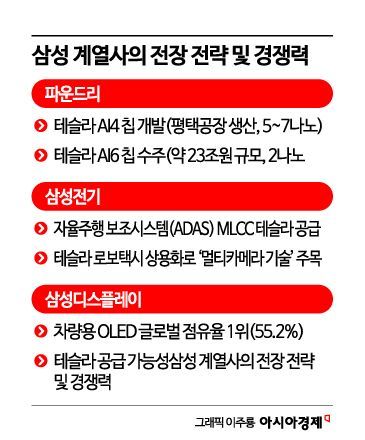
According to the electronics industry on the 29th, following Samsung Electronics, Samsung Display is also strongly mentioned as a potential supplier to Tesla. Samsung Display has long focused on selling OLEDs for vehicles, and since 2023, it has ranked first globally in both shipments and sales. As of last year, it held a dominant global market share of 55.2%. The fact that Tesla's purchasing executives visited Samsung Display earlier this year lends further weight to these observations.
Expectations that the collaboration between Samsung Electronics and Tesla will develop into an 'automotive electronics package deal' are based on the synergy among Samsung affiliates. This is the result of securing technological competitiveness across key areas, from AI chips to camera modules and displays.
Samsung Electro-Mechanics already supplies Tesla with automotive electronic components such as multilayer ceramic capacitors (MLCCs) used in advanced driver-assistance systems (ADAS). MLCCs are core components that store and release electricity, and are used in virtually all devices, earning them the nickname 'the rice of the electronics industry.' High-value-added products in this category can fetch hundreds of millions of won, even for a small wine glass's worth. While a typical vehicle requires at least 3,000 MLCCs, electric vehicles use around 15,000 MLCCs. Samsung Electro-Mechanics views this field as a future growth engine and is focusing its capabilities on high-value-added product lines. The growing spotlight on Samsung Electro-Mechanics' multi-camera technology, as Tesla moves to commercialize robotaxis this year, is also noteworthy.
Samsung SDI is also cited as a potential mid- to long-term partner for Tesla as the latter's battery demand increases. Its next-generation batteries, which combine energy density and safety, are considered well-suited for Tesla's premium electric vehicle lineup.
Samsung's automotive electronics strategy is seen as a reflection of Chairman Lee Jae-yong's vision. The first merger and acquisition he undertook after becoming a registered director was Harman, for which he spent $8 billion (about 9.4 trillion won) in 2017. This decision led to securing automotive electronics competitiveness across the group, including semiconductors, Samsung Electro-Mechanics, and Samsung Display. The acquisition process for the U.S. company Masimo's audio division, into which $350 million (about 500 billion won) was invested recently, is also scheduled to be completed within the year.
In particular, Samsung Electronics and Tesla have maintained active exchanges to secure next-generation competitiveness, including joint development of fully self-driving (FSD) chips. In May 2023, Chairman Lee met with Elon Musk, CEO of Tesla, at Samsung's North America Semiconductor Research Center to discuss cooperation. In April of this year, it was reported that Tesla's senior executives visited both the foundry and Samsung Display in succession. The fact that Samsung's top semiconductor executives have visited the U.S. several times recently, and that Han Jinman, who attended the Lee-Musk meeting as Executive Vice President overseeing the Americas and is now head of the foundry division, are cited as key links.
Within and outside Samsung Electronics, there is a view that this contract could not only serve as a turning point for the group by resolving deficits in the semiconductor division, but also add momentum to Chairman Lee's global management activities now that legal risks have been cleared. In the business community, it is expected that Chairman Lee will attend the 'Google Camp' in Sicily, Italy at the end of this month to discuss business issues and the latest technology trends with the heads of big tech companies, including Google.
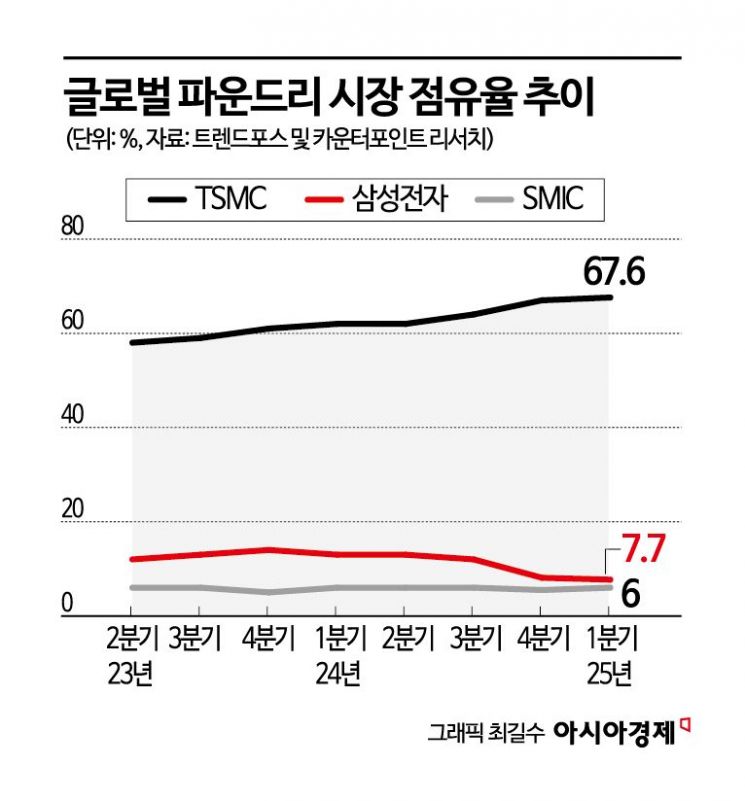
Meanwhile, Samsung Electronics' decision to begin operations at the Taylor plant ahead of the U.S. government's announcement of semiconductor tariff items is expected to be a positive factor. However, some raise concerns that additional investment demands from the U.S. government could increase the burden. In the semiconductor market, there is a widespread view that if Samsung Foundry can prove its technological prowess and mass production stability in advanced processes through this order, it is highly likely to secure Tesla as an anchor client and win further orders from other big tech companies.
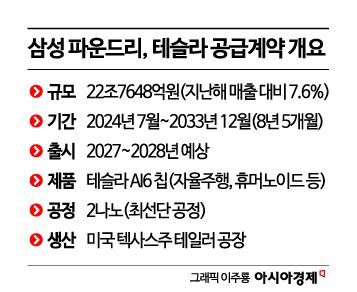
The AI6 chip ordered by Tesla from Samsung Electronics' foundry division is scheduled to be produced at the Taylor plant in Texas, USA. The 2nm (1nm = one-billionth of a meter) process, which Samsung Electronics aims to mass-produce within this year, is expected to be used.
Tesla's AI6 chip is an integrated AI chip that will be used not only for FSD but also for the Optimus humanoid robot and the Dojo supercomputer. This means it is a core component that will be deployed throughout the Tesla ecosystem, including vehicles and humanoids. The AI4 chip currently under development by Samsung Electronics uses a 5-7nm process, while the AI5 chip, which TSMC will mass-produce, uses a 3nm process. An industry insider commented, "Since the AI6 chip, which will use the 2nm process, is a next-generation chip crucial to Tesla's future, it means the foundry division has received a preliminary passing grade in terms of yield and performance."
© The Asia Business Daily(www.asiae.co.kr). All rights reserved.













