10 Local Companies Declare Transition to RE100... Governance Strengthened
Gwangju Leads Metropolitan Cities in Solar Power Adoption, Pursues Energy Self-Sufficiency
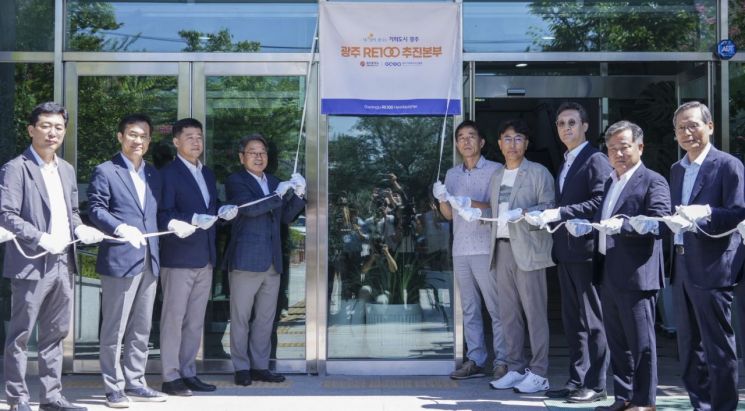 Gwangju Mayor Kang Gijeong attended the 'Gwangju RE100 Promotion Headquarters Plaque Unveiling Ceremony' held on the morning of the 28th at the Gwangju Climate Energy Promotion Agency in Seo-gu, where he unveiled the plaque with Go Sangyeon, director of the Gwangju Climate Energy Promotion Agency, and other guests. Provided by Gwangju City
The city of Gwangju has officially launched the 'Gwangju RE100 Promotion Headquarters' and is set to accelerate its Gwangju-style energy transition toward becoming an 'RE100 City Gwangju.' This initiative is in line with President Lee Jaemyung's energy transition policies, such as the creation of RE100 national industrial complexes, and aims to expedite the realization of Gwangju as a 2045 carbon-neutral city.
On July 28, the city held an unveiling ceremony for the 'Gwangju RE100 Promotion Headquarters' signboard at the Gwangju Climate and Energy Promotion Institute. The ceremony was attended by Mayor Kang Gijung, Gwangju City Council member Park Pilsun, Korea Climate and Energy Promotion Institute President Ko Sangyeon, Gwangju Urban Corporation President Kim Seungnam, Future Mobility Promotion Institute President Kim Seongjin, Korea Energy Agency Regional Headquarters Director Jang Seungchan, and about 50 other officials from related organizations and companies.
The Promotion Headquarters will serve as the control tower and execution body for realizing 'RE100 City Gwangju' by adding two PhD-level research fellows and hiring one master's-level professional researcher at the Gwangju Climate and Energy Promotion Institute.
The main tasks include, in cooperation with Gwangju City: ▲ promoting the establishment of government-led RE100 industrial complexes ▲ supporting RE100 companies linked to agrivoltaic solar power ▲ facilitating the transition to renewable energy through the designation of distributed energy special zones ▲ and expanding public-led urban solar power initiatives.
As an inland city with limitations in renewable energy production, Gwangju is attracting attention as an optimal location for the government’s envisioned RE100 industrial complexes because it can efficiently utilize renewable energy electricity produced in nearby regions without waste.
On the same day as the Promotion Headquarters unveiling, the city also held the 'RE100 Preliminary Enterprise Declaration Ceremony.' At the ceremony, 10 local companies participating in the Ministry of Trade, Industry and Energy’s 'RE100 Full-Cycle Process Support Technology Development and Demonstration Project' officially declared their transition to RE100.
Additionally, at the 'Gwangju RE100 Seminar' held that day, the following were shared: ▲ 'Strategies for Expanding Renewable Energy in Gwangju' by Jang Seungchan, Head of the Gwangju-Jeonnam Branch of the Korea Energy Agency ▲ and 'New Government RE100 Policies and Gwangju’s Response Strategies' by Park Dongwon, Head of the Advanced Industrial City Research Office at the Gwangju Research Institute.
Gwangju City is currently pursuing various projects to achieve RE100, including full-cycle process support technology development and demonstration, and the establishment of energy self-sufficiency infrastructure in advanced industrial complexes. The city also has the highest solar power installation rate among all metropolitan and special cities nationwide.
Going forward, the city plans to accelerate its transition to a 'sustainable energy city' by using the 'Gwangju-style RE100 policy model' as a foundation to realize RE100 within industrial complexes, expand support for companies, and connect renewable energy with the southwestern region.
Mayor Kang Gijung stated, "Gwangju is creating opportunities for development centered on artificial intelligence (AI) and the mobility industry, while Jeonnam is focusing on the energy industry. AI, mobility, and RE100 will be the future growth engines for Gwangju and Jeonnam, and will redraw the industrial map of Korea."
Mayor Kang added, "The Gwangju RE100 Promotion Headquarters must become the center of public-private cooperation to systematically promote the expansion of renewable energy, demand management, and the strengthening of energy governance. I hope that the Gwangju-style RE100 model will become the standard for energy self-reliant cities representing Korea."
© The Asia Business Daily(www.asiae.co.kr). All rights reserved.












