A technology that precisely removes the gene responsible for progeria using gene-editing scissors has been developed in South Korea.
The Korea Research Institute of Bioscience and Biotechnology (KRIBB) announced on the 28th that Dr. Kim Sunwook and his research team at the Future Animal Resources Center have developed, for the first time in the world, a next-generation gene regulation technology that precisely suppresses the cause of progeria as a new therapeutic method.
 Dr. Sunwook Kim, Future Animal Resources Center. Provided by Korea Research Institute of Bioscience and Biotechnology
Progeria is a genetic disorder in which the skin begins to wrinkle and the bones and blood vessels age rapidly from about one to two years after birth. The average life expectancy is only 14.5 years. It is classified as a rare and intractable disease, occurring in only one out of eight million people. Until now, there had been no treatment that could completely cure the disease.
So far, 'Lonafarnib (Zokinvy)' has been the only treatment approved by the US FDA. However, the cost for a single dose is as high as 1.4 billion KRW, and the life extension period is only about 2.5 years, making its effectiveness limited.
In addition, the need to use it in combination with other therapies and the risk of side effects have been limiting factors in using it as a fundamental solution for treating progeria.
However, with the development of the new therapy by KRIBB, the possibility of treating progeria has increased. The new treatment can precisely cut out the disease-causing gene (RNA) while maintaining normal functions, ensuring safety.
Progeria is caused by a single mutation in the LMNA gene. This mutation produces an abnormal protein called 'progerin' inside cells. This protein damages the structure of the cell nucleus and accelerates cellular aging. As a result, progeria patients experience weakened bones and hardened blood vessels, which eventually leads to the failure of major organs.
To address this, the research team created an RNA scissor (RfxCas13d, progerin gRNA) that can accurately distinguish and target the progerin gene from the normal gene. This RNA scissor can precisely remove only the disease-causing protein without damaging normal proteins.
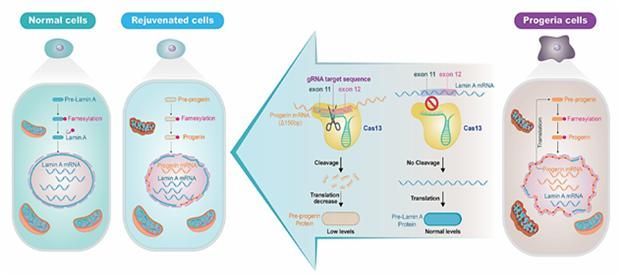 Mechanism of Action and Expected Effects of RNA-Targeted Gene Therapy Representative Diagram. Provided by Korea Research Institute of Bioscience and Biotechnology
In particular, this technology regulates only RNA without affecting DNA, making it significantly safer than existing gene-editing technologies such as CRISPR-Cas9. In addition, there is almost no risk of accidentally cutting other genes, and even if another gene is cut, it can be reversed, making it an innovative therapeutic method.
When the research team applied the RNA therapy to a mouse model with the progeria gene, they observed noticeable improvements in progeria symptoms such as hair loss, skin atrophy, spinal deformities, and reduced motor abilities.
Most notably, as body weight increased, the functions of the reproductive organs, heart, and muscles recovered, making the mice appear almost as healthy as normal mice.
KRIBB believes that this research opens up the possibility of not only treating diseases but also precisely controlling the fundamental causes of aging. In fact, the research team confirmed that progerin gradually increases in the skin cells of elderly individuals and obtained experimental results showing that the RNA scissor technology can partially suppress natural aging processes.
Dr. Kim Sunwook, the lead researcher, stated, "This technology can be applied to more than 15% of other genetic diseases caused by RNA editing errors, as well as progeria," and added, "The RNA therapy developed by our team will become a platform technology that can be expanded to treat aging-related diseases, as well as cancer and neurodegenerative diseases in the future."
© The Asia Business Daily(www.asiae.co.kr). All rights reserved.













