"Improve Working Conditions Instead of Forcing Sacrifice"
More Than Half of All Employees Are in the Lowest Ranks
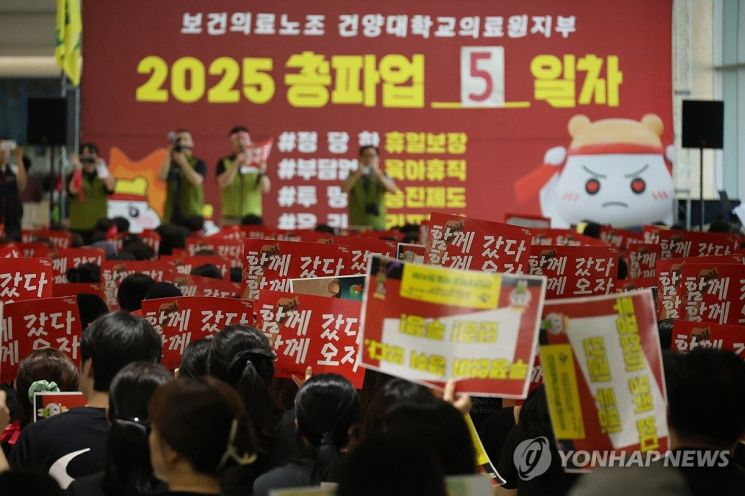
The labor union of Konyang University Hospital, a major general hospital in Daejeon, held a launch ceremony and began a general strike on July 28.
Out of approximately 2,000 employees at Konyang University Hospital, 1,097 are union members. Most of them are nurses, and the rest include radiologic technologists, occupational therapists, physical therapists, and clinical pathologists.
The Konyang University Medical Center branch of the Korean Health and Medical Workers' Union Daejeon-Chungnam Regional Headquarters held a general strike launch ceremony and a press conference in the hospital lobby that morning. They condemned Konyang University Medical Center, urging, "Do not force only medical professionals to make sacrifices. Improve working conditions."
They argued that although Konyang University Medical Center has grown into a major general hospital 25 years after its opening, improvements in workers' treatment have been thoroughly neglected.
The union pointed out, "Wages at Konyang University Medical Center are up to 30% lower compared to other private university hospitals of the same level. Even though we still work six days a week, we do not receive fair compensation. Due to an unreasonable personnel system, opportunities for promotion are deprived, and more than half of all employees are concentrated in the lowest ranks."
They continued, "We will change the outdated practices and culture of Konyang University Medical Center, such as the low-wage structure, insufficient staffing, abnormal organizational culture, and unfair personnel system. The foundation must respond responsibly to the union's legitimate demands."
Patients and caregivers visiting the hospital watched the health and medical workers' union's general strike launch ceremony with great interest.
A 70-year-old cancer patient, surnamed Lee, who has been visiting this hospital for over 10 years, learned about the general strike while visiting for outpatient treatment.
Mr. Lee said, "Older patients like me are naturally worried about the strike. I hope the issue is resolved quickly so that we can visit the hospital without concerns."
Yang Insuk, a 65-year-old local resident, said, "Having a major general hospital in the neighborhood is reassuring and good for us. I believe that improving the working conditions and treatment of employees will also improve the quality of hospital services, which will benefit citizens like us. I support the voices of those medical professionals."
Some patients and caregivers loudly protested against the union.
A middle-aged man strongly protested, saying, "My son once nearly died from a sudden cerebral hemorrhage as we had to go to nine different hospitals. How can it be right to strike at the expense of patients? Do not harm patients."
On the first day of the general strike, there have not yet been any disruptions in medical services. However, if the strike continues for an extended period, there are concerns about possible disruptions in patient care.
A caregiver, Ahn Changnam, aged 64, who visited the hospital for his cancer-stricken husband's outpatient treatment, said, "Today, my husband's inflammation levels were high, so I asked if hospitalization was possible. I was told that, due to the general strike, even patients who are already admitted are being guided to discharge unless they are in serious condition."
A representative of Konyang University Hospital stated, "Even during the general strike, we are maintaining essential personnel in areas directly related to life, such as the emergency room and operating room, so we will take all possible measures to prevent any disruption in medical services. We are operating an emergency medical response team, and are minimizing disruptions by reallocating medical staff and reinforcing substitute personnel."
© The Asia Business Daily(www.asiae.co.kr). All rights reserved.












