US and EU Reach Dramatic Trade Agreement Five Days Before Tariff Suspension Ends
15% Tariff to Be Uniformly Applied to Most Items Including Automobiles
EU to Purchase $750 Billion in US Energy and Invest $600 Billion in the US
South Korea on High Alert... Economic Chiefs to Hold Final Talks on the 31st
The United States has decided to impose a 15% tariff on most imports from the European Union (EU), including automobiles. In response, the EU will open its market to the US tariff-free, purchase $750 billion worth of US energy, and make new investments in the US amounting to $600 billion. This agreement was reached just five days before the expiration of the mutual tariff suspension scheduled for August 1, thereby averting the feared transatlantic trade war.
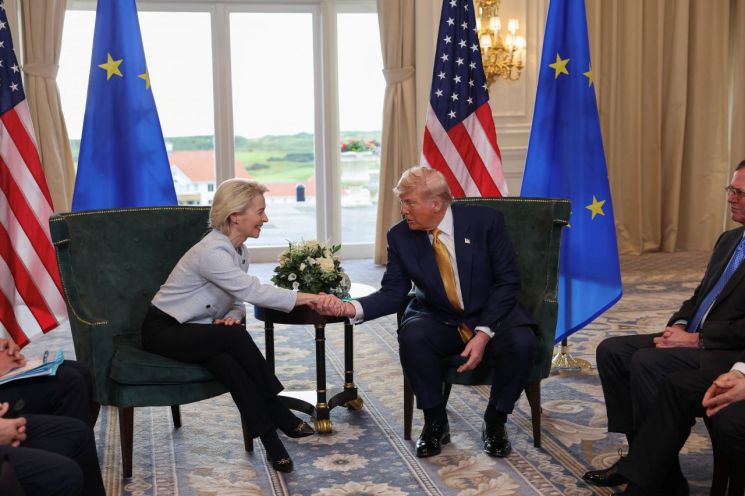
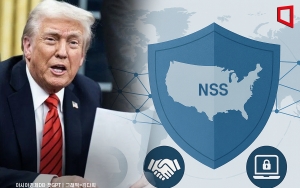
On July 27 (local time), US President Donald Trump held final tariff negotiations with Ursula von der Leyen, President of the European Commission, in Scotland, United Kingdom, and reached this agreement.
President Trump had initially announced a 30% reciprocal tariff on the EU, but in this meeting, he decided to lower it to 15%, half of the original rate. He emphasized, "This agreement is essentially finalized" and described it as "the largest deal ever made." The 15% tariff will apply to all items except for pharmaceuticals, steel·aluminum.
President von der Leyen also commented, "This trade agreement will bring stability and predictability."
Under this agreement, the EU will purchase $750 billion worth of US energy and make an additional $600 billion investment in the US, on top of existing investments. In addition, EU member states agreed to open their markets to the US tariff-free and to make large-scale purchases of US military equipment.
The 15% tariff rate that the US has decided to apply to the EU is the same as the rate agreed upon in the earlier deal with Japan. Japan lowered its reciprocal tariff rate set by the US from 25% to 15% in exchange for $550 billion in investments in the US and partial opening of its rice·automobile markets, and the tariff on automobiles was also adjusted to 15% per item.
As a result, the 15% tariff is effectively the lowest rate applied by the US to countries with which it runs a trade deficit, and it is expected to serve as the baseline for future negotiations with major trading partners. When asked by reporters before his meeting with President von der Leyen whether the EU could achieve a better outcome than 15%, President Trump drew a clear line, stating, "If better terms mean a lower tariff, that's not going to happen." Currently, the US applies a basic tariff rate of 10% only to the United Kingdom, which has a trade surplus with the US.
With the US concluding trade deals in succession with Japan and the EU, South Korea, whose negotiations have not yet been completed, is now on high alert. South Korea's reciprocal tariff rate stands at 25%, and in order for Korean companies to remain competitive in the US market, it is inevitable that this rate will need to be lowered to at least the 15% level applied to Japan and the EU. For the government, maintaining the 15% tariff is now a critical red line that must be defended.
Previously, the "Korea-US 2+2 Trade Consultation" was canceled unilaterally by the US just two days before the meeting. In this context, Deputy Prime Minister and Minister of Economy and Finance Koo Yooncheol is scheduled to hold final negotiations with US Treasury Secretary Scott Besant in Washington, D.C., on July 31, one day before the US deadline for tariff imposition on August 1. Currently, Minister of Trade, Industry and Energy Kim Jeonggwan is conducting preliminary negotiations in the US, and it is expected that Deputy Prime Minister Koo and Secretary Besant will finalize the details. In order to conclude the tariff negotiations, the government is now proactively considering additional opening of the agricultural market and expanding investments in the US, which had previously been set as 'red lines.'
© The Asia Business Daily(www.asiae.co.kr). All rights reserved.