Kim Jeonggwan Holds Back-to-Back Negotiations at U.S. Commerce Secretary's Residence
Both Tariff and Non-Tariff Barriers on the Table... Agricultural Products Included in Talks
Trump Departs for Scotland for Summit... 'Top-Down' Negotiation Approach Unlikely
Presidential Office: "A Mutually Beneficial Solution to Be Reached Before August 1"
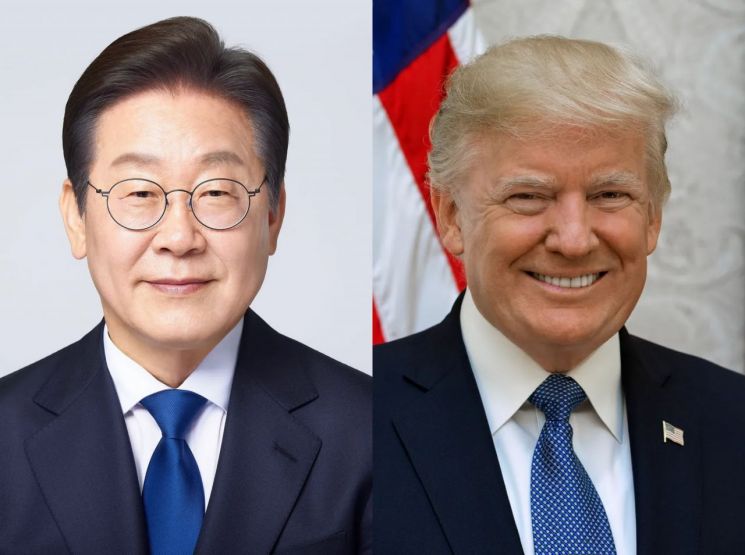
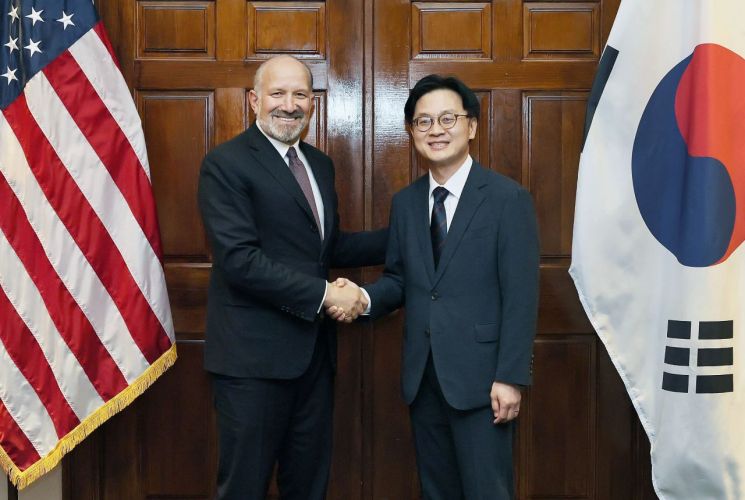
As the Donald Trump administration in the United States announced its plan to implement a 25% reciprocal tariff starting August 1, South Korea and the United States have entered the final stage of intensive negotiations toward a resolution on tariffs. The negotiation teams are treating this weekend as a critical juncture, postponing their return home in order to continue their all-out efforts. The South Korean government, led by Minister of Trade, Industry and Energy Kim Jeonggwan and Trade Negotiation Head Yeo Hangu, has been holding a series of negotiations in Washington, D.C. since July 24 (local time) with U.S. Secretary of Commerce Howard Lutnick and U.S. Trade Representative (USTR) Jamison Greer. In particular, on July 25 (local time), Minister Kim held a closed-door negotiation late into the night at Secretary Lutnick's private residence in New York, underscoring the importance of the talks.
In these negotiations, both countries have brought issues of tariff and non-tariff barriers to the table. The United States, in particular, is strongly demanding that South Korea increase its investment in the U.S. as a condition for reducing tariffs on major Korean export items such as automobiles and steel. Kim Yongbeom, Policy Chief at the Presidential Office, stated in a briefing after the trade strategy meeting on July 25 that "the United States showed considerable interest in the mutually beneficial proposal put forth by our side during negotiations between the Minister of Trade and Secretary Lutnick." However, he maintained a cautious stance, saying that the government would need to further observe the U.S. response to the specific proposals.
Initially, the government pursued negotiations with the United States as a 'package deal' linking various fields such as trade, security, procurement, and investment. However, it has recently adjusted its strategy. The U.S. has shifted to focusing separately on tariff and non-tariff issues, as shown in its negotiations with Japan. Last month, the U.S. reached an agreement with Japan to lower tariffs to 15% in exchange for securing a $550 billion (about 758 trillion won) investment fund. The South Korean government has proposed a $100 billion (about 137 trillion won) investment fund?smaller than Japan's?as leverage in the negotiations.
The issue of opening the agricultural market has emerged as the most contentious point in these negotiations. The government had previously set the opening of markets for key agricultural products such as rice and beef as a 'red line.' However, Kim, the Policy Chief, officially confirmed that "agricultural products have been included among the negotiation items," making some level of market opening for agricultural products inevitable. While the government has excluded sensitive items like rice and beef from the negotiation table for now, it may have to open parts of the market further if negotiations stall. If the markets for major U.S. agricultural products such as beef aged over 30 months, rice, potatoes, and apples are opened, the impact on the domestic agricultural sector is expected to be significant.
Discussions on the Korean government's Online Platform Law (Onple Law), which has raised concerns in the U.S. political sphere, have been temporarily suspended. The U.S. has opposed the Onple Law, arguing that it regulates American companies, and the South Korean government has decided not to provoke the U.S. government during the negotiation period. On July 24 (local time), the U.S. House Judiciary Committee, under Chairman Jim Jordan, sent a letter to the Korea Fair Trade Commission expressing concerns about the Onple Law. Wi Seongrak, Director of the National Security Office, stated, "The National Assembly is aware that the Onple Law is a major issue for the U.S. in trade matters," adding, "The government and the ruling party are in constant communication on major current issues."
Compared to the trade negotiations, security negotiations led by Director Wi are proceeding relatively smoothly. The government is considering partially accepting sensitive U.S. demands, such as increasing South Korea's share of the cost for stationing U.S. forces and raising defense spending relative to GDP, which has reportedly helped create a breakthrough in the talks. Director Wi stated, "Security consultations are somewhat more stable than those in other areas," and evaluated that "the positive momentum in security negotiations is expected to have a virtuous effect on trade negotiations as well."
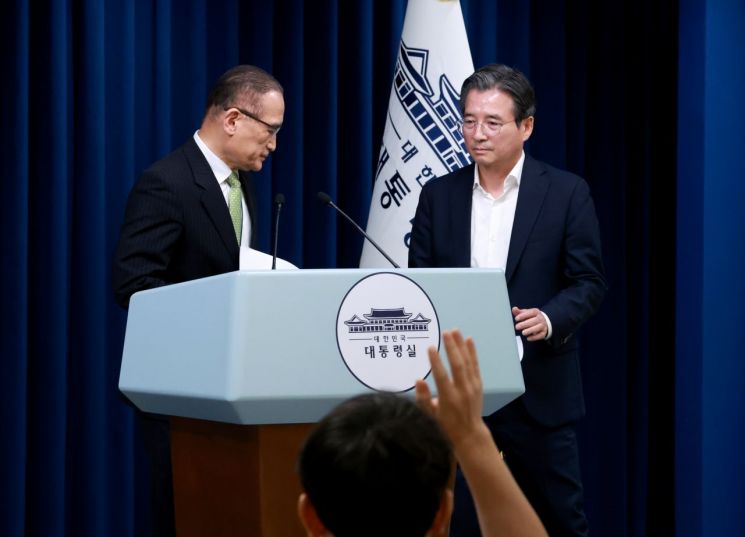
The Presidential Office plans to hold another trade strategy meeting on the afternoon of July 26 in New York, following the meeting on July 25, to develop additional negotiation strategies based on the results of the ongoing talks. Attendees will include Policy Chief Kim, Security Director Wi, Deputy Prime Minister and Minister of Economy and Finance Koo Yooncheol, Minister of Foreign Affairs Cho Hyun, and Chief Presidential Secretary for Policy Coordination Yoon Changryeol. As President Donald Trump has departed for Scotland to negotiate with the European Union (EU), the possibility of a 'top-down' approach through direct talks between the leaders has become unlikely. Accordingly, the government aims to reach a final agreement through a 'bottom-up' approach, focusing on ministerial-level working negotiations before the tariffs take effect on August 1.
Policy Chief Kim commented on the progress of the U.S.-Korea negotiations, stating, "South Korea and the United States have reaffirmed the importance of mutual cooperation in strategic manufacturing sectors such as shipbuilding and semiconductors, and have agreed to further specify ways to cooperate in the future." He added, "We have also reaffirmed our commitment to finding a mutually beneficial solution before August 1."
© The Asia Business Daily(www.asiae.co.kr). All rights reserved.













