More Than 100 Heat-Related Illness Cases for Three Consecutive Days
A 2.7-Fold Increase Compared to Last Year
As the sweltering heat continues day after day, the number of heat-related illness cases has surpassed 2,000. According to the Korea Disease Control and Prevention Agency, as of July 25, the cumulative number of heat-related illness cases this summer has reached 2,103. With record-breaking heat waves forecasted for the weekend, it is expected to be a difficult summer.
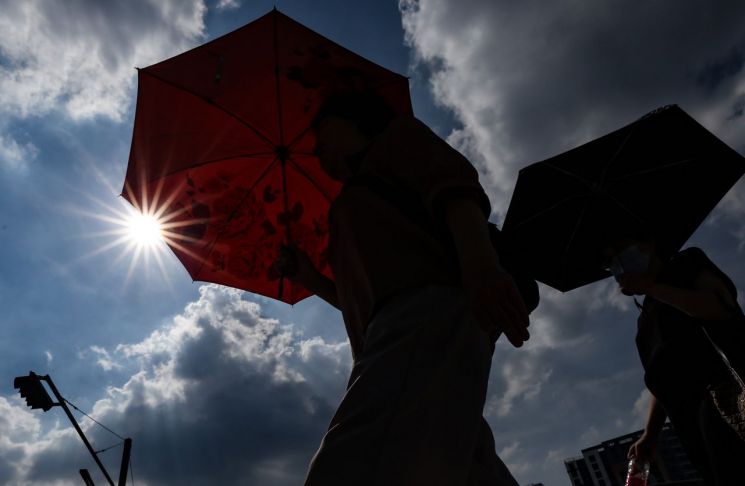 On the 23rd, when the heatwave warning continued in Daegu, citizens were walking with parasols in the plaza of Dongdaegu Station. Photo by Yonhap News
Yonhap News reported that fatal accidents among outdoor workers battling the scorching heat have also continued to occur.
In Pohang, North Gyeongsang Province, at around 12:23 p.m. the previous day, a Nepalese man in his 40s collapsed while descending a mountain after cutting grass. Responding to a report by a colleague at the scene, emergency responders arrived to find him showing convulsions and no pulse. He was transported to the hospital but was pronounced dead.
The daytime high in Pohang on July 24 was 33.6 degrees Celsius. A heat wave warning has been in effect in the area since July 22.
It was found that the man had been working on weeding with his group since 6 a.m. that day, despite the heat wave warning.
On the same day, at around 2:36 p.m., a woman in her 30s suffered heat cramps at a logistics center in Gosan-dong, Gwangju, Gyeonggi Province. At around 11:17 a.m., a Chinese worker in his 40s showed symptoms of heat cramps at a construction site in Hansu-ri, Hallim-eup, Jeju City, and was taken to the hospital.
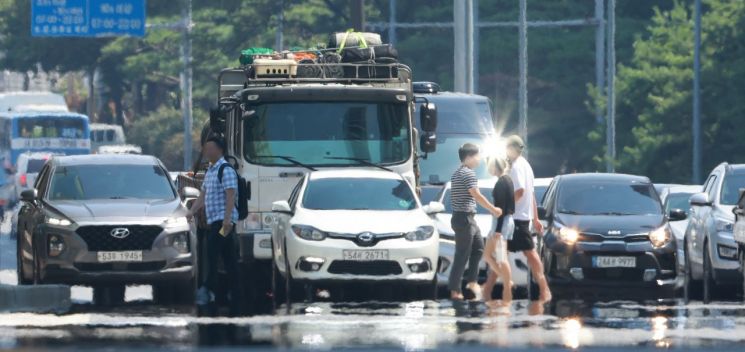 On the 25th, when heatwave warnings were issued in most regions nationwide, heat haze was rising on Yeouidaero in Yeouido, Yeongdeungpo-gu, Seoul. Photo by Yonhap News
The number of heat-related illness cases has also increased. According to the Korea Disease Control and Prevention Agency, the number of cases by region is as follows: Gyeonggi 408, North Gyeongsang 219, South Gyeongsang 191, Seoul 175, South Jeolla 140, Incheon 130, North Jeolla 120, South Chungcheong 91, North Chungcheong 88, Ulsan 86, Gangwon 76, Busan 72, Daegu 71, Jeju 38, Gwangju 34, Daejeon 25, and Sejong 15.
In particular, Busan has seen a 3.2-fold increase compared to the same period last year, when there were 17 cases. Among the heat-related illness cases in South Gyeongsang, one person died. Compared to the same period last year (71 cases), this is a 2.7-fold increase.
This year, the estimated number of deaths from heat-related illness has been reported as 10. Among all patients, heat exhaustion accounted for the largest proportion at 60.1%, followed by heat stroke (16.5%), heat cramps (14.1%), and heat syncope (8.0%). By age group, those aged 65 or older accounted for 31.4%. The main locations where cases occurred were workplaces (32.3%), fields (13.1%), and roadsides (12.6%).
Meanwhile, the Ministry of the Interior and Safety activated Level 1 of the Central Disaster and Safety Countermeasures Headquarters at 2 p.m. on this day and raised the heat wave crisis alert level to "serious." The crisis alert level is raised to "serious" when the daily maximum perceived temperature is expected to exceed 38 degrees Celsius for more than three consecutive days in at least 40% of the country. As of 10 a.m. on this day, heat wave advisories were in effect in 180 out of 183 special alert areas nationwide (98%).
© The Asia Business Daily(www.asiae.co.kr). All rights reserved.













