"Chaebol Privilege" vs "Market Revitalization" Face-Off
Policy Committee Chair and Lawmaker Clash on SNS
Ruling Party Faces Internal Conflict Over Economic Policy Direction
A debate has erupted within the Democratic Party of Korea over whether the separate taxation of dividend income constitutes a tax cut for the wealthy. When Jin Sungjoon, the party's Policy Committee Chair, expressed a cautious stance regarding the proposed revision of the stock dividend income tax system, Lee Soyoung, the lawmaker who introduced the relevant bill, issued a rebuttal.
On the 25th, Jin Sungjoon stated via social networking services (SNS) that the system revision could benefit only a very small number of conglomerates and thus should be approached with caution. While he agreed with the context behind the discussion of the system overhaul, he pointed out that dividend income is heavily concentrated among a tiny minority.
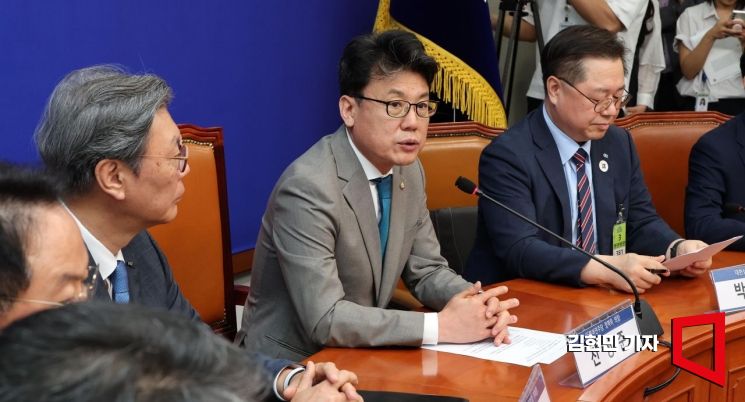 Jin Sungjun, Policy Committee Chairman of the Democratic Party of Korea, held a meeting with the vice chairmen of six economic organizations at the National Assembly on the 30th to gather opinions from the business community regarding the proposed amendment to the Commercial Act. Attendees included Park Iljun, Executive Vice Chairman of the Korea Chamber of Commerce and Industry; Kim Changbeom, Executive Vice Chairman of the Korea Economic Organization Association; Lee Donggeun, Executive Vice Chairman of the Korea Employers Federation; Jang Seokmin, Executive Director of the Korea International Trade Association; Oh Giwoong, Executive Vice Chairman of the Korea Federation of Small and Medium Business; Lee Hojun, Executive Vice Chairman of the Korea Association of Mid-sized Companies; and Jung Wooyoung, Vice Chairman of the Korea Listed Companies Association. 2025.6.30 Photo by Kim Hyunmin
Jin Sungjoon said, "As of 2023, 17,464 people, representing the top 0.1%, took 45.9% (13.8842 trillion won) of total dividend income. Expanding to the top 1%, they account for 67.5% (20.3915 trillion won) of all dividend income," adding, "In other words, 1 out of every 100 stock investors takes 70% of all dividend income."
Regarding this, he argued, "The revision of the dividend income tax system must be approached with caution," and warned, "Otherwise, only a tiny minority of stock conglomerates will benefit, while the vast majority of individual investors will receive little to no advantage." He continued, "It cannot be assumed that corporate dividends will necessarily increase as a result of the tax revision, but even if dividends do increase, if individual investors see only a few thousand won in gains while a handful of conglomerates reap tens of billions of won, can that really be called fair?"
Lee Soyoung Rebuts Jin Sungjoon's Claim of Tax Cuts for the Wealthy... Points Out Statistical Errors
In response, Lee Soyoung, who introduced the legislation related to the separate taxation of dividend income, countered Jin's claims on SNS. Without directly naming Jin Sungjoon, she argued, "Such claims are based on misunderstandings and reflect a failure to properly understand the statistics and the bill."
First, Lee Soyoung challenged the statistics cited by Jin Sungjoon regarding "dividend income received by the top 0.1%." She argued that the figures referenced "combine a broad range of data, including 'dividends from unlisted companies,' which are irrelevant to the current discussion," and pointed out, "The statistics do not include dividends received by pension funds and corporations, so they do not show how the total dividends of domestic listed companies are actually distributed."
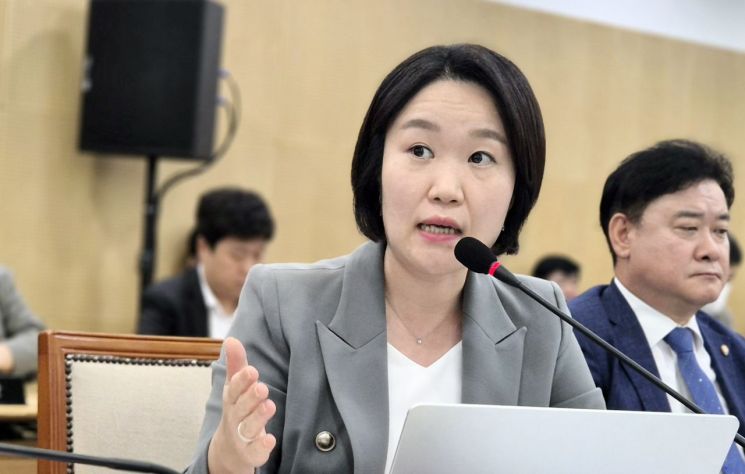
Lee Soyoung explained that if dividends increase, the greatest beneficiaries would be pension funds such as the National Pension Service. She stated, "If Samsung Electronics' dividends increase by 2 trillion won, the amount distributed to conglomerate families (including related parties) would be around 100 billion won (about a 5% combined stake)." She also pointed out that the current tax system is not tailored to dividends in terms of corporate profit allocation. Lee Soyoung argued, "On the premise that a company is exemplary in paying dividends, it is only reasonable to at least align the dividend income tax rate with the capital gains tax rate," adding, "From the perspective of major shareholders, this would create an incentive to strengthen dividends rather than considering a stake sale."
Regarding concerns over tax revenue shortfalls, she said, "The estimated decrease in tax revenue would be around 200 billion won," and argued, "If companies with a dividend payout ratio below 35% actively increase dividends to benefit from the revision, the total amount of dividends could rise, resulting in an overall increase in dividend income tax revenue."
She also emphasized that the separate taxation of dividend income is a measure to revitalize the capital market. Lee Soyoung asserted, "To propose a modest special provision for the advancement of the domestic capital market and then dismiss it outright as a 'tax cut for the wealthy' is not factually accurate, and even if there is some tax reduction, the extent is very limited." She stressed, "With the Lee Jaemyung administration being met with high expectations from the market immediately after its launch, the ruling party must not make the mistake of dampening the capital market by becoming mired in ideological debates."
© The Asia Business Daily(www.asiae.co.kr). All rights reserved.













