The National Institute of Forest Science has succeeded in optimizing the mass production process of cellulose nanofibers and securing advanced application technologies.
The Institute announced on July 25 that, through research conducted from 2021 to 2024, it has established a low-energy, high-efficiency mass production process model using domestically produced market pulp. It has also secured technologies to apply cellulose nanofibers manufactured through this process to high value-added fields such as air filters, all-solid-state battery separators, and biosensors.
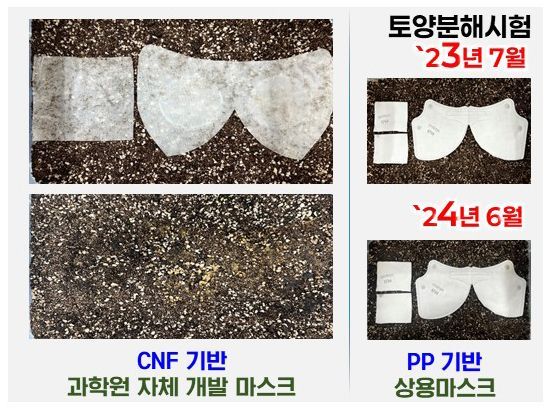 While cellulose-based masks undergo decomposition in soil within about one year, conventional PP-based commercial masks do not decompose and retain their original form during the same period. Provided by National Institute of Forest Science
With the acquired technology, the Institute can now precisely control the porous structure of cellulose nanofibers by utilizing their self-assembly properties.
Additionally, this has led to the development of core technologies such as eco-friendly filters for fine dust removal, water treatment filters for removing heavy metals and dyes, separators for solid electrolytes to prevent electrode short circuits, and temperature and pH-responsive sensors.
The research results can be accessed and reviewed through the publication "Optimization of Mass Production Process of Cellulose Nanofibers and Utilization Technology of Porous Structures Using Them" available on the library website of the National Institute of Forest Science.
Kwon Jaekyung, a researcher at the Department of Forest Biomaterials Research, stated, "This study is significant in that it has established a technology model linking the mass production and application of cellulose nanofibers," and added, "The Institute will continue to conduct research for the practical application of related technologies."
© The Asia Business Daily(www.asiae.co.kr). All rights reserved.












