NH Nonghyup Bank Analyzes 420 Million Consumer Records
Instant Rice Purchases Up 9.1%
Mixed Grain Instant Rice Purchases Jump 22.1%
The consumption of mixed grains is showing a clear upward trend, driven by the wellness trend.
On July 25, NH Nonghyup Bank announced that it had identified this trend by analyzing 420 million purchase records from Hanaro Mart by members of the NH Members program, the integrated membership of the Nonghyup group, from January 2022 to last month.
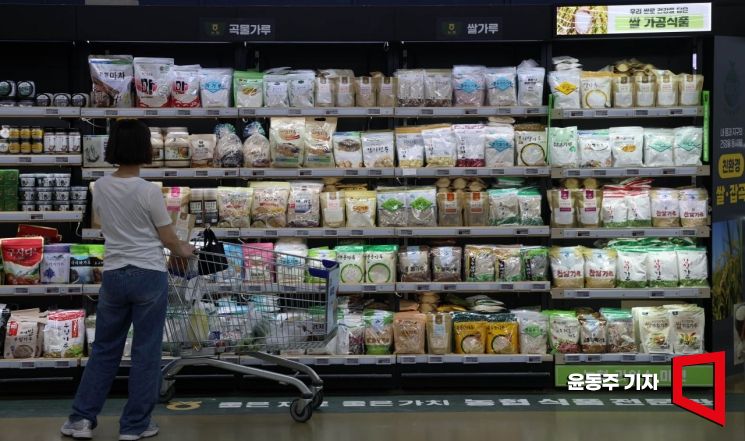 A processed food section in a large supermarket in Seoul. This photo is for illustrative purposes and is unrelated to the content. Asia Economy DB.
If the purchase amount of instant rice in 2022 is set at 100, it increased to 104 in 2023 and 111 in 2024, showing a steady rise. Among these, the proportion of mixed grain instant rice steadily increased from 15.6% in 2023 to 18.0% in 2024 and 20.2% in 2025.
Compared to 2022, the purchase amount of white rice instant rice increased by only 9.1% last year, while the purchase amount of mixed grain instant rice rose by more than double that rate, at 22.1%.
There were also differences by age group. The growth rate of mixed grain instant rice purchases was 39% among those in their 30s and younger, and 30% among those in their 40s. This is significantly higher than the rates for those in their 50s (22%), 60s (18%), and 70s and older (10%). According to NH Nonghyup Bank, black rice, brown rice, mixed grains, and five-grain blends were the most popular, and the bank analyzed that "the trend of seeking both convenience and nutrition through mixed grain instant rice is spreading more rapidly among younger generations."
Last year, among NH Members, the purchase share by grain type was highest for rice at 83%, followed by beans (6%) and barley (4%). The remaining 7% was other mixed grains. Among various mixed grain products, mixed grain sets accounted for the highest share at 21.1%, followed by beans (21%), barley rice (15%), red beans (8%), millet (8%), mung beans (6%), oats (4%), and other mixed grains (17%).
Regarding regional differences, NH Nonghyup Bank explained, "Rice consumption is decreasing and mixed grain consumption is increasing in the Seoul metropolitan area," and "in the Honam and Yeongnam regions, where the population has declined, both rice and mixed grain consumption are increasing."
© The Asia Business Daily(www.asiae.co.kr). All rights reserved.












