Park Urges Expulsion of Opposition Lawmakers Who Blocked Yoon's Arrest
Jung Proposes Prosecutor Disciplinary Act Allowing Dismissal for Serious Crimes
On July 25, eight days before the 8·2 Democratic Party of Korea National Convention, party leader candidates Jung Chungrae and Park Chandae each sought to win over party members by introducing so-called "strong laws," such as the Prosecutor Disciplinary Act and a resolution urging the expulsion of lawmakers who obstructed the arrest of Yoon Sukyeol. Although the two candidates expressed different views regarding Kang Sunwoo, who recently withdrew as a candidate for Minister of Gender Equality and Family, they are now competing to introduce bills favored by the party's core supporters in a last-minute effort to boost their approval ratings. It is also interpreted that both candidates focused on recovery efforts from heavy rainfall damage, making it difficult to create political events, which in turn fostered this legislative competition.
On the morning of the same day, Park held a press conference at the National Assembly's Communication Center and announced his intention to submit a resolution urging the expulsion of 45 People Power Party lawmakers who, on January 6, blocked the execution of an arrest warrant for then-President Yoon Sukyeol by the Corruption Investigation Office for High-ranking Officials (CIO). Previously, on January 6, the CIO attempted to execute an arrest warrant for President Yoon at the presidential residence in Hannam-dong. At that time, 45 People Power Party lawmakers surrounded the presidential residence and protested the execution of the arrest warrant by the CIO.
Park described them as "45 human shields who turned their backs on the law and public authority, focusing only on Yoon Sukyeol. They are clearly 'accomplices to insurrection.'" He then called out each lawmaker who had been present in front of the presidential residence at the time, stating, "They surrounded Yoon Sukyeol's residence, volunteering as 'human shields.' The law was halted, the Constitution was violated again, and the people and democracy were trampled."
He continued, "Even now, these individuals sit in the main chamber of the National Assembly, receiving salaries paid by the people, handling laws and reviewing budgets. Furthermore, they are using every possible means to undermine the Lee Jaemyung administration and hinder reforms. The reality that those who destroyed the Constitution are denying the legitimate authority of a democratic government cannot be left as it is," emphasizing his determination to ensure their expulsion.
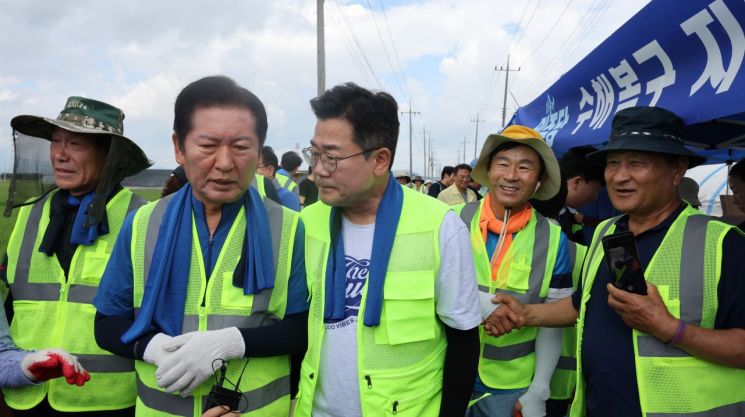
On the same day, Jung announced that he had introduced a bill allowing for the maximum penalty of dismissal for prosecutors who commit serious crimes. This move is interpreted as a response to Park's proposal of the Prosecutorial Past Affairs Committee Act, which would allow for disciplinary action, impeachment, and investigation of prosecutors if it is revealed through thorough investigation that the prosecution or indictment was unjust.
Under the current Prosecutor Disciplinary Act, prosecutors can only be subject to five types of disciplinary action?dismissal, removal, suspension, salary reduction, and reprimand?excluding dismissal, and the Prosecutors' Office Act stipulates that prosecutors cannot be dismissed except in cases of impeachment or a sentence of imprisonment or higher. For this reason, some have pointed out that this is inconsistent with the disciplinary measures applied to police officers, soldiers, and general public officials.
Jung stated, "Prosecutors are not a privileged class but ordinary public officials. By making it possible to dismiss prosecutors through disciplinary action, we will pursue procedural fairness and equity in disciplinary measures, and transform the organization to meet the public's expectations," adding, "If I become party leader, I will complete prosecution reform with strong leadership before Chuseok."
© The Asia Business Daily(www.asiae.co.kr). All rights reserved.












