Hosted by the Korean Association for Policy Studies
KEPCO Stresses "Need to Improve Public Understanding of Electromagnetic Fields"
Calls for "Off-site PPA System Reform...
Flexible Application of Offshore Wind Supply Chain"
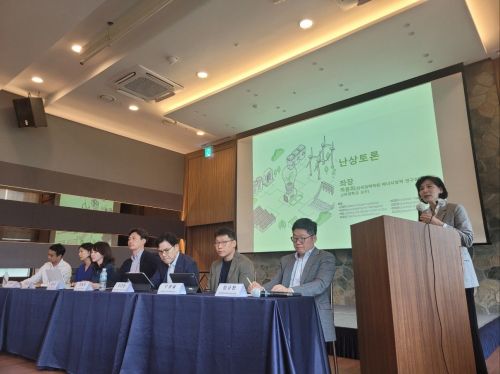 At the panel discussion titled "Asking the New Government's Energy Policy Priorities" held on the 23rd at the LW Convention Center in Seoul, the panelists are engaged in discussion. Photo by Kang Heejong
"A new regulatory framework tailored to Small Modular Reactors (SMRs) is necessary." "A Hydrogen Distribution Corporation should be established." "There is a need for governance that can comprehensively manage both electricity and heat."
On July 23, at the forum "Asking the New Government for Energy Policy Priorities" hosted by the Korean Association for Policy Studies Energy Policy Research Group, Korea University Sustainable Energy, Resource Technology-Policy-Data Convergence Education and Research Group, and the Korea Energy Economics Institute, a number of policy proposals for the new government’s energy agenda were presented.
On this day, Ryu Jeongdong, Head of Policy Development at Korea Hydro & Nuclear Power, stated, "After the inclusion of the first innovative small modular reactor (i-SMR) in the 11th Basic Plan for Electricity Supply and Demand, we are now preparing for licensing and construction," and suggested that the regulatory framework should be revised to suit SMRs.
Specifically, Ryu Jeongdong argued that the emergency planning zone, which is currently set at 20 to 30 km for large-scale nuclear power plants, should be rationally adjusted, and that legal grounds should be established to enable the integration of SMRs with hydrogen and renewable energy. He also added that it is necessary to improve the licensing system by integrating the construction and operation permit processes and optimizing the review period.
Korea Hydro & Nuclear Power also requested the establishment of support systems for SMRs, including: ▲ research and development (R&D), demonstration, and future export support to accelerate reactor type development; ▲ economic support such as power purchase agreements (PPA) and specialized tariff plans; and ▲ financial and tax support such as construction investment tax credits and the inclusion of national power technology in tax incentives.
Ryu emphasized, "If 14.1 gigawatts (GW) of coal-fired power plants are replaced with SMRs, it would reduce carbon dioxide emissions by 83 million tons," and stressed, "We must proactively commercialize SMRs to secure a leading position in the global market."
Chae Sumin, Head of Transmission and Substation Construction at Korea Electric Power Corporation, noted, "With the enforcement of the Special Act on National Backbone Power Grid, it is now possible to normalize the construction period for power grids, which had been delayed by four years compared to sample projects." However, he also emphasized, "Going forward, objective and transparent principles for underground cabling must be established to minimize unproductive conflicts." Specifically, he proposed limiting underground cabling to 154-kilovolt (kV) underground conduits to reduce unnecessary construction costs and suggested coordinating with the construction of social infrastructure (SOC) such as roads.
He also stressed the importance of dispelling public misconceptions about electromagnetic fields from power facilities to increase public acceptance of the power grid. Chae stated, "The World Health Organization (WHO) conducted joint research in 54 countries from 1996 to 2007 and concluded that there is insufficient evidence to claim that electromagnetic fields from power facilities cause childhood leukemia," and added, "The scientific and medical communities need to communicate in a neutral and continuous manner so that the general public can have confidence."
Kim Jaekyung, Senior Research Fellow at the Hydrogen Economy Research Division of the Korea Energy Economics Institute, emphasized the need to establish a Hydrogen Distribution Corporation. Kim pointed out, "Currently, there are eight public institutions (five hydrogen-dedicated agencies and three clean hydrogen certification agencies) responsible for hydrogen, but except for the Korea Hydrogen Alliance (formerly Hydrogen Convergence Alliance), most only handle hydrogen as a secondary responsibility." He argued, "We need to strengthen the expertise of hydrogen-dedicated agencies through reorganization and consider establishing a Hydrogen Distribution Corporation."
He also emphasized, "While past hydrogen policies were centered on bureaucrats and environmental civic groups, going forward, companies and industries that actually invest should take the lead."
There were also calls for policy improvements to expand renewable energy. Sung Taegun, Head of Green Energy Finance at Korea Asset Investment & Securities, suggested, "The system should be improved so that companies can sign power purchase agreements (PPA) directly with solar power producers without going through KEPCO's transmission and distribution network."
Sung pointed out, "According to the 11th Basic Plan for Electricity, more than 2.7 GW of offshore wind power projects need to be deployed annually, but it is becoming increasingly difficult to advance large-scale offshore wind projects that require significant capital, as foreign capital is withdrawing." He further stated, "Since the offshore wind turbine market is oligopolistic, reducing the range of choices is disadvantageous for project developers. Therefore, it is necessary to apply flexible yet principled supply chain regulations, considering the attraction of turbine factories, localization of parts, and technology transfer."
Sung also said, "To expand domestic financial institutions' participation in renewable energy projects, it is necessary to set targets for environmental, social, and governance (ESG) financial support and to exempt project financing (PF) and investment in renewable energy projects from the Risk Weighted Asset (RWA) ratio regulation."
Jung Gyuchang, Head of Business Support at Hanwha Solutions Qcells Division, pointed out, "Just as the U.S. Inflation Reduction Act (IRA) gives companies confidence to invest, Korea also needs a system that can instill such confidence," and added, "It is also necessary to establish an institutional foundation to expand the use of Korean-made solar equipment."
© The Asia Business Daily(www.asiae.co.kr). All rights reserved.












