South Korea and the United States have achieved results in blocking drug smuggling at the border through joint cooperation. The official operation name of the joint crackdown conducted by the two countries is "Silent Sweeper II," which signifies a "silent cleanup" of drug crimes carried out discreetly and quietly.
The Korea Customs Service announced on the 24th that it recently held a performance report meeting for the "2nd Korea-US Joint Operation Against Drug Smuggling" at the Seoul Main Customs Office.
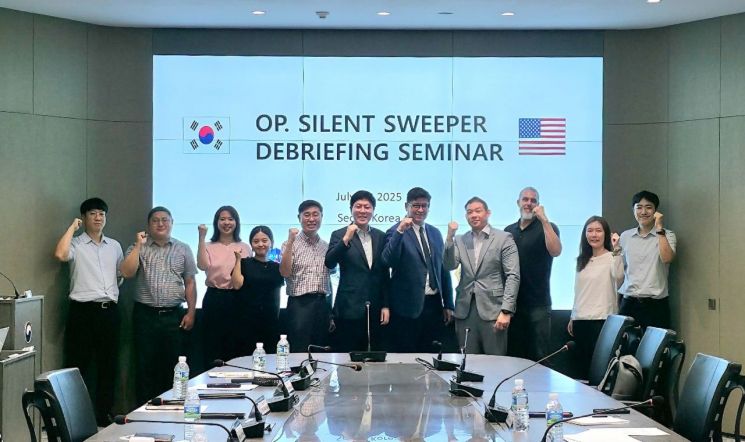 After the performance report meeting of the '2nd Korea-US Joint Operation to Crack Down on Drug Smuggling,' customs officials from both countries are taking a commemorative photo. Provided by Korea Customs Service
The joint operation was conducted from June 23 to July 18. This was the second such operation, following last year's effort. During this period, the customs authorities of both countries focused their inspections on high-risk individuals suspected of concealing drugs, both at the point of departure in the United States and upon arrival in South Korea.
The two countries shared pre-identified information on high-risk drug smuggling cases, dispatched personnel to each other's locations for joint intelligence analysis and inspections, and established a system where, if drugs were detected at the border, information on the seizure and the sender/receiver was provided to the counterpart. The receiving customs authority would then conduct expanded analysis and focus inspections on related targets, leading to further detections and arrests.
Through this operation, the customs authorities of both countries detected 30 attempts to smuggle drugs from the United States. The seized drugs and their quantities included 18.5 kg of liquid marijuana, 4.7 kg of methamphetamine, 1 kg of ketamine, and 2,782 tablets of illegal pharmaceuticals containing narcotics, totaling 31.4 kg.
This year's joint operation involved the Korea Customs Service, the US Customs and Border Protection (CBP), the Homeland Security Investigations (HSI), and the Drug Enforcement Administration (DEA).
In particular, the Korea Customs Service explained that, compared to last year, the crackdown period was extended from one week to four weeks, and the scope of inspections was expanded from only express cargo to all entry routes, including travelers, international mail, and air cargo, resulting in a much tighter enforcement network.
Lee Myunggu, Commissioner of the Korea Customs Service, stated, "Close cooperation among multiple countries is essential to effectively block drug smuggling," and added, "The Korea Customs Service will strengthen international cooperation with major drug-supplying countries to lead the standard for international joint crackdowns, ensuring the protection of public health and social safety."
© The Asia Business Daily(www.asiae.co.kr). All rights reserved.











