A Rare Ceratosaurus Fossil Auctioned for 42.5 Billion Won
Stands 1.9 Meters Tall and Measures About 3.25 Meters in Length
A rare Ceratosaurus dinosaur fossil, of which only four specimens exist worldwide, was sold at auction for approximately 42.5 billion won.
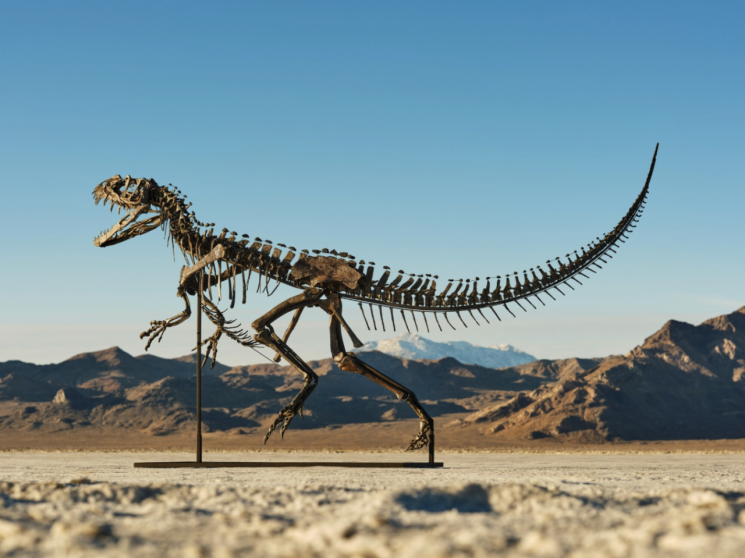
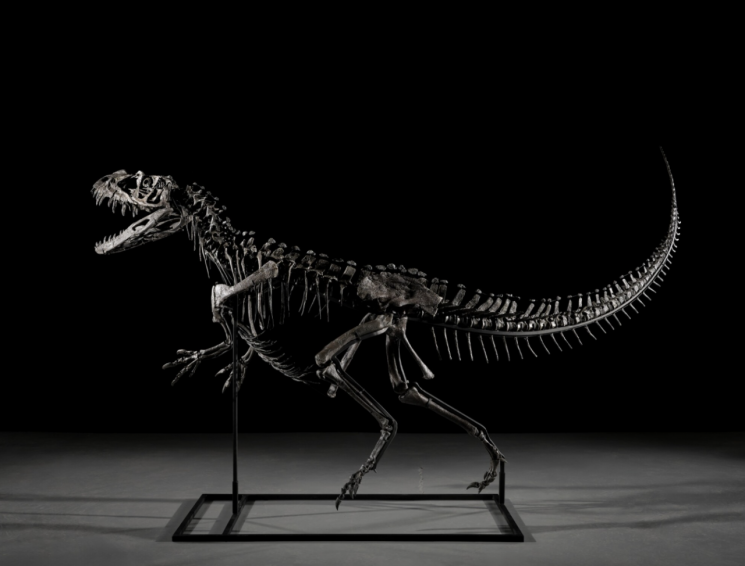
According to CNN, Sotheby's in New York announced in a statement on July 17 (local time) that the most complete and sophisticated Ceratosaurus fossil ever discovered was sold for about $30.5 million (42,483,450,000 won).
This fossil is the only juvenile among the four known Ceratosaurus fossils. During the auction, six bidders competed for about six minutes, and the final price far exceeded the estimated range of $4 million to $6 million (5,570,800,000 to 8,356,200,000 won).
Ceratosaurus nasicornis is a carnivorous dinosaur characterized by a horn on its nasal bone, long teeth, and bony plates (armor) running from its torso to its tail.
The fossil auctioned this time measures 1.9 meters in height and about 3.25 meters in length, and consists of a total of 139 bone fragments. Of these, 57 pieces make up an "almost complete skull," according to Sotheby's.
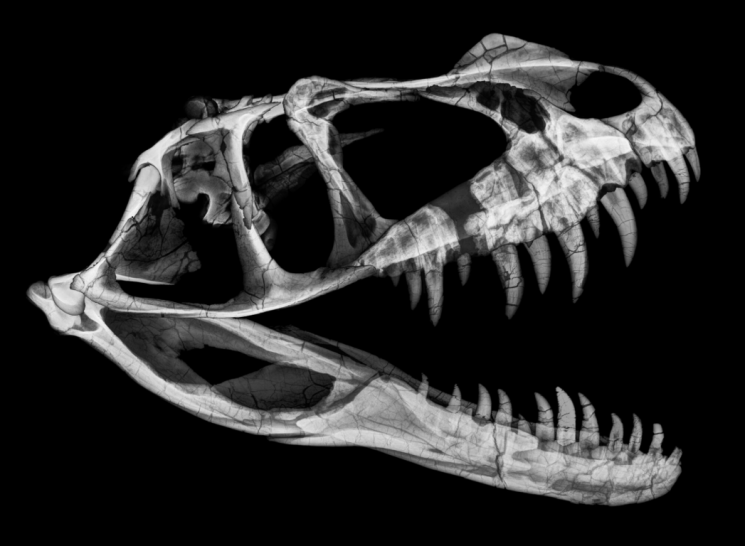
This fossil was discovered in 1996 at the Bone Cabin quarry in Wyoming, USA. The specimen is estimated to have lived during the Late Jurassic period, about 150 million years ago. From 2000 to 2024, the fossil was also exhibited at the Museum of Ancient Life in Utah, USA.
So far, this fossil has not been formally reported or studied in academic papers, but there is a possibility that research may be conducted in the future. Sotheby's stated, "The buyer of the Ceratosaurus specimen plans to loan it to a public institution," adding, "This is an appropriate measure for such a rare and important specimen."
At the same auction, the largest Martian meteorite currently on Earth was also sold for $5.3 million (737,972,000 won). Cassandra Hatton, head of Sotheby's Science and Natural History Department, said in a statement, "These astonishing results reflect humanity's deep awe and curiosity about the natural world, from the cosmos to the depths of the Earth," and added, "Collectors have an instinctive curiosity about the forces that have shaped our world, beyond just science."
Mark Westgarth, a professor of art market history at the University of Leeds in the UK, told CNN, "This sale shows that interest in fossils and natural history is reviving."
The highest price ever paid for a dinosaur fossil at auction is $44.6 million, for the 'Stegosaurus Apex' specimen sold at Sotheby's in July last year. Professor Westgarth analyzed, "The trend in the high-end market is ultimately related to the desire for 'differentiated ownership,'" and added, "Dinosaur fossils are sculptural and awe-inspiring, much like works of art."
However, some experts have voiced concerns about dinosaur fossils being sold at such high prices. They argue that the privatization of fossils by large capital could distance them from academic research and education. Steve Brusatte, a professor of paleontology and evolution at the University of Edinburgh in Scotland, described these high-priced auction results as "shocking."
He pointed out, "Who could possibly spend that much money on a dinosaur? Certainly not museums or educational institutions," and added, "While the buyer may display it in a museum, their identity remains anonymous and there is no definite plan." He continued, "I worry that this specimen could end up disappearing into some billionaire's mansion or a hedge fund's investment portfolio, never to see the light of day again," and warned, "In a world where dinosaur skeletons are traded for tens of millions of dollars in just a few minutes, it is becoming increasingly difficult for them to remain educational assets for everyone."
Nevertheless, Professor Westgarth referenced the case of Mary Anning, who excavated fossils and even opened a shop on the southern coast of England in the 19th century, noting that "the market and academic research have a symbiotic relationship." He added, "At the time, the fossil market stimulated research at public institutions and helped raise public interest," and said, "Given that the buyer of this Ceratosaurus has expressed an intention to donate it to a research institution, there is hope for future academic value as well."
© The Asia Business Daily(www.asiae.co.kr). All rights reserved.














