Five Key Innovation Measures for the Ministry of Economy and Finance Presented at Inauguration
Official Duties Begin:
"Traveling to the US as Soon as Possible...
Negotiations to Reflect National Interest and Pragmatism"
Newly appointed Deputy Prime Minister and Minister of Economy and Finance Koo Yooncheol, who will serve as the leader of the first economic team under the Lee Jaemyung administration and steer the Korean economy through its current crisis, emphasized "innovation" as his inaugural message. He urged Ministry of Economy and Finance employees, who are the core staff of "Corporation Korea," the basic direction for economic innovation, to earn the trust of the public and to be reborn as supportive partners to other ministries. The new economic team is determined to completely shift from the previous Yoon Sukyeol administration’s tight fiscal policy to an expansionary fiscal stance, and to fight to manage urgent crises such as the recovery of the people’s livelihoods and the Korea-US tariff negotiations. As the economic crisis deepens due to nationwide flood damage, the team has set the stabilization of consumer prices as an immediate, short-term task, and plans to accelerate Korea-US tariff negotiations with a focus on national interest and pragmatism.
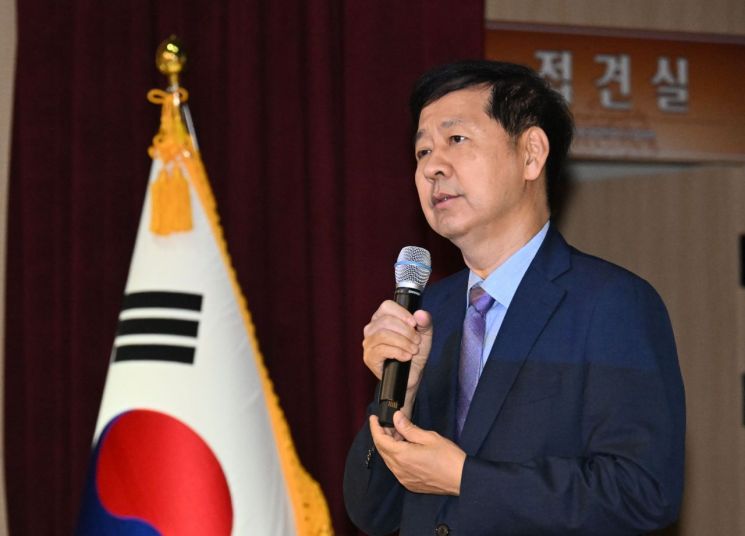
Five Key Innovation Measures for the Ministry of Economy and Finance Presented at Inauguration
At his inauguration ceremony held on the 21st at the Government Complex Sejong, Central Building, Deputy Prime Minister Koo called on Ministry of Economy and Finance staff to "become a ministry that is innovatively reborn as a 'partner to other ministries.'" Through an inauguration ceremony structured as a lecture under the theme "The First Step of Innovation with the Deputy Prime Minister?The Ministry of Economy and Finance Has Changed," Koo emphasized cooperation, integration, and support with related ministries. He stressed that the Ministry of Economy and Finance should not focus on leading other ministries from the front, but rather on supporting and empowering them. In response to criticism that the ministry has acted as a "super ministry," the new administration is preparing a major organizational overhaul to strip the ministry of its budget-setting authority. Key positions traditionally held by ministry officials, such as the presidential office’s economic team and the head of the National Tax Service, are now mostly being filled by external candidates. This is seen as a call to recognize the ministry’s current crisis and to create a renewed Ministry of Economy and Finance through reform.
Deputy Prime Minister Koo also emphasized the importance of the field. He stated, "We must become problem-solvers focused on the field, always paying attention to on-site difficulties and shifting all thinking to be field-oriented." He continued, "We must always remain alert, generate innovative ideas, and combine those ideas with our work to deliver results," asking staff to become icons of innovation. He also promised, "Employees who come up with innovative ideas will receive exceptional rewards." He mentioned the need to minimize unnecessary formalities such as face-to-face reports and meetings, to create a culture where anyone can freely and directly report new ideas to the Deputy Prime Minister regardless of rank, and to enhance productivity by utilizing technologies such as artificial intelligence (AI). He concluded by emphasizing, "Through all these efforts, let us become a hard-working Ministry of Economy and Finance so that Korea’s development and its fruits can be returned to the people."
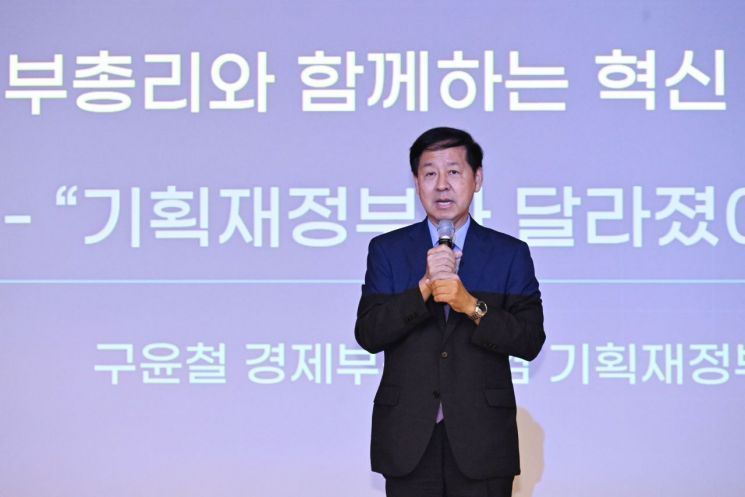
Official Duties Begin: "Traveling to the US as Soon as Possible... Negotiations to Reflect National Interest and Pragmatism"
With Deputy Prime Minister Koo officially beginning his term on the 19th, the vacancy in the Deputy Prime Minister position that had persisted for 80 days since Choi Sangmok’s resignation on May 1 was finally resolved. Koo identified the stabilization of consumer prices as the new economic team’s top priority. Speaking to reporters after the inauguration, he said, "Stabilizing prices, especially those affecting daily life, is urgent due to the flood situation," highlighting the need for step-by-step measures. As a mid- to long-term task, he cited the need to devise innovative measures to raise the potential growth rate, which is projected to fall into the 0% range. He believes that restoring the potential growth rate, the fundamental strength of the Korean economy, is essential to realizing the national vision and strategy of transitioning to a leading economy centered on AI.
With this sense of crisis, his first external official duty was to visit the field. Ahead of the government’s first supplementary budget (supplementary budget bill) under the new administration, which will provide nationwide consumer coupons to boost the economy through expansionary fiscal policy, he planned to visit Sanseong Market in Gongju at 2 p.m. that day to inspect the site and listen directly to the voices of local small business owners struggling with sluggish domestic demand. Over the previous weekend, he convened a meeting of first-level executives to discuss urgent issues such as the Korea-US tariff negotiations, the new administration’s economic policy direction reflecting its governance principles, and preparations for tax reforms including a corporate tax rate increase. The meeting was attended by First Vice Minister Lee Hyungil, Second Vice Minister Lim Kigeun, Director General of Tax Policy Park Geumcheol, and Director General of Fiscal Management Ahn Sangyeol.
He also intends to accelerate the Korea-US tariff negotiations. With the US having announced that it will impose a 25% reciprocal tariff on Korean imports starting August 1, Koo plans to depart for the US as early as July 22-23 to join the final stage of negotiations. Koo and Minister of Trade, Industry and Energy Kim Jeonggwan are coordinating plans to participate in a 2+2 finance and trade ministerial meeting with US Treasury Secretary Scott Besant and US Trade Representative (USTR) Jamison Greer. Koo stated, "We are currently coordinating with the US on the timing of the visit and whether the 2+2 negotiations will take place," adding, "As soon as coordination is complete, I will travel as quickly as possible to explain Korea’s situation and seek understanding so that the tariff negotiations proceed as well as possible, in line with national interest and pragmatism." During the visit, he is also expected to raise issues such as exchange rates in discussions with his counterpart, Secretary Besant.
While National Security Office Director Wi Sunglak is currently in Washington, D.C. for Korea-US consultations, high-level government officials are converging on Washington, D.C. to intensify the final negotiations. However, with about ten days left before the negotiation deadline of August 1, the outlook remains uncertain as the US has raised additional demands, including an increase in defense cost-sharing, further opening of the agricultural and livestock markets, and amendments to the online platform law.
© The Asia Business Daily(www.asiae.co.kr). All rights reserved.













