A 1 Percentage Point Hike in Each Tax Bracket Likely
Corporate Tax Revenue Plunges from 103.6 Trillion Won in 2022 to 62.5 Trillion Won in 2024
Major Shareholder Capital Gains Tax and Reduced Capital Dividends Set for Reform
The Lee Jaemyung administration is strongly considering raising the corporate tax rate as the centerpiece of its first tax reform plan. This move is seen as an effort to effectively reverse the "tax cuts for the wealthy" implemented during the Yoon Sukyeol administration and to secure fiscal soundness.
According to the Ministry of Economy and Finance and other relevant authorities on the 21st, the government has decided to include measures to broaden the tax base in the "2025 Tax Law Amendment," which will be announced at the end of this month. Previously, Koo Yoonchul, Deputy Prime Minister and Minister of Economy and Finance, stated during his confirmation hearing at the National Assembly on the 17th, when he was still a nominee, that he would "actively and comprehensively review the restoration" of the corporate tax cuts, which had been labeled as tax cuts for the wealthy. An official from the Ministry of Economy and Finance said, "The Deputy Prime Minister's use of the term 'actively review' in reference to the relevant tax system suggests an intention to pursue amendments."
The main reason the current administration is seriously considering raising the corporate tax rate is its assessment that the corporate tax cuts implemented by the Yoon Sukyeol administration in 2022 failed to achieve the intended virtuous cycle of boosting investment and growth, thereby increasing tax revenue. The current corporate tax rate is applied in brackets ranging from 9% to 24%, depending on the taxable base. Although the rates for each bracket were reduced by 1 percentage point to ease the tax burden on companies, this ultimately led to a greater decline in tax revenue. In fact, corporate tax revenue plummeted from 103.6 trillion won in 2022 to 80.4 trillion won in 2023, and further to 62.5 trillion won last year.
The upcoming tax reform plan is expected to focus on raising the maximum corporate tax rate by 1 percentage point for each bracket. The government and the ruling Democratic Party of Korea have also formalized their intention to increase the corporate tax rate during the recent regular session of the National Assembly, giving momentum to legislative action. The government notes that, as of last year, Korea's corporate tax rate was higher than the OECD average of 23.9%, but lower than the average of the Group of Seven (G7) countries, which stands at 27.2%. Currently, Korea's highest corporate tax rate, including local taxes, is 26.4%.
However, there are concerns that raising the corporate tax rate could reduce companies' capacity to invest. Since corporate tax is levied on net profits, a higher tax rate may prompt companies to scale back or delay investment plans, such as research and development (R&D).
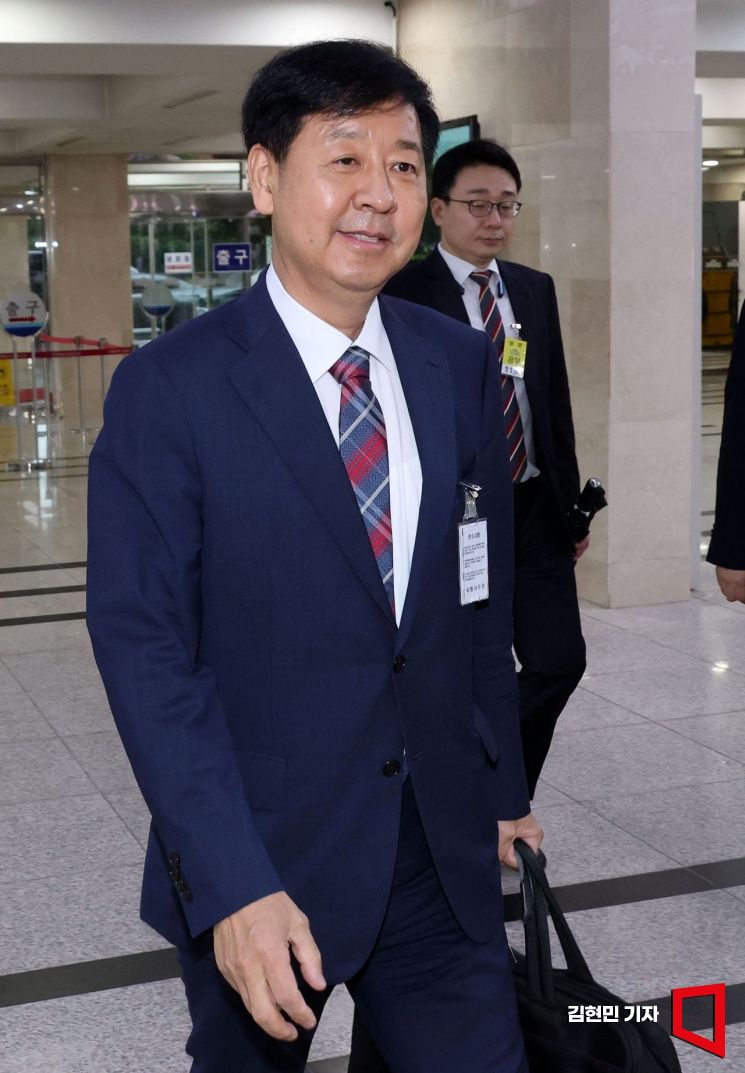 Koo Yoonchul, nominee for Deputy Prime Minister and Minister of Economy and Finance, is entering the National Assembly where the confirmation hearing is being held on the 17th. 2025.7.17 Photo by Kim Hyunmin
The upcoming tax reform is also likely to include a plan to restore the major shareholder capital gains tax to its previous level. The Yoon administration had significantly relaxed the threshold for capital gains tax on listed shares, raising the standard for major shareholders from 1 billion won to 5 billion won. The government is reportedly considering reverting this threshold to 1 billion won. The intention is to withdraw tax benefits that have been granted to a small number of investors and thereby strengthen tax equity.
The government is also expected to partially reverse the phased reduction of the securities transaction tax. The reduction in the securities transaction tax was premised on the introduction of the Financial Investment Income Tax (Geumtuse), but with the introduction of Geumtuse having fallen through, only the transaction tax cut has proceeded, leading to criticism that excessive tax exemptions are being granted solely to capital income. Instead of further reducing the transaction tax, the government is reportedly considering the option of separately taxing a portion of dividend income to encourage higher dividend payouts.
'Reduced capital dividends,' which major shareholders have used as a means of tax avoidance, are also expected to become subject to taxation. Reduced capital dividends refer to a method where a company pays dividends by reducing its own capital; although economically similar to ordinary dividends, they have so far been excluded from taxation. In a written response to the confirmation hearing, Deputy Prime Minister Koo stated, "Since reduced capital dividends are not economically different from ordinary dividends, which are taxed as dividend income, there are concerns that they distort economic activity and are exploited for tax avoidance," indicating a possible policy change.
© The Asia Business Daily(www.asiae.co.kr). All rights reserved.












