Future Energy Policy Institute Power Forum
From Market and System Operation to Policy and Regulation
Questions Raised Over Policy Accountability and Potential Conflicts of Interest
"Power Exchange Should Focus on Policy Implementation and Market Operation
Regulation Must Be Transferred to an Independent Commission"
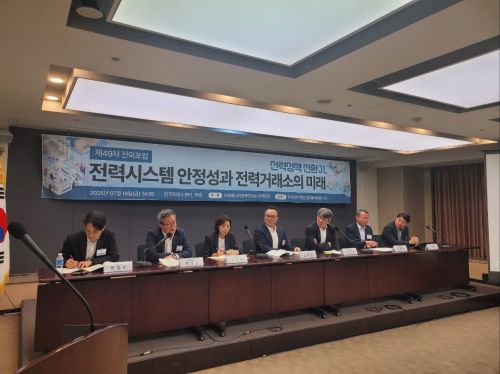 On the 18th, participants are discussing at the 49th Power Forum hosted by the Future Energy Policy Institute at the Korea Press Center in Seoul. (From left) Cheolwoo Baek, professor at Duksung Women's University; Youngjin Chae, director at Korea Power Exchange; Sungkyung Cho, professor at Myongji University; Hohyun Yoon, team leader at GS EPS; Changseop Kim, professor at Gachon University; Hyunsu Kim, manager at Dongseo Power; Haein Kim, department head at Korea Electric Power Corporation. 2025.7.18 Photo by Heejong Kang
Amid ongoing discussions about restructuring energy governance under the Lee Jaemyung administration, there have been calls to redefine the functions and roles of the Korea Power Exchange (KPX). When KPX was established in 2001, it had 10 member companies, but as the number of renewable energy and private power generation companies has increased, membership has grown to 6,665 companies. As a result, KPX's roles have become more complex, extending beyond its original mandate of power market and system operation to include policy and regulatory duties, which has led to various issues.
At the 49th Power Forum, held on the afternoon of July 18, 2025, by the Future Energy Policy Institute at the Korea Press Center in Seoul, Cheolwoo Baek, professor at Duksung Women's University, stated, "In the context of energy transition, digitalization, and decentralization, the structure of the power market and KPX's functions cannot remain stagnant. It is necessary to redesign KPX's identity and functions based on future-oriented capabilities, such as operational expertise and responsiveness to digital transformation."
According to Professor Baek, the complexity of system operation in Korea is increasing as ultra-high-voltage direct current (HVDC) transmission lines are being expanded. In addition, the growing share of renewable energy is heightening the need to respond to output volatility.
In this situation, KPX has taken on policy planning, operations, and regulatory functions, in addition to its original roles of market operation (MO) and system operation (SO). KPX participates in the Basic Plan for Electricity Supply and Demand, operates the Market Surveillance Committee, proposes amendments to market operation rules, manages the Cost Evaluation Committee, and operates the platform for issuing and trading Renewable Energy Certificates (REC), thereby comprehensively carrying out government policy and regulatory tasks.
Professor Baek pointed out, "A structure in which rule-making, operation, and monitoring are concentrated in a single institution lacks checks and balances between functions, and may lead to conflicts of interest and problems with self-monitoring." For example, KPX establishes and implements power system reliability standards on its own and evaluates its own performance in this regard.
Unlike Korea, major advanced countries such as the United States, the European Union (EU), and Japan have institutionally separated the roles of power market design, policy-making, market operation, monitoring, and regulation.
In the United States, Independent System Operators (ISOs) and Regional Transmission Organizations (RTOs) operate the grid, while the North American Electric Reliability Corporation (NERC), an independent body, sets and monitors reliability standards for the power grid. The Federal Energy Regulatory Commission (FERC) establishes the overall regulatory framework for the power grid.
Professor Baek stated, "Recently, the operation of the power market has become excessively complex due to the participation of diverse resources, complicated settlement methods, and rapidly changing policy directions. This has resulted in reduced predictability for market participants and weakened market credibility. When policy and regulatory functions are not clearly separated, the accountability for policy decisions becomes ambiguous, and there is a risk of signal distortion."
For example, within KPX, the Market Innovation Division, with about 30 staff members, is responsible for system improvement tasks such as the centralized contract market for energy storage systems (ESS), the liquefied natural gas (LNG) capacity market, the hydrogen power bidding market, the Jeju pilot project, and the regional pricing system. In effect, KPX is carrying out policy functions delegated by the Ministry of Trade, Industry and Energy.
Accordingly, Professor Baek emphasized the need to first clarify the roles between policy functions (Ministry of Trade, Industry and Energy) and regulatory functions (Electricity Regulatory Commission or an independent body). Based on this, he proposed that KPX should focus on policy implementation and market operation, while rule-making and market order supervision should be transferred to an independent regulatory agency or commission.
The panelists at the forum also agreed on the need to redefine the functions and roles of KPX. Hyunsu Kim, head of Power Generation Operations at Dongseo Power, said, "To advance the direct current-alternating current hybrid operation system, design a central-distributed linked energy system, establish an integrated operation system for electricity, gas, and heat grids, and enhance market predictability, it is necessary to redefine the role of KPX."
Hohyun Yoon, team leader of Power Policy at GS EPS, pointed out, "Although the number of staff in KPX's market operation division has not significantly increased, the number of member companies reached 6,665 at the end of 2024, which is 660 times more than the 10 companies at its inception in 2001. The reality is that KPX, which operates the power system, is facing a growing workload and burden." Yoon added, "It is necessary for many specialized institutions and various stakeholders to jointly address the development tasks related to the power market and system at KPX to reduce this burden."
Sungkyung Cho, professor at Myongji University, commented, "KPX needs to objectively and honestly assess its own capabilities and limitations, and independently present directions for innovation toward a better future. It must transform itself from a passive defender into a proactive pioneer."
Changseop Kim, professor of electrical engineering at Gachon University and former president of the Korea Energy Agency, who chaired the panel discussion, emphasized, "Currently, the issue of KPX is not being addressed in the ongoing discussions about restructuring energy governance. However, since KPX is closely linked to power system stability and the investment returns of power generators, it is an issue that must be discussed in the governance restructuring process."
© The Asia Business Daily(www.asiae.co.kr). All rights reserved.












