Heavy rain is expected to continue, mainly in the Chungcheong and southern regions. The so-called 'water bomb' is forecast to persist for another two days.
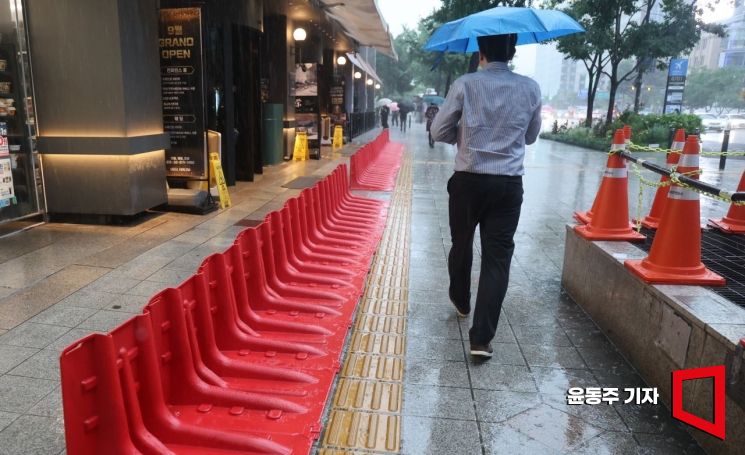 On the 17th, heavy rain fell mainly in the Seoul metropolitan area and central regions. Facilities to prepare for flooding at the entrance of a building located at Gwanghwamun Intersection in Seoul have been installed. 2025.07.17 Photo by Yoon Dongju
According to the Korea Meteorological Administration and other sources, as of 4:00 p.m. on the 17th, heavy rain warnings have been issued for most parts of the country except for Gyeonggi and northern Gangwon, the east coast of Gangwon and North Gyeongsang, and Jeju. Rainfall is reaching nearly 100 mm per hour in some areas. In Danseong-myeon, Sancheong-gun, South Gyeongsang, 101.0 mm of rain fell between 2:51 p.m. and 3:51 p.m.
Currently, a band of rain clouds stretches across North Chungcheong and the southern regions. At night, a stronger low-level jet stream from the south is expected to push the rain clouds up to South Chungcheong, resulting in heavy rain in Chungcheong and the southern regions. By July 19, additional rainfall is expected to reach 200-300 mm (over 400 mm in some areas) in Gwangju and South Jeolla, 150-300 mm (over 400 mm in some areas) in Busan, Ulsan, and South Gyeongsang, 100-200 mm in Chungcheong and North Jeolla (up to 300 mm in South Chungcheong and North Jeolla, over 250 mm in North Chungcheong), 80-200 mm in Daegu and North Gyeongsang (over 250 mm in some areas), and 10-60 mm in Ulleungdo and Dokdo.
Specifically, in the Yeongnam region, rainfall of 50-80 mm per hour is expected near the southern coast and Jirisan Mountain until the morning of July 19, and around 30 mm of rain is expected in North Gyeongsang until dawn on the 19th.
In the Honam region, the northwestern coast of South Jeolla and North Jeolla are expected to see around 30 mm and 30-50 mm of rain respectively, repeatedly, until the morning of the 19th. In Gwangju and South Jeolla, heavy rain of 50-80 mm per hour is expected until tonight, followed by another round of intense rainfall of 30-50 mm per hour from the morning of the next day until the morning of the 19th. On the southern coast of South Jeolla, rain is expected at a rate of 30 mm per hour until tonight, and from the morning of the next day until the morning of the 19th, rain will fall at a rate of 50-80 mm per hour near Jirisan Mountain and the southern coast.
In the Chungcheong region, rainfall of 50-80 mm per hour is expected until the afternoon of the next day, and 30-50 mm per hour from the night of the next day until dawn on the 19th.
In the central region, an additional 50-150 mm of rain is expected in the Seoul metropolitan area until July 19, 50-100 mm in the inland and mountainous areas of Gangwon, and 10-50 mm on the east coast of Gangwon. However, southern Gyeonggi could see more than 200 mm, and central and southern inland Gangwon could see more than 150 mm. In Jeju, areas outside the northern region are expected to receive 50-100 mm (up to 200 mm in mountainous areas, up to 150 mm in non-mountainous areas), and the northern region could receive an additional 20-80 mm of rain.
Specifically, southern Gyeonggi is expected to receive 50-80 mm of rain from tonight until the morning of the next day, while other areas could see rainfall of 30-50 mm per hour. From the night of the next day until dawn on the 19th, heavy rain of around 30 mm per hour is expected.
In Jeju, Hallasan Mountain is expected to receive rainfall of 30-50 mm per hour until dawn on the 19th. In other areas of Jeju, heavy rain of around 30 mm per hour is expected from the afternoon of the next day until dawn on the 19th.
The minimum and maximum temperatures on the morning and afternoon of the next day are forecast to be 22-26 degrees Celsius and 27-32 degrees Celsius, respectively. The expected minimum and maximum temperatures for major cities are: Seoul 24 and 30 degrees, Incheon 24 and 28 degrees, Daejeon 25 and 29 degrees, Gwangju and Daegu 25 and 30 degrees, Ulsan and Busan 25 and 28 degrees. Once the rain stops on the 19th, the apparent midday temperature is expected to soar to around 33 degrees Celsius, bringing intense heat.
© The Asia Business Daily(www.asiae.co.kr). All rights reserved.












