Abolition of the Mobile Device Distribution Act from July 22...
No More Cap on Subsidies
Additional Retailer Subsidies Available Even with Bill Discount
Ban on Discrimination by Subscription Type or Rate Plan Also Removed
Follow-up Legislation Will Take Time...
"Market Monitoring to Be Implemented"
Starting from July 22, the Act on the Improvement of Distribution Structure of Mobile Communication Devices (commonly known as the Mobile Device Distribution Act) will be abolished, removing the upper limit on subsidies. With the restrictions on subsidies provided by mobile carriers and retail stores for handset purchases lifted, sales incentives that were previously distributed covertly will now become legal. In addition to the impact of SK Telecom's recent waiver of cancellation fees and the upcoming release of new flagship devices by major manufacturers, competition among mobile carriers to secure customers is expected to intensify.
The Korea Communications Commission (KCC) announced this at a briefing held at the Gwacheon Government Complex on July 17, stating that the Mobile Device Distribution Act will be abolished and the amended Telecommunications Business Act will take effect starting July 22.
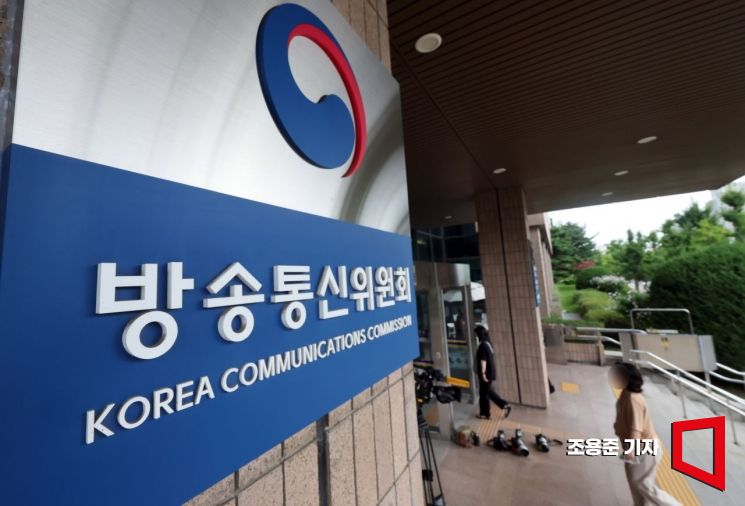 Employees are arriving at the Gwacheon Broadcasting and Communications Commission building. Photo by Jo Yongjun jun21@
The Mobile Device Distribution Act, which was implemented in October 2014, was introduced to prevent discriminatory practices against users. Some retailers had significantly increased sales incentives and attracted customers through closed online communities, which was seen as discriminatory against users with limited access to such information.
Under this law, mobile carriers could only provide a fixed amount of official subsidies, and retail channels such as authorized dealers were allowed to offer additional subsidies only up to 15% of the official amount. The so-called “optional contract discount,” which provided a 25% monthly bill reduction for a set period, was only available to those who did not receive a subsidy.
Cap on Additional Device Purchase Subsidies Abolished... Additional Subsidies Available Even with Bill Discounts
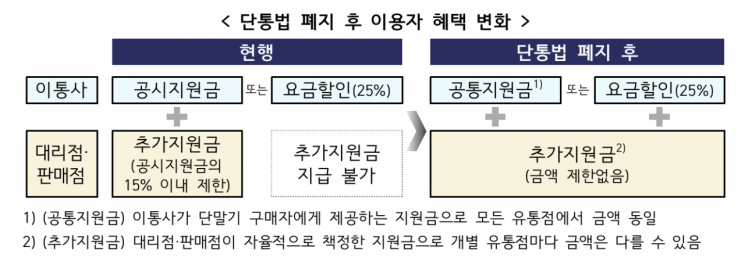
First, with the abolition of the Mobile Device Distribution Act, the obligation for mobile carriers to officially announce device subsidies will be removed. The “official subsidy” previously offered by carriers will be renamed the “common subsidy” and can be disclosed at the carrier’s discretion.
Additionally, the cap that limited additional subsidies from retail stores to 15% of the official subsidy will also be abolished. Certain authorized dealers, often referred to as “Seongji,” had continued to provide off-the-books incentives even after the law was enacted, but such incentives will now become legal.
The regulations prohibiting carriers from offering different subsidies based on type of subscription (such as number portability or new activation) or discriminating between rate plans will also be removed. As a result, mobile carriers and retailers will be able to compete in a variety of ways by offering different forms of device subsidies.
However, mobile carriers have agreed, after discussions with the KCC, to voluntarily disclose the amount of subsidies by rate plan and subscription type on their websites and through customer service centers. Consequently, users will be able to obtain information on the total amount of device subsidies, including additional incentives provided by retailers, directly from the stores.
The existing optional contract system, which provides a bill discount in exchange for using the carrier for a certain period, will remain in place. Users who do not receive the common subsidy will continue to be eligible for the 25% bill discount as before.
However, even if users choose the bill discount, they will still be able to receive additional subsidies from retail stores. Under the previous system, users could not receive both the carrier’s subsidy and the retailer’s additional subsidy if they chose the bill discount. Now, users can receive the bill discount and still obtain additional subsidies from retailers.
Some Provisions of the Mobile Device Distribution Act Transferred to the Telecommunications Business Act... Ban on Subsidy Discrimination by Region or Age
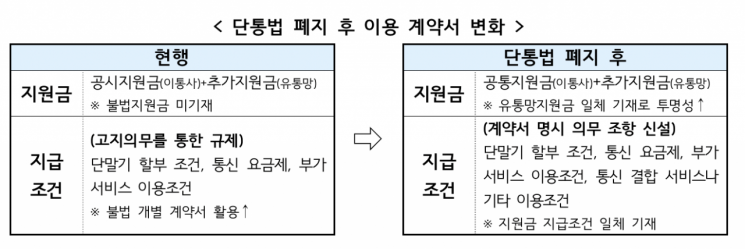
After the abolition of the Mobile Device Distribution Act, authorized dealers and retailers will be required to specify the details and conditions of device subsidies in contracts. This is because the relevant legal provisions have been transferred from the Mobile Device Distribution Act to the amended Telecommunications Business Act. Specifically, contracts must include: ▲ detailed information on the provider and method of subsidy payment ▲ conditions for receiving subsidies, such as the required rate plan or value-added services ▲ conditions for bundling with high-speed internet services. Failure to clearly specify the details and conditions of subsidy payments will constitute a violation of the amended Telecommunications Business Act.
Other provisions transferred from the Mobile Device Distribution Act to the Telecommunications Business Act include: ▲ prohibition of subsidy discrimination based on user’s place of residence, age, or physical condition ▲ prohibition of misleading explanations that could cause misunderstanding of subsidy information ▲ obligation for retailers to indicate that they have been authorized by the carrier to sell devices ▲ prohibition of requiring or coercing users to subscribe to specific rate plans or services designated by the carrier or manufacturer.
However, it is expected to take some time for the follow-up legislation, such as the Enforcement Decree of the Telecommunications Business Act, to be completed. This is due to the resignation of KCC Vice Chair Kim Taegyu, resulting in a single-leader system under Chair Lee Jinsook. A KCC official stated, “Since the KCC cannot make decisions under a single-leader system, it will be difficult to prepare the enforcement decree by the effective date of the amended Telecommunications Business Act on July 20. However, even if there is a temporary gap in the enforcement decree, major provisions such as the ban on discriminatory practices have been transferred to the Telecommunications Business Act, so there should be no problem correcting such practices based on the law.”
Additional measures will be implemented to prevent confusion in the mobile communications market. Until the enforcement decree is amended, the KCC issued administrative guidance to mobile carriers on July 17, including: ▲ prevention of incomplete sales ▲ use of new contract templates to enhance information provision to users ▲ prohibition of unfair discrimination against users ▲ strengthening supervision and management of illegal or irregular business practices in distribution channels.
To monitor the market, a response task force (TF) involving mobile carriers and others will operate at least twice a week. The KCC also plans to strengthen monitoring of violations such as inducing or coercing users to subscribe to expensive rate plans or value-added services, and will take action when violations are confirmed.
By the end of this year, the KCC will announce a comprehensive policy to prevent unfair practices by mobile carriers and manufacturers and to promote fair competition. Through market monitoring, the KCC will identify illegal business practices and discrimination, and will review specific countermeasures through a consultative body involving experts, mobile carriers, manufacturers, and related organizations.
A KCC official stated, “We plan to respond more proactively to market confusion and incomplete sales that may occur during the process of abolishing the Mobile Device Distribution Act and to any resulting harm to users. In particular, we will closely monitor the market to ensure that the abolition does not lead to negative side effects, such as the exclusion of vulnerable groups from subsidies or unfair practices targeting budget phone users.”
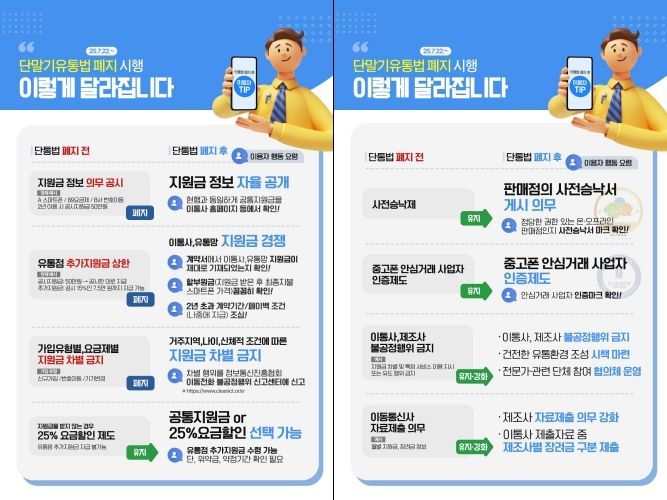 Changes Before and After the Abolition of the Mobile Device Distribution Act. Provided by the Korea Communications Commission
© The Asia Business Daily(www.asiae.co.kr). All rights reserved.














