Connecting the City Anew...
Completion of a Citizen-Centered Circular and Metropolitan Transportation Network
Preparing for the Future as an Eco-Friendly Smart Transportation City...
Pohang Leaps Toward the World
Pohang City is making great strides toward becoming a future-oriented transportation city under the three key themes of "people-centered," "technological convergence," and "green transition."
Over the past decade, the city has steadily established a solid foundation for improving citizens' quality of life and ensuring sustainable urban growth through the following initiatives: expansion of transportation infrastructure; enhancement of transportation welfare and the adoption of eco-friendly public transit; expansion of a rail-centered metropolitan transportation network; and transportation innovation utilizing advanced technologies.
In the area of "transportation infrastructure expansion," the city has actively pursued the construction and expansion of urban planning roads and rural roads, as well as the establishment of a major coastal road network, in line with its development as a hub for new industries such as secondary batteries and hydrogen. These efforts have laid the groundwork for Pohang to become the central city of the Pan-East Sea era.
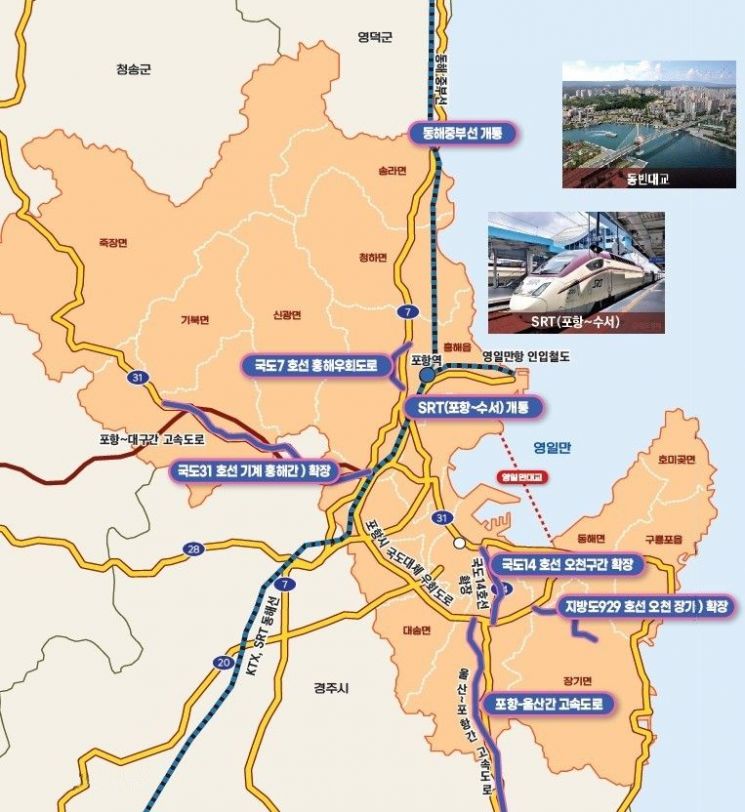
The internal urban transportation system is also being steadily improved. The four-lane National Route 20 (between Hyoja and Sangwon) and the tentatively named Dongbin Bridge are scheduled for early opening in November, which is expected to reduce commuting times and contribute to improved urban connectivity and balanced development.
By the end of the year, the Pohang-Yeongdeok Expressway is set to open. In addition, the city is laying the foundation for becoming a hub for industry, logistics, and tourism in the era of the Arctic sea route by constructing the Pohang-New Airport Expressway and railway, which will connect Yeongilman Port with the Daegu-Gyeongbuk Integrated New Airport, as well as the Yeongilman Bridge.
The city also plans to quickly complete the Jangseong-Jigok urban ring road, which broke ground this year, to alleviate downtown congestion, and to sequentially complete public parking facilities such as the Pohang Station parking lot and the Hwanho Park public parking tower.
Efforts to "enhance transportation welfare and expand eco-friendly public transit" are also accelerating. The city has strengthened mobility rights for transportation-vulnerable groups through a comprehensive overhaul of city bus routes, the operation of demand-responsive transport (DRT), and the operation of companion call and companion taxi services for people with disabilities and seniors.
The free public transportation program for citizens aged 70 and above, which began in July, allows for free transfers between Pohang, Gyeongju, and Yeongdeok, and is expected to not only improve mobility for seniors but also boost local businesses and leisure activities.
The introduction of eco-friendly public transit is also accelerating, with 124 electric buses currently in operation. Environmentally friendly transportation infrastructure, such as hydrogen transportation complexes and dedicated charging stations for electric buses, is also being expanded.
Furthermore, the "expansion of a rail-centered metropolitan transportation network" is greatly improving accessibility to the East Coast region and connectivity to the Seoul metropolitan area.
Pohang currently offers access to the Seoul metropolitan area within two hours via KTX and SRT services, and the opening of the Donghae Nambu Line connecting Busan, Ulsan, and Pohang has significantly improved access to Busan and Ulsan.
The Donghae Jungbu Line (Pohang-Samcheok), which opened its entire section in January, connects 18 major stations along the East Coast, including Pohang, Yeongdeok, Uljin, Samcheok, and Gangneung. The cumulative number of users has surpassed one million, demonstrating its high popularity and positive impact on revitalizing the local economy.
If the introduction of KTX trains on the Donghae Jungbu Line, which Pohang City is continuously requesting from the Ministry of Land, Infrastructure and Transport, is realized, accessibility to the Pohang area for East Coast residents is expected to improve dramatically.
The city is also achieving significant results in "transportation innovation utilizing advanced technologies." Pohang plans to continue advancing its systems in connection with projects such as the AI-based Intelligent Transportation System (ITS) and the Smart Village project, creating a smart transportation environment that citizens can tangibly experience.
Mayor Lee Kangdeok stated, "Pohang is evolving from an industrial city into a transportation welfare city where people, the environment, and technology coexist," adding, "Based on an AI-based smart transportation system and a metropolitan road network, we will develop Pohang into a sustainable central city of the Pan-East Sea region."
© The Asia Business Daily(www.asiae.co.kr). All rights reserved.

![Clutching a Stolen Dior Bag, Saying "I Hate Being Poor but Real"... The Grotesque Con of a "Human Knockoff" [Slate]](https://cwcontent.asiae.co.kr/asiaresize/183/2026021902243444107_1771435474.jpg)














