Pioneering the Arctic Sea Route, Relocation of the Ministry of Oceans and Fisheries, and Gadeok New Airport
Emergence of a New Growth Hub Amid Global Supply Chain Restructuring
As the global maritime economy and supply chain landscape undergo rapid transformation, the Busan-Jinhae Free Economic Zone (BJFEZ) is emerging as a key hub for the maritime economy in Northeast Asia, gaining attention beyond South Korea.
With a series of positive developments such as the opening of the Arctic Sea Route, the relocation of the Ministry of Oceans and Fisheries to Busan, and the development of the Gadeok New Airport and Jinhae New Port, BJFEZ has declared the beginning of the "2.0 era," positioning itself as a strategic industrial center.
The Busan-Jinhae Free Economic Zone Authority (Commissioner Park Seongho) emphasized, "After 20 years of the BJFEZ 1.0 era, it is now time to enter the 'BJFEZ 2.0' era, growing into a strategic base for the global maritime economy."
Amid growing global geopolitical instability and intensifying supply chain restructuring, BJFEZ is rapidly rising as the "new maritime economic capital," with a steady stream of visits from public and private institutions from Europe, Asia, and the Americas.
Organizations such as Germany's BVMID, the EU Ambassador to Korea, Japan’s Ministry of Land, Infrastructure, Transport and Tourism, Florida International University in the United States, Hubei Province in China, and Taoyuan City in Taiwan have shown keen interest in BJFEZ's development strategies and logistics and manufacturing infrastructure. Notably, these visits have led not only to exchanges but also to tangible results such as investment attraction and expanded partnerships.
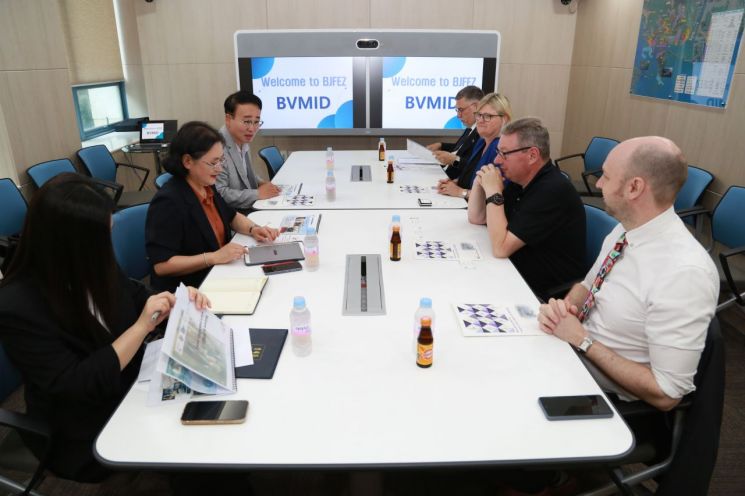 Commissioner Park Seongho held a meeting on June 16 to establish a strategic alliance with the German Federation of Small and Medium Enterprises. Provided by Busan-Jinhae Free Economic Zone Authority
The development of the Arctic Sea Route is further strengthening BJFEZ's strategic position. The Arctic route, which is shorter than the traditional Suez Canal route and reduces carbon emissions, is drawing attention as the future of eco-friendly shipping and as a vital alternative route even in blockade situations. BJFEZ already possesses the necessary industrial complexes and port infrastructure to support this.
Additionally, if the Ministry of Oceans and Fisheries relocates to Busan, the policy center will shift from the Seoul metropolitan area to the southeastern region, and BJFEZ is expected to become a true hub of the maritime economy.
While BJFEZ currently boasts a high development rate of 98.7%, expansion of the free economic zone is urgently needed to meet future demand. Accordingly, expansion projects are underway, including the Triport Integrated Logistics District, the Jinhae New Port hinterland complex, and the Gadeokdo Airport Complex City.
Regulatory improvements are also being pursued in parallel to enhance competitiveness with global special economic zones. Three major regulatory reforms?extending the rent reduction period for foreign investors, expanding tax benefits for logistics businesses, and increasing flexibility in land supply methods?are being actively proposed to the Ministry of Oceans and Fisheries and the Ministry of Trade, Industry and Energy.
In fact, tangible achievements have been made, such as attracting an additional investment of 48.2 billion KRW from Mitsui-Soko Korea, establishing a smart logistics center, and introducing raw material taxation within the free trade zone.
BJFEZ is currently focusing on nurturing five strategic industries: green coffee beans, cold chain components, robot parts, hydrogen energy, and ship components. This is contributing to the creation of a convergent ecosystem among manufacturing, logistics, and energy industries, as well as expanding foreign investment.
For the future, BJFEZ is prioritizing three major strategies: establishing a global-standard free economic zone operation model, creating a future convergence support center, and developing a maritime digital demonstration city.
In particular, building a demonstration city where advanced maritime technologies such as marine robotics, smart ports, and autonomous navigation can be tested and commercialized is a core strategy for BJFEZ to become a testbed for global maritime technology.
Commissioner Park Seongho stated, "Now is the time to shift from 'design' to 'execution.' As BJFEZ leaps forward as a global maritime economic hub, it will overcome the metropolitan-centered system and become a true base for balanced national development."
BJFEZ, which is emerging as the "heart" of the national maritime economic strategy, is expected to serve not only as a regional development milestone but also as a key turning point that will redefine the direction of the South Korean economy.
© The Asia Business Daily(www.asiae.co.kr). All rights reserved.