Artificial Shark Skin Material Developed in Korea
Shape Can Be Controlled by Light and Magnetic Fields
Enables Self-Healing and Precise 3D Microstructures
A domestic research team has developed an 'artificial shark skin' material that, when applied to the exteriors of aircraft or ships, can significantly reduce air and fluid resistance, thereby greatly saving fuel. This innovation is drawing considerable attention.
Dong-Eui University (President Han Suhwan) announced that Professor Sodam Jung and master's student Dongwook Lee from the Department of Chemical Engineering have successfully developed a micro-material similar to shark skin that can be precisely controlled in shape in response to magnetic fields and light. This achievement was made through joint research with Professor Chaebin Kim's team at Pusan National University and Professor Jeongjae Wi's team at Hanyang University.
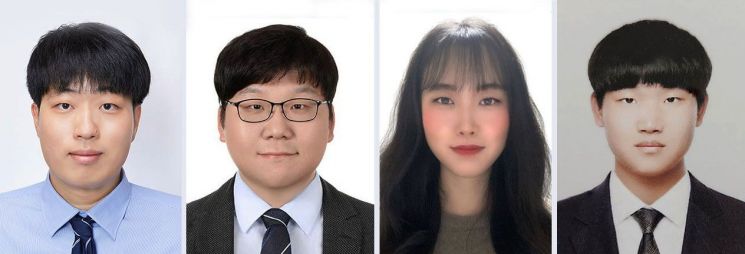 Research team, from the left: Professor Chaebin Kim of Pusan National University, Professor Jeongjae Wi of Hanyang University, Professor Sodam Jung of Dong-Eui University, and master's student Dongwook Lee. Provided by Dong-Eui University
The research team noted that the fine riblet structures of shark skin reduce fluid resistance and enable fast swimming. Based on this, they developed a high-performance artificial surface that mimics these features.
Shark skin consists of a three-dimensional composite structure with fine, overlapping scales, rather than simple grooves, making precise replication difficult with conventional molding technologies. To overcome this, the team developed a new functional material in which microstructures formed by a magnetic field can be fixed or released in real time by exposure to light, thereby successfully implementing sophisticated biomimetic structures.
Previously, even if the artificial riblet structures mimicking shark scales were deformed by applying a magnetic field, they would revert to their original shape once the magnetic field was removed. In this study, however, the structures can be fixed in place using light after being shaped by a magnetic field, and can be reverted to their original form when needed using light and a magnetic field again.
The key lies in the use of cross-linked polymers with 'Dynamic Covalent Bonds' (CAN, Covalent Adaptable Networks), which react to light or heat to re-form molecular bonds. This enables the material to be reprocessed multiple times like plastic or to easily repair damaged areas.
The team combined a light-responsive disulfide bond-based CAN polymer with magnetic particles to develop an artificial shark skin structure whose shape can be controlled by light and magnetic fields. They elucidated the reaction mechanism through molecular dynamics simulations and fabricated precise microstructures using a thermal curing process.
In this study, Professor Sodam Jung's team at Dong-Eui University's Department of Chemical Engineering used molecular simulations to clarify how the reprocessability of the material changes with light and temperature, as well as the molecular-level mechanism by which the material returns to its original state. This scientifically demonstrated, at the molecular level, the principle of self-healing smart materials.
Professor Sodam Jung stated, "Through this research, we have achieved performance close to that of actual shark skin. This material can repair damage and fix shapes at room temperature using light and magnetic fields, making it applicable in next-generation smart surfaces, self-healing coatings, flexible devices, and more. It is also expected to contribute to the fabrication of 3D microstructures and the development of new materials."
This research was conducted by Professor Sodam Jung of Dong-Eui University, Professor Chaebin Kim of Pusan National University, and Professor Jeongjae Wi of Hanyang University as co-corresponding authors; Yeomyung Yoon, a doctoral student at Pusan National University, and Hojun Moon, an integrated master's and doctoral student at Hanyang University, as co-first authors; and Woongbi Jo, a postdoctoral researcher at Hanyang University, and Dongwook Lee, a master's student at Dong-Eui University, as co-authors. The project was supported by the National Research Foundation of Korea.
This study was published online on June 1 in 'Advanced Materials' (Impact Factor = 27.4, JCR top 1.9%), a top international journal in the field of materials science. In particular, the research was recognized for its excellence and selected as the 'Front Cover' article.
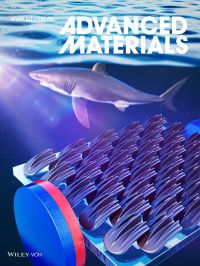 Journal Cover.
© The Asia Business Daily(www.asiae.co.kr). All rights reserved.












