Seoul Issues Heavy Rain Advisory
Access to 29 Major Streams Restricted
Emergency Response Level 1 Activated
On the afternoon of July 16, a heavy rain advisory was issued across Seoul, prompting the city government to activate Emergency Response Level 1 and to completely restrict access to 29 major streams within the city, including Cheonggyecheon and Anyangcheon.
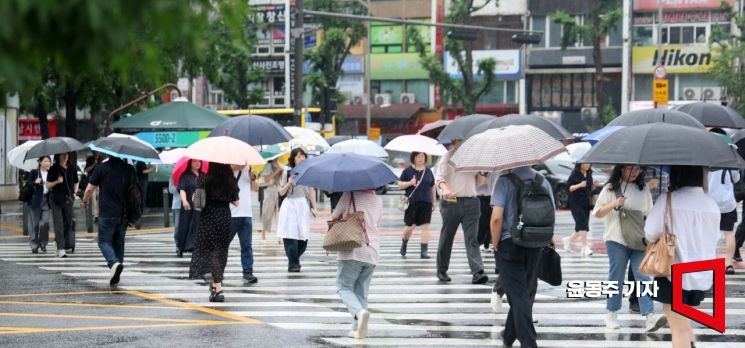 Citizens passing near Sungnyemun in Jung-gu, Seoul, are hurrying along with umbrellas. Photo by Yoon Dongju
According to the Korea Meteorological Administration, rain began to fall across Seoul from the morning of that day, and due to the influence of a low-pressure system approaching from the west, very heavy rain is expected between the night of July 16 and the early morning of July 17. As of 5:00 p.m. that day, a heavy rain advisory was in effect throughout Seoul, and the cumulative precipitation in Gwanak-gu recorded 14.5 mm. The expected total precipitation is between 50 and 150 mm, with a maximum of 30 to 50 mm per hour.
To prepare for the risk of river flooding and inundation, the Seoul Metropolitan Government completely restricted access to 29 streams, including Cheonggyecheon, Dorimcheon, and Anyangcheon. Vehicle access was also blocked at four riverside parking lots: two at Anyangcheon, one at Jungnangcheon, and one at Tancheon.
From 4:30 p.m. that day, Emergency Response Level 1 for disaster and safety management was activated, with 355 Seoul city officials and 3,110 personnel from 25 district offices mobilized for the response.
Over the previous two days, the city inspected 58 large construction sites and 997 locations at risk of landslides, and carried out preemptive maintenance in vulnerable areas such as parks, Hangang Park, and hiking trails.
Additionally, the city inspected approximately 8,000 stormwater inlets and cleaned about 1,700 of them, repaired 370 locations including underpasses, dedicated roads, tunnels, and bridges, and fixed 122 potholes.
Seoul plans to continue real-time monitoring of weather conditions and stream water levels, and to implement additional measures such as operating disaster prevention facilities according to the intensity of rainfall.
© The Asia Business Daily(www.asiae.co.kr). All rights reserved.












