Kim Youngsik Emphasizes the Need for a Shift Toward "Complete R&D"
Calls for Bridging Research and Industry Through a Demand-Oriented Approach
"In order for research outcomes to generate tangible value in industry and society, it is essential to shift the research paradigm toward 'complete R&D,' which bridges the gap between supply and demand."
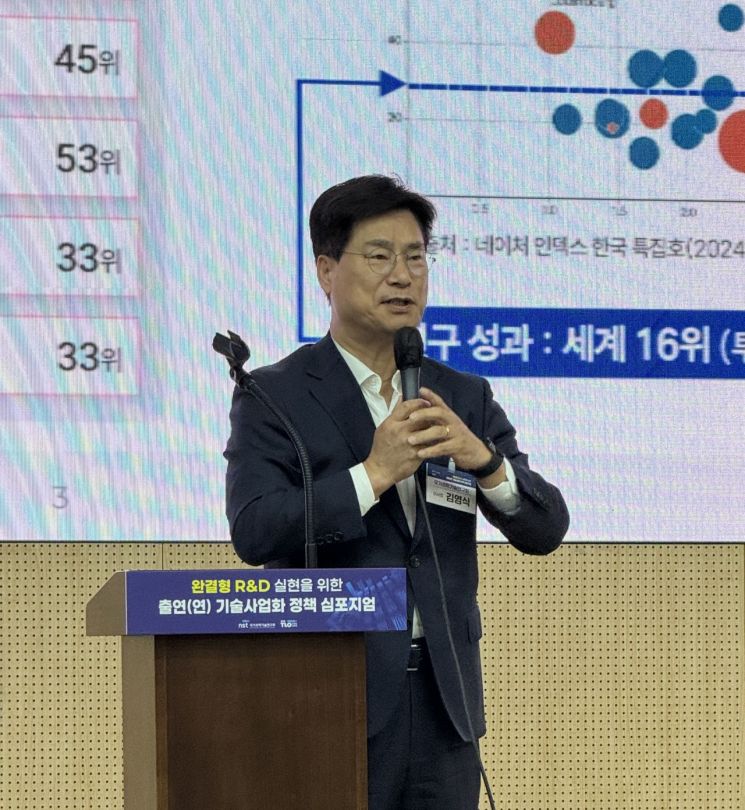 Kim Youngsik, Chairman of NST, is delivering the keynote speech at the Research Institute Technology Commercialization Policy Symposium held on the 15th at the Science and Technology Center in Gangnam-gu, Seoul. Chairman Kim emphasized the importance of realizing complete R&D as he walked across the stage holding the microphone installed on the podium. Photo by Baek Jongmin, Tech Specialist
On July 15, Kim Youngsik, Chairman of the National Research Council of Science and Technology (NST), took the podium at the "Policy Symposium on Technology Commercialization for Achieving Complete R&D" held at the Korea Science and Technology Center. Rather than delivering a congratulatory address, Chairman Kim diagnosed the current state of Korea's R&D capabilities and proposed solutions for strengthening national competitiveness and commercializing acquired technologies by linking them with businesses.
Chairman Kim raised the issue of the "R&D paradox," where research and development spending continues to rise, yet national competitiveness declines. He criticized the fact that although Korea's R&D investment ranks second in the world after Israel, its outcomes remain at the "bottom," resulting in poor returns on investment. He added that this situation is contrary to the general trend, where outcomes should rise ahead of investment costs.
The solution, according to Kim, is to establish a "complete R&D system." He suggested that from the planning stage, research should be designed with the "end point" in mind?where outcomes create value in the market?so that the beginning and end are seamlessly connected.
He emphasized the importance of enabling researchers to adopt the perspective of demand-side stakeholders. Kim also strongly highlighted the need for an integrated technology commercialization support platform, NSMAP (Needs Supply Matchmaking Platform), to better connect research demand and supply. He pointed out the limitations of existing Technology Licensing Offices (TLOs) and venture capital (VC) organizations, and stressed the importance of the matchmaker role, which operates efficiently according to market logic and generates profit.
Chairman Kim also discussed the necessity of creating an offline "Science Business Mecca" (SBM) for in-person connections. While NSMAP serves as an online platform, he noted the need for a physical space and a venue for face-to-face meetings, which he named the "Science Business Mecca."
The presenters at the symposium shared similar views. Son Sujeong, Director at the Science and Technology Policy Institute, proposed shifting the focus of technology commercialization policy from the number of cases and technology fees to one centered on challenging opportunities and socio-economic impact. She also suggested the need to establish a comprehensive support system for technology commercialization and to develop a strong brand.
Park Sungjin, Professor at Pohang University of Science and Technology, advised, "In Silicon Valley, VCs?who are investors?have a clear understanding of the technologies that big tech companies will need over the next five years and request investments accordingly." He emphasized that having information on technology direction is essential for successful technology commercialization.
Based on the diverse opinions and consensus gathered at this symposium, NST plans to continue preparing for the full-scale establishment of NSMAP and to develop detailed implementation strategies to ensure that technologies from government-funded research institutes become tangible outcomes of complete R&D.
© The Asia Business Daily(www.asiae.co.kr). All rights reserved.