Produced for Children Since 2021
Booklet Distributed for the First Time This Year
The Japanese Ministry of Defense has sparked controversy by distributing a Defense White Paper for Children to elementary schools. While the ministry has produced a children's version of the white paper every year, this is the first time it has been directly distributed to elementary schools. Like the general Defense White Paper, it designates Dokdo as Japanese territory and emphasizes the Self-Defense Forces' counterstrike capabilities. Amid this, some local governments, concerned about potential negative effects, have instructed schools to keep the book out of children's reach.
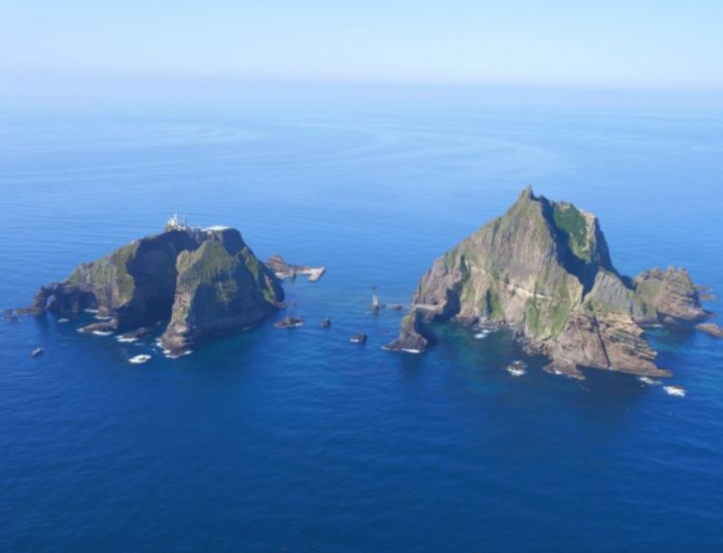
On July 15, Yonhap News, citing NBC Nagasaki Broadcasting, a local broadcaster in Nagasaki Prefecture, reported that the Ministry of Defense distributed about 6,100 copies of the Defense White Paper for Children to elementary schools nationwide this year. Although the Ministry of Defense has published the children's white paper online since 2021, this is the first time it has produced a printed version and sent it to elementary schools.
The map included in the Defense White Paper for Children labels Dokdo as "Takeshima" and depicts it as Japanese territory, while the East Sea is marked as the "Sea of Japan" (the name claimed by Japan). The children's white paper begins with Russia's invasion of Ukraine. It attempts to explain why the Self-Defense Forces need to strengthen their deterrence, stating, "One reason this happened is that Ukraine lacked sufficient defense capabilities." The white paper also mentions North Korea, China, and Russia, emphasizing the need for Japan to bolster its military strength. It asserts that "Japan cannot be protected by missile strike capabilities alone," stressing the necessity of possessing counterstrike capabilities. However, the phrase "Dokdo is Japan's inherent territory," which the Japanese government has explicitly stated in the Defense White Paper, was not included in this version.
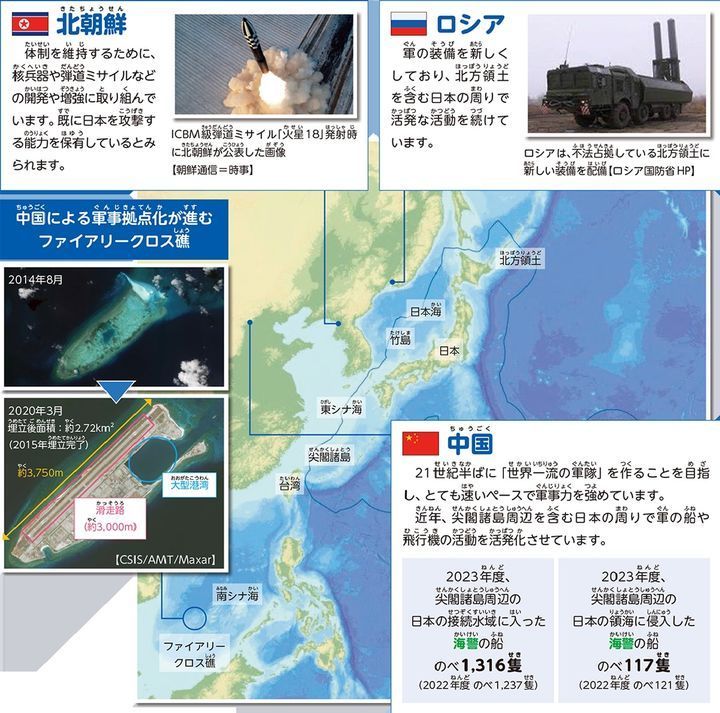 Map included in the Defense White Paper for Children. Online version of the Defense White Paper for Children.
There are also concerns within Japan about distributing a defense white paper focused on military perspectives of neighboring countries to elementary schools. The Nagasaki City education authorities stated, "There are students of various nationalities attending our schools, and some children may be hurt by content related to specific countries mentioned in this book." As a result, they instructed schools to keep the book in the teachers' office rather than making it available for student viewing.
Yamakawa Takeshi, an atomic bomb survivor, said in an interview with NBC Nagasaki Broadcasting, "I am alarmed that the target audience for distribution is elementary school students," and added, "There is a risk that what children learn at a young age will be accepted as a matter of course." Furthermore, there is criticism that unilaterally educating children about the need to strengthen military power is problematic. Nakamura Keiko, an associate professor at the Nagasaki University Research Center for Nuclear Weapons Abolition, told NBC, "Describing Russia's invasion of Ukraine as being due to a lack of defense capabilities could justify the logic of the aggressor," and pointed out, "There is a risk that children may fall into the bias that 'Japan's security can be maintained by military strength alone.'"
© The Asia Business Daily(www.asiae.co.kr). All rights reserved.













