Clam Production Projected to Drop Below Half by 2050
as Sea Surface Temperatures Rise
Shocking research findings have emerged regarding clams, which have always been considered common. As sea surface temperatures rise due to climate change, it is projected that by 2050, clam production could decrease to less than half of current levels.
According to the Korean Society of Climate Change on July 13, Jung Pilgyu, a researcher at the National Pukyong University Institute of Resource and Environmental Economics, recently published a paper analyzing changes in clam production and the resulting economic losses under various climate change scenarios.
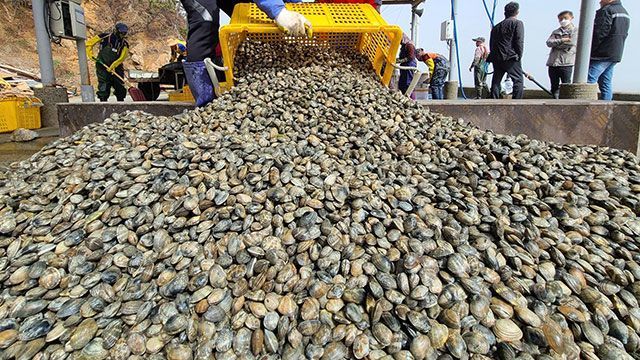
Researcher Jung projected how clam production would change under three scenarios: 'continuing greenhouse gas emissions at current levels' (SSP5-8.5, high-carbon scenario), 'gradually reducing carbon emissions' (SSP2-4.5, medium-carbon scenario), and 'achieving carbon neutrality by around 2070' (SSP1-2.6, low-carbon scenario).
The analysis found that, under the high-carbon scenario, clam production between 2041 and 2050 is expected to decrease by 52.0% compared to the period from 2000 to 2022.
Under the medium-carbon scenario, production decreased by 37.9%, and under the low-carbon scenario, by 29.2%. While clam production still declines when carbon emissions are reduced, the rate of decrease is lower.
Among bivalves inhabiting Korea's intertidal zones, clams are the most commonly harvested species. As a result, the economic losses caused by reduced production are also expected to be significant.
Assuming an average clam price of 3,015 won per kilogram (the 2013-2022 average), the potential loss for domestic fishers due to decreased production is estimated at 46.07 billion won under the high-carbon scenario and 25.88 billion won under the low-carbon scenario.
Previously, in June, the average sea surface temperature around Korean waters was 19.3 degrees Celsius, which is 0.3 degrees lower than the average for the past ten years. By region, the Yellow Sea was 18.2 degrees, the East Sea 19.4 degrees, and the South Sea 20.3 degrees, each 0.1 to 0.6 degrees lower than the ten-year average. This was due to the continued influence of lower spring sea surface temperatures.
Meanwhile, across Europe, abnormal weather led to the Mediterranean Sea recording its highest-ever sea surface temperature for June. The main cause of this heatwave has been identified as the rise in Mediterranean sea surface temperatures. The French meteorological agency announced, "The Mediterranean recorded its highest-ever June sea surface temperature at 26.04 degrees Celsius." This is about 2 degrees higher than the average for June from 1991 to 2020. In Corsica, the Gulf of Lyon, and near Spain's eastern Balearic Islands, sea temperatures were measured at more than 5 degrees above average.
© The Asia Business Daily(www.asiae.co.kr). All rights reserved.












