KAIST announced on July 13 that the research team led by Distinguished Professor Sangyeop Lee from the Department of Biological Sciences and Chemical Engineering has succeeded in developing a microbial strain capable of mass-producing lutein.
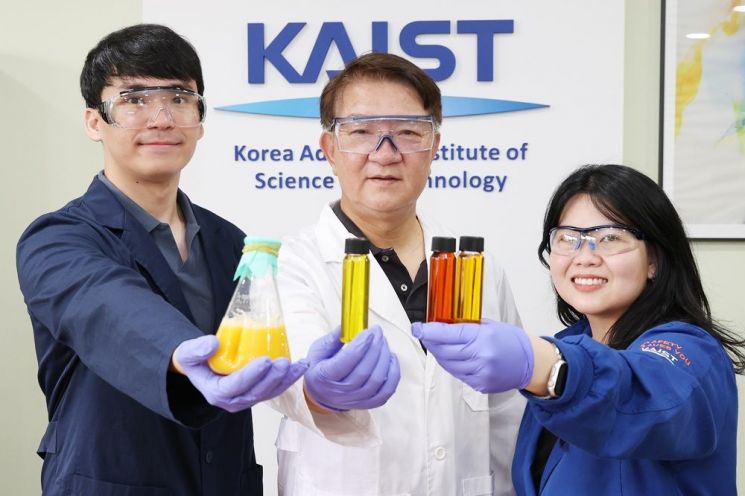 (From left) Hyunmin Eun, PhD candidate; Sangyeop Lee, Distinguished Professor; Cindy Shin, PhD. Provided by KAIST
Previous studies on lutein production through microbial metabolic engineering have faced limitations, such as the generation of numerous byproducts and restricted lutein accumulation. This was analyzed to be due to specific bottleneck steps in the lutein biosynthetic pathway, which prevented smooth metabolic flow.
To address this, the research team introduced an electron channeling strategy to improve the metabolic reactions that act as major bottlenecks in the lutein production pathway.
Electron channeling is a technology that controls the pathway through which electrons move, enabling certain enzymatic reactions to occur faster and more efficiently within biological or artificial biosynthetic systems.
Based on this, the team arranged the enzymes required for lutein production in close proximity within an optimized protein scaffold system, thereby increasing the concentration of substrates and electrons around the enzymes and effectively enhancing the metabolic flow for lutein biosynthesis.
In addition, they established a microbial platform capable of efficiently producing lutein using glucose.
As a result, the research team succeeded in producing 1.78 g/L of lutein in just 54 hours. This corresponds to a productivity of 32.88 mg/L per hour, demonstrating a rapid and efficient method for mass-producing lutein compared to conventional extraction methods from plants or microalgae.
Notably, this study utilized Corynebacterium glutamicum, which is classified as a Generally Recognized As Safe (GRAS) strain with high industrial applicability, as a new production host.
Hyunmin Eun, PhD candidate, stated, "This research is significant in that it established an eco-friendly process that resolves the bottleneck in lutein production using a microbial GRAS strain, thereby enhancing industrial competitiveness."
Meanwhile, Hyunmin Eun, PhD candidate, and Cindy Shin, PhD, from the Department of Biological Sciences and Chemical Engineering, participated as co-first authors in this study.
© The Asia Business Daily(www.asiae.co.kr). All rights reserved.












