The Asahi Shimbun reported on the 13th that the Japanese government has repeatedly requested the United States to refrain from making comments regarding the increase in defense spending, out of concern that the issue could negatively affect the ruling party ahead of the House of Councillors (upper house) election scheduled for the 20th.
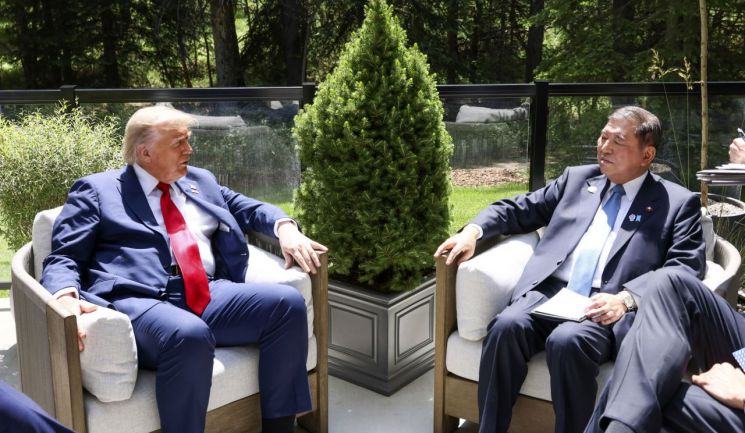 US President Donald Trump and Japanese Prime Minister Shigeru Ishiba are holding talks in Canannaskis, Canada, on the occasion of the Group of Seven (G7) summit. Photo by Yonhap News
According to the report, the Japanese government voluntarily expressed its intention to increase defense spending to the United States after the inauguration of the Donald Trump administration. In fact, during the US-Japan defense ministers' meetings in March and May this year, no specific figures were mentioned.
Ahead of the US-Japan foreign and defense ministers' meeting (2+2) that was scheduled for the 1st of this month, the Japanese government again requested the US to refrain from mentioning defense spending in early June. However, a US government official stated that it would be difficult to remain silent continuously, and conveyed the position that "if defense spending is not mentioned, the position of US Secretary of Defense Pete Hegseth within the administration could become precarious."
In relation to this, the newspaper reported unofficially that the US has demanded Japan increase its defense spending to 3.5% of GDP. Japan's current defense-related budget stands at about 1.8% of GDP, with plans to raise it to 2% by 2027. Japan proposed postponing the 2+2 meeting.
The Asahi Shimbun stated, "What Japan earnestly hoped for from the US was consideration regarding the House of Councillors election," and explained that "Japan was concerned that if US pressure to increase defense spending became publicly known, it could have a negative impact on the government and ruling party in the election." The newspaper added that raising defense spending to the US-requested level of 3.5% of GDP would require about 21 trillion yen (approximately 196 trillion won), and that it would be difficult to achieve this without tax increases or cuts to social security budgets.
© The Asia Business Daily(www.asiae.co.kr). All rights reserved.












