Korea Employers Federation Releases Survey on Summer Vacation Practices and Economic Outlook
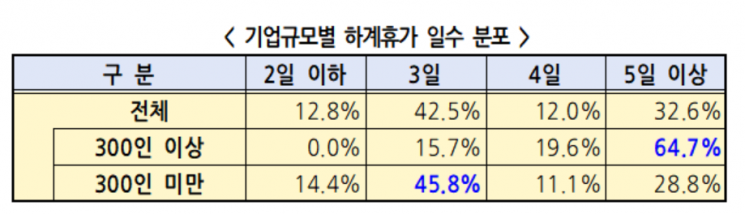
This year, the average number of summer vacation days for domestic companies was 3.7 days. By company size, companies with 300 or more employees tended to offer vacations of five days or more, while the most common response among companies with fewer than 300 employees was three days.
On July 13, the Korea Employers Federation announced the results of its "2025 Summer Vacation Status and Economic Outlook Survey" conducted among domestic companies. The survey targeted 528 business sites nationwide with five or more employees. In the survey, "summer vacation" refers to all forms in which companies designate a specific period and allow employees to use separate or annual leave.
According to the results, 91.1% of responding companies said they would implement a summer vacation this year, while the remaining 8.9% reported that employees use annual leave throughout the year without a designated period.
Among companies implementing summer vacations this year, the average vacation period was calculated at 3.7 days. By company size, 64.7% of companies with 300 or more employees responded "five days or more," while 45.8% of companies with fewer than 300 employees answered "three days," making it the most common response in that group.
When examining the timing of summer vacations by industry, 77.3% of manufacturing companies reported "concentrated short-term vacations (about one week)," while 73.6% of non-manufacturing companies reported "vacations over a relatively long period (one to two months)" as the most common practice.
Among companies implementing summer vacations, 53.9% responded that they plan to provide summer vacation allowances this year. This is a slight decrease of 2.6 percentage points from the previous year (56.5%).
By company size, the proportion of companies providing summer vacation allowances this year was 63.3% for companies with 300 or more employees, which is 10.6 percentage points higher than the 52.7% for companies with fewer than 300 employees.
Meanwhile, in this year's survey on the economic outlook for the second half of the year, the most common response was that the economy would "deteriorate compared to the first half" (46.8%), similar to last year (45.0%). While the "deteriorate" response increased by 1.8 percentage points compared to the 2024 survey, the proportion of respondents expecting the economy to "improve" also increased by 3.9 percentage points from last year.
© The Asia Business Daily(www.asiae.co.kr). All rights reserved.











